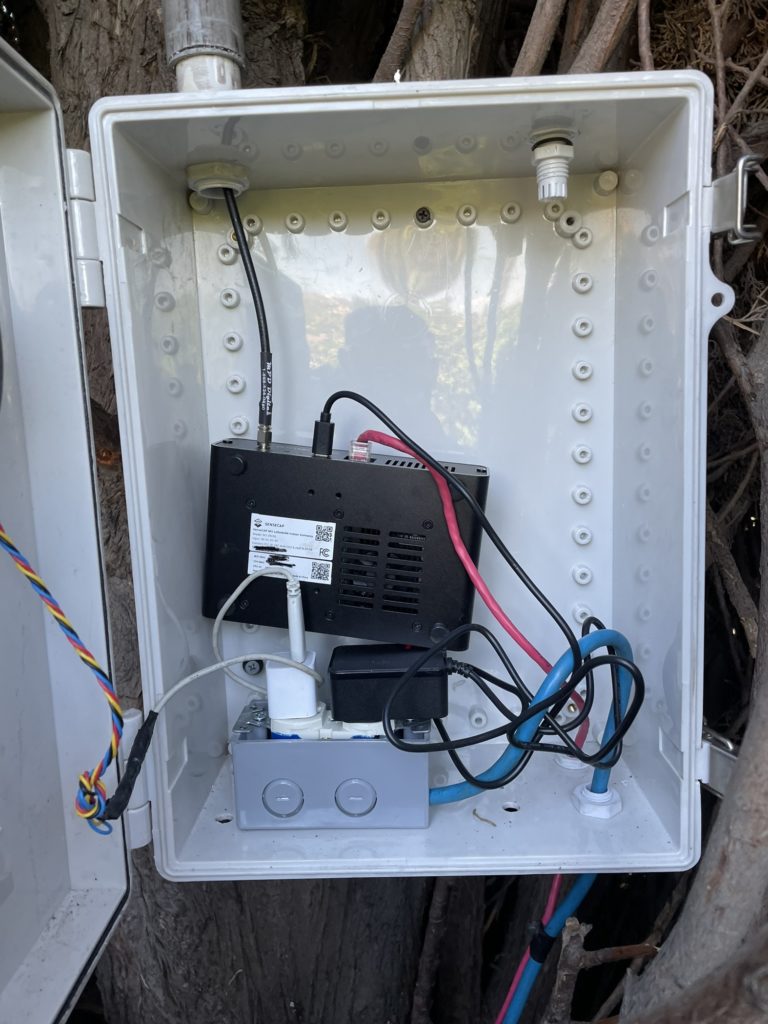
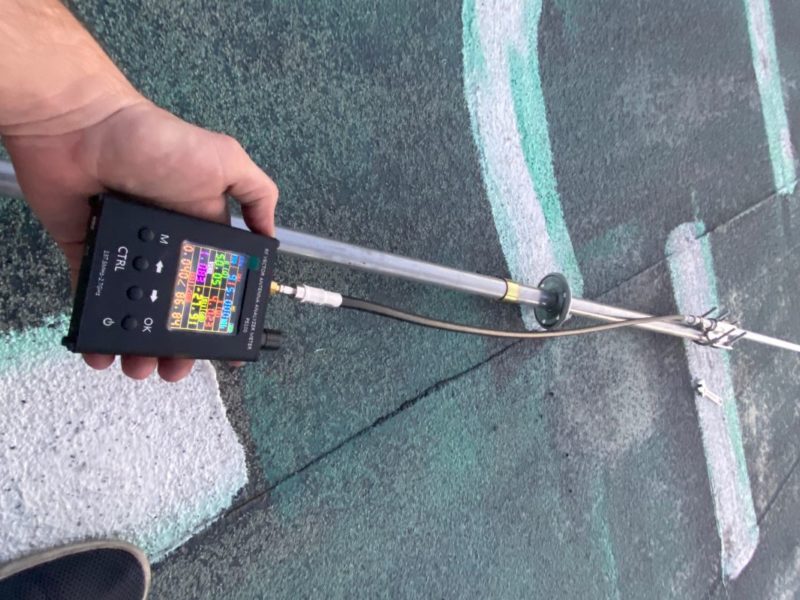
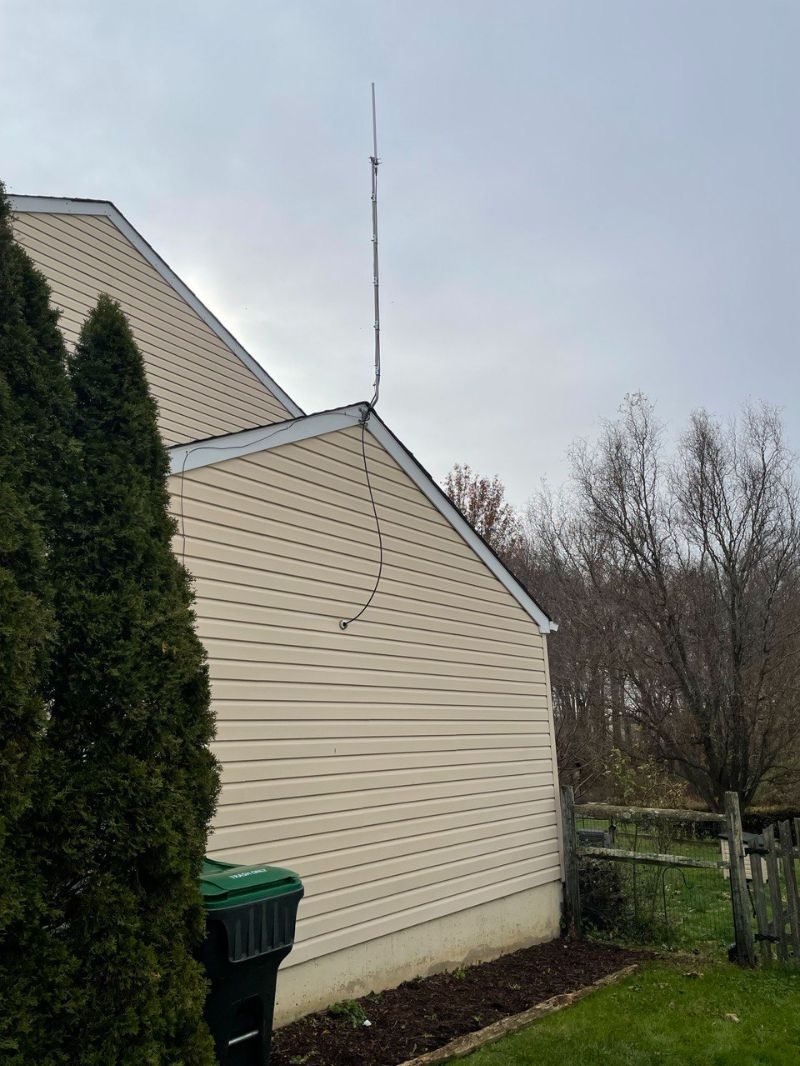
Got questions about what kind of cable you should use to connect your Helium hotspot to your antenna? Want a Helium-specific cable loss table?
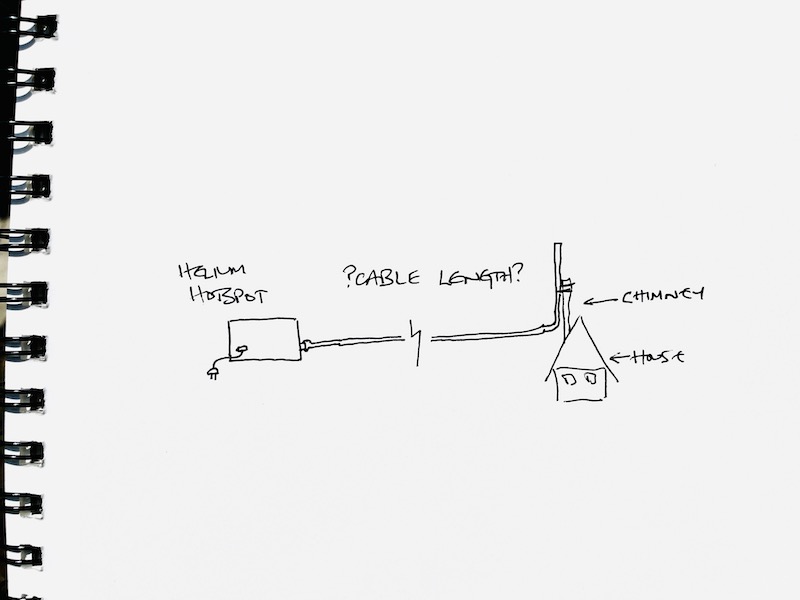
You're not alone! Lots of folks want to know if they should use LMR 240 or 400 or 900, or how long it can be, or if they should use the cable that came with their cheap-o eBay antenna.
In order to answer that, I'm going to walk you through how the whole thing works. That way, instead of asking me if your XX antenna with YY feet of ZZ cable will work, you'll know how to calculate the answer.
First, let's talk about the precise but confusing terminology in the land of RF (Radio Frequency). Well, if you want to just skip to the cable loss tables, go here.
You'll commonly see dB (decibel), dBm (decibel milliWatt), and dBi (decibel isotropic) thrown around, as well as dBm, EIRP, ERP, FSL, and others. Sheesh, that's a lot!
We'll start with dB, which stands for "Decibel". A decibel is the difference between two signal levels. RF engineers (and the rest of us) use it to add or subtract the effect of cables (or other "system devices") on signal strength.
dB are logarithmic: Every time you add 3 dB of gain, you double to the signal level. Every time you halve power, you subtract 3 dB. That means a 3 dBi antenna is doubling your emitted power over a zero gain antenna! But wait...that can't be right, can it? Antennas don't "add" energy.
As I've covered in other blog posts, antennas focus and shape energy. They don't add energy. It's kind of like a garden hose sprayer with multiple spray patterns. The water pressure going into the nozzle doesn't change, but as you switch from "mist" to "shower" to "stream", your emitted pattern changes.
That pattern change, and the resulting focus and range, is measured in dBi (decibel isotropic).
Ok, it's about to get a little more confusing, but I promise you can understand this.
"Isotropic" refers to having the same energy value in all directions. It's the idea that an antenna could emit a perfectly shaped "globe" of energy. For various reasons, it's impossible to build an isotropic antenna. Every antenna in the real world emits energy in slightly uneven patterns.
Still, RF engineers use a perfect 0 dBi as a reference point. As you go up in gain (the dBi goes from 0 to 1 to 3 to...13), the pattern becomes less and less globe-like and more focused in a single direction & plane.
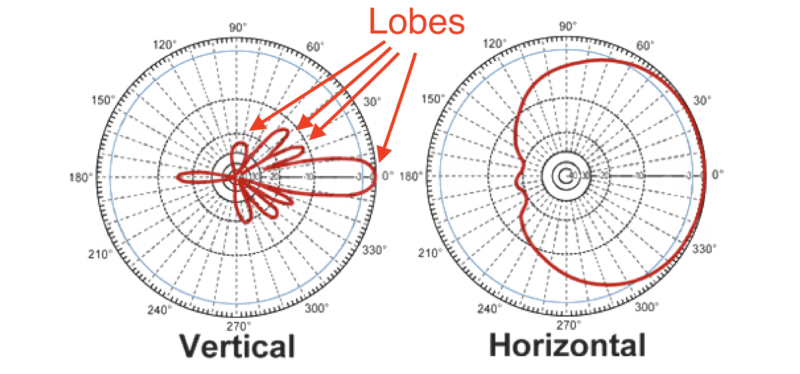
That brings us to EIRP, or Effective Isotropic Radiated Power. This is a measure of the radiated power coming out of an antenna in the direction of its largest lobe. What's a lobe? Let me show you:
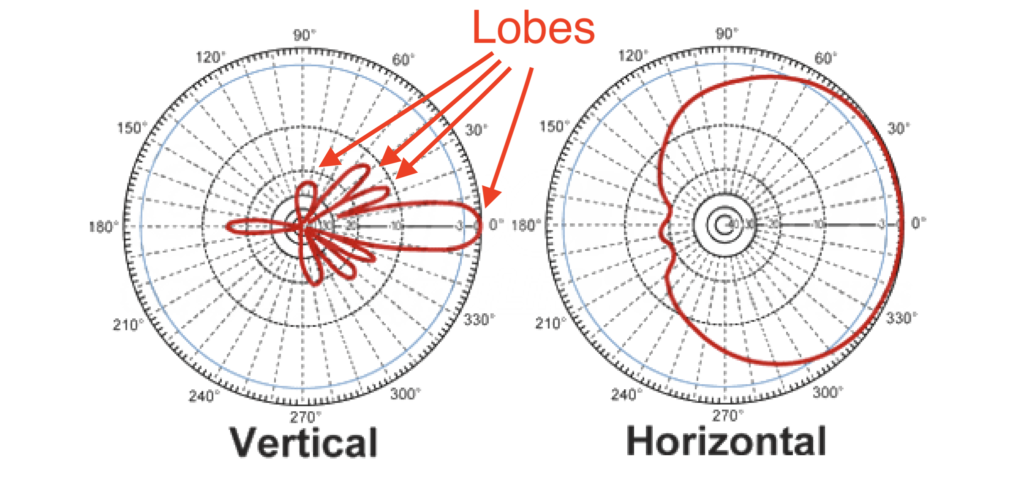
Why is that max lobe energy measure of EIRP important? Because that's what regulatory agencies (like the FCC) use to measure the power coming out of an antenna.
In the US on the 915 MHz frequency we use, the FCC limit for EIRP is 36. You get the EIRP by adding the transmitted power in dBm (what gets fed into the antenna) to the antenna gain in dBi.
Transmitted power is measured in dBm, or decibel milliwatts. The max transmit power we can use in US Helium Hotspots is 30 dBm, or 1 watt. For Euros, the max transmit power for uplinks is 14 dBm. You can read more on this here, in the LoRa docs. I'm US based, so we'll stick with the US numbers for this article.
The transmitter used in a US Helium Hotspot pushes out 27 dBm. The stock antenna shipped with the original Helium Hotspot was a 3 dBi Antenna gain.
That gives us a total EIRP of 27 dBm + 3 dBi = 30 dBm
If you're US based and do the math, you're now realizing why a 9 dBi antenna is the limit for your Helium Hotspot deployments. 27 dBm + 9 dBi = 36 dBm, or the max allowable EIRP.
But wait, wait, wait, Nik. I thought this post was about cable loss? Why are we talking about antennas and gain? Well, when you pass energy through a cable, you lose some of it. Different cables lose energy at different rates, usually measured as dB per distance. In general, thicker cables lose less, and thinner cables lose more.
Cable loss effects EIRP, because remember, EIRP is a measure of what is "fed into the antenna". So:
EIRP = Transmitter power (dBm) - Cable loss (dB) + Antenna Gain (dBi)
This is why you can have a 9 dBi antenna with lots of valid witnesses if you have cable loss that brings your EIRP down to what Helium considers "normal" limits.
Before we get to the cable loss table, let's cover one more term that gets thrown about, which is FSPL, or Free-Space Path Loss. This is the decrease ("attenuation" for the RF nerds) in radio signal power over distance. FSPL is important in Helium because it's one of the factors the blockchain uses to determine if the signal strength of any beacon is "out of bounds".
FSPL is used to combat gaming. If you've got 10 hotspots in your closet (remember Modesto?), you can "say" they're deployed in a perfect grid pattern, but using FSPL to calculate the signal strength that should be reported is one way to make sure they're actually, say, 800 meters apart and not all stacked on top of each other.
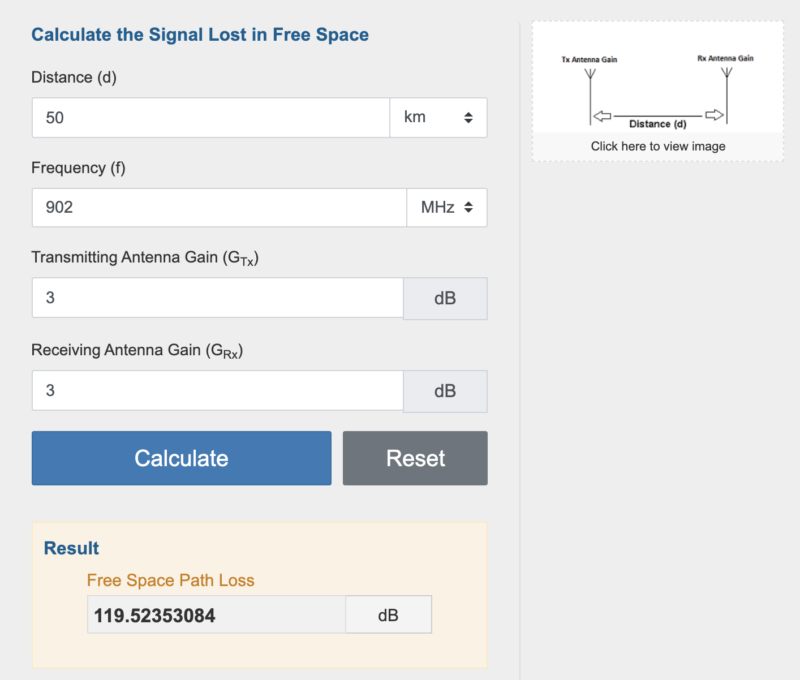
You can calculate FSPL here. Here's what that might look like for 2 hotspots 50 km apart with clear line of sight, both using 3 dBi antennas:
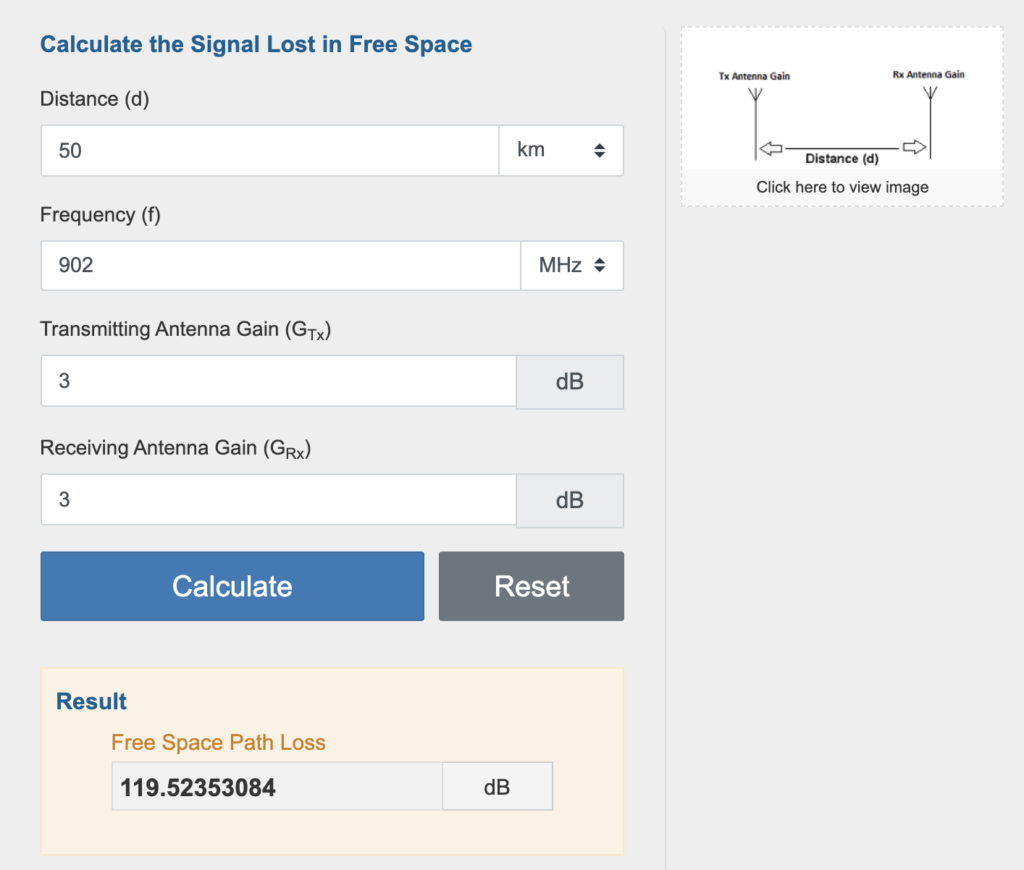
How would you know if that's within limits?
Let's do this! Remember that your hotspot pushed out 27 dBm. Let's imagine you're not using any cables, so cable loss is 0.
We've already accounted for the gain using the calculator, so we just subtract the FSPL from the transmitted power (27 dBm - 119.4 dB) to get -92.4 dB.
That's a signal strength within normal limits. For Helium hotspots in the US, most common signal strengths are (generally) between -90 and -122, though it can go higher or lower, down to -130 in some instances. Now, there are some other measures, both public and private, that Helium uses to combat gaming when assessing a tx/rx receipt, but these are the basics.
So, with all that as background, here's your cable loss table. Use your transmitter power minus the cable loss plus your antenna gain to get your EIRP, and make sure that number is 36 dBm or below.
You can get as detailed as you want, but I'd recommend not getting too wrapped up about your EIRP to the thousandth dBm.
[ninja_tables id="1782"]
Finally, one thing to think about is this: Having more power come out of your antenna isn't always a good thing. An effective way to plan your EIRP is to go after the LOWEST number you think you can get away with, say, 30 or lower. LoRa is already pretty darn capable, so "extending the range" with antenna gain can be pointless. I mean, I've seen a 3 dBi antenna be witnessed 200 km away. That antenna does a way better job of hitting lots of local hotspots than a higher gain would, in large part because of the effective pattern it has. Higher dBi doesn't always mean "useful longer range" (or greater HNT earnings). Just something to think about.
Rock on!
References & Resources
Kerry Prudhomme - 6/15/2021
O K I'm a little confused. My first hotspot will be at my home. I live in a relatively flat area. I have tall trees about 50 - 100 feet from my house. I plan to use an 8 DBI antenna. I could place the hotspot within 20' of the antenna. Should I purchase an outdoor enclosure for the bobcat miner to reduce the amount of cable between the miner and the antenna. Is the 8 DBI antenna Ok in my situation?
Nik - 6/15/2021
Hi Kerry, I always aim to reduce the cable length between miner & antenna. You don't *have* to, it's just a good idea. Your 8 dBi antenna will probably be fine. Does that help clear it up?
Kerry Prudhomme - 6/16/2021
Thank you. I think I will purchase the enclosures. I will also need to purchase a short length of cable for each.
Dan Carare - 6/17/2021
Hi! So the best thing to do is to buy the most short cable with highest LMR 600, considering will be short distance between hit spot and antenna location ) Is this correct? Shir cable, maximum LMR Right?
Nik - 6/17/2021
Technically, yes. Practically, you don't need anything beyond LMR400 for most instances, and the 600 & 900 are thick and more difficult to work with.
scott dieken - 6/19/2021
Hey, could you please add the LMR900 cable to your chart. I do not understand why people would cheap out on their cables. I was making 2 grand a month on a rak miner with the factory provided rak antenna on an 8ft lmr-400 ft cable. I tried moving it up 25 feet with a 50 ft lmr-400 cable and was making zero dollars a day. If you can make one or two grand a month why buy anything but the very best cable? Then you don't even need these high dbi antennas. Please let me know if you have any good suppliers for lmr-900 cables. It wouldn't matter to me if the cable was $500 or $1000.
Nik - 6/20/2021
Hi Scott, sure, we can add LMR900.
Johnny - 6/26/2021
First, awesome stuff Nik. Thank you for sharing. Second, any links to pre-made cables you’d recommend and/or to tool and connectors that most easily make for reliable connections. Again, thank you.
Nik - 6/26/2021
Thanks Johnny. I'd use USACoax for cables. You definitely can make your own, but it's more expensive unless you're making a bunch, and even then you're probably still breaking even.
Evangelos Foutris - 7/1/2021
Hello Nik, thanks for the info! 1) You state one place that the max EIRP in US is 30 dBm but then elsewhere say 36 dBm. Can you clarify? 2) Is loss only from the antenna to the miner or also from the miner to the router (ethernet)?
Nik - 7/1/2021
Hmm, let me know where I screwed that up. For clarification: Max transmit power fed to the antenna is 30 dBm. Max EIRP (the focusing of that power) is 36 dBm. Does that make sense? More on that here.
scott dieken - 7/4/2021
if you wanted to make a longer cable run like 100ft using the lmr-600 could you offset some of the power loss using some kind of booster?
Nik - 7/4/2021
I haven’t seen that work well. Usually better off to figure out how to run long Ethernet and short antenna cable.
Natko Jankovi? - 7/9/2021
Please can you explain me is there any gain for those hotspots for Emrit which are all set to 1,2dBi and 0m vs. private which are adjusted to real values? No need to say that may hosts modify antenna and don't place hotspots on the ground level.. Are there any consequences for Emrit for this falsely setting gor thousends hotspots around the globe from Helium?
Devon - 7/9/2021
Hi Natko those settings (Antenna Height/Antenna Gain) are not currently active, and no there will never be penalizations for not having the proper parameters set. That will be utilized to advance the network specifications further. For now it is not active, and again even when it is active you will NOT need to have to settings match your system. It will only be in place to improve YOUR performance.
Nik - 7/9/2021
The current antenna & elevation settings in the app don't have any bearing on your RSSI/SNR values (as far as I know.). Shouldn't be an issue.
scott - 7/9/2021
hey nik your previous comment I haven’t seen that work well. Usually better off to figure out how to run Kong Ethernet and short antenna cable. I am not familiar with Kong Ethernet, and a google search really did not bring anything up. For those of us who have not bought outdoor units with POE could you please link to where I can find more info on Kong Internet. P.S. I did end up buying one of those HNTenna so we will see how much improvement I get next week when it arrives and I can get it installed.
Nik - 7/9/2021
Whoops, was typing so fast I put "Kong" instead of "long". Should be "long ethernet". :)
Helium Hotspots & EMF - One Man's Search - 7/12/2021
[…] those of you who’ve read the Cable Loss & EIRP post, you’ll remember that the most powerful hotspots (American hotspots) blast out a […]
scott - 7/15/2021
what is the difference between kmr-400 and lmr-400
Nik - 7/15/2021
They look similar to me, the KMR claims to be more flexible. I haven't used it.
Michael Kozlowski - 7/17/2021
Hey there, I read that certain materials from placing an antenna indoors can cause dbi loss. I read that plywood can cause 4-6 dbi loss and that high efficiency windows could sometimes cause up to a 40dbi loss, ans paired with a bug screen, even worse! So my question being. If I were to mount say a 10dbi antenna inside my attic, would I be transmitting somewhere between 4-6 dbi, and retain the local vertical reach visibility benefits of having a 4-5.8 dbi antenna versus a 8-10dbi antenna which is more horizontal reaching? Thanks! I currently have a few miners setup with the stock 4dbi antenna next to windows but wondering if a 8-10dbi antenna in the attic would be better.
Nik - 7/17/2021
Hi Michael, good question. If it's in your attic it'll go through your roof just fine. I'd probably stick with a 6 dBi or lower, but the answer is always to test 'em out. :)
Valeri - 7/24/2021
Hi Nik, If I use 5.8dBi antenna and my cable length results in 2.8dBi loss would that mean that the performance (the radiation pattern and the ERP) of that antenna (5.8dBi - 2.8dBi in losses = 3dBi) and that of an 3dBi antenna without any cable extension would be the same (because they have the 3dBi gain)?
Nik - 7/24/2021
Nope. The radiation patterns are different for different antennas. A drop in power doesn't change the pattern of radiated power.
Richmond Mcfarland - 8/2/2021
How do I invest in the cryptocurrency, Helium?
Richmond Mcfarland - 8/2/2021
What do I need to do to invest in Helium, a cryptocurrency? I know its symbol is HNT, But I don't know to access it and buy some of it.
Richmond Mcfarland - 8/2/2021
Can I get an answer to how to invest in HNT
Nik - 8/2/2021
Look for cryptocurrency exchanges that list it. Binance.us and Bilaxy are two you can look at.
Nik - 8/2/2021
Sure. Just wait a bit, dawg. There's only one guy running this site. :) You'll probably get more information faster over on the Helium Trading Discord.
Brad - 8/3/2021
Hey Nik, I am looking at this chart and I think I need help with the math. I have a 5.8 Dbi antenna with 30' of LMR400. So, I am guestimating that is about a loss of 1 dB. But how do I calculate that out since dB and Dbi are different. 36 + 5.8 - ?(dB loss)? = ??? Also I pontificate the following: Is there math that makes an 8Dbi as effective as a 5.8, just by running longer cable? I guess the pattern doesn't change for the antenna, but it would kill the distance, effectively making the widest point of coverage, closer to you, correct or no?
Nik - 8/3/2021
Hi Brad, 30' of LMR400 will give you 1.17 dB of loss (3.9 dBi loss for 100', so 3.9 x 30%). dB = decibel (relative) and dBi = decibel isotropic (measured against an absolute). It's confusing, I get it. For the purposes of this equation you can add & subtract them without conversion. Re. making an antenna more "effective", I'm not sure I follow. You'll be putting less power through the same pattern as far as I know. I'd take the 5.8 over the 8 in pretty much every circumstance we'll have for Helium. :)
Brad - 8/4/2021
Thanks Nik, so basically, because of the cable length, I now have a 4.63 dBi antenna... For the "effective" question, I was thinking that upsizing the antenna to an 8 dBi instead of the 5.8 dBi would make up for the cable loss. Where it gets a little fuzzy for me is that an 8 dBi has a more laser-like pattern with less coverage close by. So, would the reduction in the dBI from the cable loss change the pattern to be more like the 5.8 or would it stay very narrow and just be a weaker signal?
Nik - 8/4/2021
Not really re. having an 4.63 dBi antenna. You have an antenna emitting at a certain pattern with a reduction in strength along that pattern equal to the cable/connection loss. Minor detail, but just to be clear. :) I'd keep it at a 5.8. LoRa has so much dang range anyway (4 dBi antennas ROUTINELY witness over 100 miles away) that this constant focus on whether or not an antenna is strong enough is misplaced.
Can I Get A Witness? - One Man's Search - 8/4/2021
[…] Everyone (in the US, and in most countries) selling a radio device has to have it certified by some national body. In the US, that body is the FCC. One of the things they check during certification is that your device doesn’t break any emission-strength rules (technically EIRP, more on that here.) […]
Dave - 8/7/2021
For the case of a miner in an attic, any thoughts on 8 vs 5.8/6 dbi antenna? Rokland says that the 8 dbi antenna has a 25 vertical beam width. That still seems pretty wide, e.g. at 300m, the lower bound should be ~66m. So why would one go for the 6 dbi unless you live on a mountain?
Nik - 8/8/2021
Hi Dave, I aim for lower dBi unless there's a mitigating factor. From your situation (in the attic) the 8 dBi will probably work better, but as always with RF, you've got to test it. Please keep me posted on how it goes!
Michael - 8/13/2021
Hi Nik, I'm a bit confused. I generally understand what this post is saying but I'm confused with the different cable types. I see that my antenna has an RP-SMA Male connector and my Bobcat Miner 300 hotspot has an RP-SMA Female connector. I've seen "N-Male" thrown around on different websites, along with LMR-400. I assume I would need a cable with the RP-SMA Male + RP-SMA Female ends. However, when I do a search for LMR-400 with those connectors, the results don't look anything like what I'd need. I'm looking for a 2 or 3 foot cable and was wondering if you could send me a link of where to buy the cable I'd need?
scott dieken - 8/13/2021
could you compare these lmr cable types with the pulsar cable listed on rak for dbi loss? https://store.rakwireless.com/products/pulsar-cable-rak9731-rak9733?variant=39677580968134
Nik - 8/13/2021
Yep, head to USACoax. If they don't have what you want on their "Helium" offerings, look for their standard LMR400 or just call them. Their phone customer service is knowledgeable. Tell 'em Gristleking sent ya; they'll probably have no idea what you're talking about, but it'll be funny. :). Oh, and if you want to see what an N-male looks like, go here and scroll down.
Michael Johnson - 8/13/2021
Thanks Nik! I appreciate your sense of humor along with valuable information. I'll take a look at usacoax.com and reach back out on here if I still have questions. I might end up calling their customer service and tell 'em you sent me, for a good laugh too LOL
Nik - 8/13/2021
Hi Scott, use loss per distance to compare. For example on the page you linked, 16.4 feet has a loss of .9 dB on the Pulsar at 902-930 MHz. Check it against LMR over here (which is all 915 centered), where you'll see that LMR400 (for example) has a loss of .8 dB at 20 feet.
Brent - 8/13/2021
Hi Nik, If I needed 50ft of cable from the antenna to the miner is LMR 400 good enough or should I go with something higher like LMR 600 Thank you for all your awesome posts!
Nik - 8/14/2021
Hi Brent, it depends on the gain of the antenna. At 50' you'll probably want a 5-8 dBi gain antenna to offset cable loss.
Tom - 8/16/2021
Hi Nik, I got a RAK V1 and a Parkey Labs 5.8dbi antenna (link: https://shop.parleylabs.com/collections/antennas/products/5-8dbi-fiberglass-antenna-for-hnt-helium-hotspots-lorawan-us915-gray). I am on usacoax.com building a custom cable (link: https://usacoax.com/custom/custom-helium-lmr-400uf-ultraflex-cable-build-530.html) But I am not familiar with the terminologies of the cables. It is asking for which connection type should it be on CONNECTOR 1 (HOTSPOT SIDE) (options: no connector or RP-SMA male for $5 extra) and which one whould be on CONNECTOR 2 (options: no connector, N male, N female, N female-bulkhead or RP-SMA female (stock antenna extension)). Each one for extra $5. I need some 30" of cable from the top of my chminey until the basement, where the hotpost will stay. Can you please help me to determine which types of connections the cable should have? Thank you!
Charlie - 8/18/2021
Hi Nik, I got a 8dbi antenna on my roof 35ft high with 20ft of Lmr400. That is not much power loss. Anyway, on a few rare occasions at 7:30pm I reached 4x as many witness as normal in different directions 120km away in disco mode! I was ecstatic! However, I was never able to duplicate this again in discovery mode or real world. Any suggestions of what this might mean? Should I try turning my 8dbi antenna or changing to a 5.8dbi to widen the beam. Right now, my only witnesses are over 30km away. Thx
Hey Nic, why does it seem like at night disco mode performs better! Is there a best time to run disco mode to get “Max effect” Thx Charlie
Nik - 8/18/2021
Hey Charlie, good question; the ham radio guys love this kind of stuff. I don't know about a "best time"; what you're aiming for with Disco is to get a rough approximation of how many witnesses your miner will have. Day or night obvi make a difference, but since your miner runs day & night it's probably worth it to check both, then see how that lines up with actual results.
Nik - 8/18/2021
Are your nearest hotspots 30 km away, or just your nearest witnesses?
Nik - 8/18/2021
Hi Tom, check out this page on cable connectors, that should help you sort it out. I usually write it down; that helps me clear it all up. "Bulkhead" connectors are extra long, to go through a (thin) wall, like a plastic enclosure; you probably don't need that.
SS Shah - 8/18/2021
Learning a lot from this site - I purchased the HNTenna 3 dbi outdoor antenna that you have recommended elsewhere, but will need to run approximately a 25 foot cable. It seems like this would be approximately 1 dbi loss per your table (if LMR 400). If I'm understanding correctly, this would bring the power from 30 dbi (27 + 3) down to 29 dbi (27 + 3 - 1) which seems like it would still be ok. Does this sound reasonable, or do I need a higher gain antenna to offset? I live in a suburb approximately 15 miles away from a very large city, which is why I was hoping to use the lower gain antenna. Thanks!
Nik - 8/18/2021
Totally reasonable, please let me know how it goes SS!
Scott Dieken - 8/19/2021
Nik Do you have any slightly higher gain antennas you recommend than the 3dbi. If I need to run a long cable like 50ft, a 3dbi just isn't enough to overcome the line loss. (I think) I have a 3dbi antenna doing very well right now on a short cable of 10ft but when it was higher on a 50ft cable it wasn't doing well at all.
Nik - 8/19/2021
Hi Scott, try the RAK 5.8, people seem to get good results with those.
alan pearson - 8/22/2021
Could you use a RF reflective metal, and place it next to your Omni-directional antenna to strengthen signal in a specific direction?
Nik - 8/23/2021
Hi Alan, sure, you're making a homemade sector antenna when you do that. It'd work, though maybe not very efficiently depending on design.
John Wilchynski - 8/27/2021
Hello Nic I live out in the boonies Florida. My nearest hotspot is 32km away. I have three Bobcat 300 units spread out in the area to form a network. We have many tall pine trees all over. What size towers should be used? I have access to 50 foot tv masts. Was thinking of 50 foot towers with 8dbi antennas. Is higher better? But then long cable runs. What do you suggest? Thank you.
Nik - 8/27/2021
Hi John, The higher the better in Florida; those pines are no joke! An 8 dBi at the end of a 50' cable should be fine if it's 50' up. Very tough environment for LoRa to go long distances.
Mike - 9/8/2021
I have a question about this statement: "That’s a signal strength within normal limits. For Helium hotspots in the US, that valid signal strength is (generally) between ?90 and ?122, though it can go down to ?130 in some instances." I'm not sure what this means but if this range is something to strive for, it means you actually want more cable loss. I ran thru the calculators and if my hotspot puts out 27dbm and my free space path loss is fairly low - for instance 3dbi antennas at both ends and the distance is only between 1 and 3 kilometers, the loss is 95db (at 3km). 27 -95 is -68 so if you want to be between -90 and -122, wouldn't you want to introduce more loss with a thinner cable? (LMR195 at 100 feet) Even with 10 more db of loss from the cable I'm still only at -78 which is not within the range. Or maybe I don't understand the comment about the range. Can you explain that?
Nik - 9/8/2021
Hey Mike, calcs look good. I'll pull the word "valid" from the post, as it's not quite accurate. Good catch! I should have said "most common". If you're running 2 x 3 dBi antennas, you are very unlikely to run afoul of any anti-gaming rules. While signal strengths are generally between -90 and -130, I've seen 'em be valid at stronger levels, although with current rules the SNR can be too high and invalidate the whole thing. In fact, SNR (at least for PoCv10) is the real problem, and a part of what I believe they're pulling out in PoCv11.
Mike - 9/9/2021
Nik, thanks for answering so quickly. So is all the hype about needing really low-loss cables overstated? In my case, I will need a 75 foot run. I don't need to hit hotspots 50 km away. However, there are a few at between 10km and 15km that I'd like to hit but I have plenty that are fairly close to me (1 to 5km). Also Vision shows that I have good line of sight for many of these including the 10km and 15km distant hotspots. So if I have the 75ft run of let's say LMR195 and have roughly 8db of loss and the free space path loss at 15km is 109, then 27 - 8 - 109 = -90 which is somewhat ideal based on your numbers but if it happens to be a little stronger that won't be a problem. For instance, right now, my little 3dbi antenna (direct connected indoors next to a sliding glass door) is solidly hitting a hotspot 8km away with an 8dbi antenna (on a 30 meter mast). The calculated signal strength is -71 and I'm getting plenty more rewards since he got started up. So again, is all the hype about needing the least cable just hype? When I mentioned a 75foot run on one of the Discord channels, I got a lot of people saying I was out of luck unless I got LMR900. Not sure I believe that. Thoughts?
Nik - 9/9/2021
Probably a lot more hype than anything else. "Needing" LMR900 is way overkill. 75' of LMR195 is on the low side for a 3 dBi antenna, but if your calcs are putting you well within acceptable levels you're probably fine. Please keep me posted on how it turns out!
Thing - 9/21/2021
Hello, i would lile to ask you about buying rak's 3 dbi antenna with 30 ft long lmr 400 cable for my bobcat. Will it cause too much loss or is 1.65 db loss is too much? And some resources says that bobcat's stock antenna is for indoor/outdoor use but i couldnt find any official answer. Can i use stock antenna with some insulation tape instead of rak? My last question is can i use 3 dbi antenna for bobcat? Because it's stock one is 4 dbi. So will it decrease my antenna gain or anything else? Thank you very much.
Thing - 9/21/2021
Hello, i would lile to ask you about buying rak's 3 dbi antenna with 30 ft long lmr 400 cable for my bobcat. Will it cause too much loss or is 1.65 db loss is too much? And some resources says that bobcat's stock antenna is for indoor/outdoor use but i couldnt find any official answer. Can i use stock one instead of rak's 3 dbi? (The reason that i want 3 dbi is the poc11). My last question is can i use 3 dbi antenna for bobcat? Because it's stock one is 4 dbi. So will it decrease my antenna gain or anything else? Thank you very much.
Nik - 9/21/2021
Check the connection loss chart on this page , 30’ of LMR400 isn’t a ton of loss. Bobcat data sheet here. You can use any antenna you want on a Bobcat (or any hotspot), 3 dBi is fine.
scott dieken - 9/23/2021
Can you make a blog post that explains what changes are in PoCv11?
Important Helium Update! How to update Antenna Dbi + location for POCV11 | ($HNT) | Chia (XCH)/Helium (HNT) Explained - 10/1/2021
[…] Helium 101: Cable Loss and EIRP. - Gristle King - A Guide to Helium gristleking.com Helium (HNT) ???????? ???????? ????? Twitter Facebook ??? Pinterest ???????? iost Chia (XCH)/Helium (HNT) Explained […]
Eric - 10/10/2021
Hello. Beginner here. I was wondering if cable loss affects the signal pattern of the antenna? Example: A 5.8 dpi antenna (outside) with a cable running 30 feet to a miner placed inside. Would the loss make the signal behave in more a "bubble" pattern like a 3dbi. Or remain more flat like the original 5.8 rating? Maybe a better example would be with a 8 dpi antenna. - Thank you.
Nik - 10/10/2021
Nope. The antenna will radiate at the same general pattern, just with less energy.
Elias - 10/15/2021
Hi nik What is the best dbi antenna to use on Cyprus (EU) on the city center of Nicosia Could you enlight me please ? Thank you
Richard Ogden - 10/15/2021
Thanks for all your excellent content Nik. Very much appreciated. From a British cousin !
Nik - 10/15/2021
I'd use a lower gain, 3-6 dBi. Whatever you get should be fine. Location & line of sight is far more important.
Mike - 10/23/2021
Nik, thanks for answering my questions above from September 8th and 9th. I ended up using 80 feet of LMR400. Got the antenna on a really nice tripod on top of my roof about 6 feet above my old TV antenna (which aIso got raised up a bit with the bigger tripod). Overall, the antenna is about 35 feet above the ground. When I had an HNTenna indoors behind a curtain, I was getting around $1 to $1.50 a day. When I moved it right next to the glass, that went up to $5 a day. When I moved the HNTenna 3dbi up to 35 feet with the 80 foot LMR400 ,that went up to around $500 to $550 a month (around $16 to $17.50 a day). A few weeks later, I switched to 6 dbi McGill tuned to see if that would do better. It does and I consider it worth it. The 6dbi really reaches out though to other hotspots that are between 10 and 30 km away. That's really nice. The rewards are up to between $20 and $23 a day. Perhaps the length of cable was worth going up to LMR400 flex but overall, this is a very nice setup for what I was expecting. Thanks again.
Nik - 10/23/2021
Right on, glad that worked out well for ya! Yeah, with those longer cable runs a higher gain antenna can make a difference.
Matty - 10/27/2021
Hi Nik, So many of of are amending our setups. I'm in the UK currently running s 5.8dBi antenna with a 10m run of LMR-400, for arguments sake let's say all my losses are 1dBi. You are asked to enter a dBi value into the Helium app, deducting the 1dBi loss from the 5.8dBi antenna and entering this value in doesn't seem correct to me. My understanding is that the antenna dBi value will never change? Am I missing something here? As I would still enter the dBi value in as 5.8dBi because cable loss will not change this? Cheers
James - 10/27/2021
Hi Nik, The helium app as asked for a dBi input for our antenna, I'm in the UK and run a 5.8dbi antenna with a 10m LMR-400 cable, for arguments sake let's say the cable loss/connector loss is 1dB, can you explain to my how this makes 4.8dBi? To me this doesn't make sense as my antenna is a fixed value, no amount of loss is going to change this. Is the value in the app 'dBi' incorrect for what we are now being advised to workout? (Cable and connector loss? Many Thanks,
Nik - 10/27/2021
Well, they're trying to calculate the output of your system, so I'd claim the loss and enter 4.8 in your case.
James - 10/28/2021
Hi Nik, Thanks for the response, whilst I get that it's a simple deduction. The cable loss doesn't change the end dBi, that is a static number surely, as that is set by your antenna? A 5.8dBi antenna will always be a 5.8dbi antenna? Is dBi the correct value being used?
Nik - 10/28/2021
The cable loss does change the dBi. In simple terms, dBi is a measure of the maximum power in a given direction from an antenna. With cable loss, that power will be reduced, since there's less energy going INTO the antenna in the first place. The antenna radiation pattern won't change, it'll just be outputting less power in all directions. Does that make sense?
R Ogden - 10/29/2021
Presumably there is no value in reporting cable loss if your antenna is at or below the maximum allowed before the miner reduces power to the antenna to get within the legal limit... iirc EU 4dbi and USA 9 dbi ?
Nik - 10/29/2021
Not right now, but come PoCv11 you'll need to accurately report gain or risk going over the RSSI limits.
Kevin s - 11/3/2021
First off I want to thank you for making such a comprehensive explanation!! I’m sure it was time consuming and I appreciate all the info as well as you taking the time to answer all our questions!! I’m here jn Denver Colorado which by the time my unit has arrived is quite saturated! Was able to find a location with 1.0 reward scale and plan to run a 50ft cable to the roof. I have numerous hotspots within 2 miles (maybe 20) and probably 100 within ten miles. And 750 I believe in within 50 miles... (as I said becoming a bit saturated!!!) Would you recommend sticking with the 3dbi (as I feel I’m going to hit my Max witness ammt with that) or should I try snd target as many as possible with 5.8 or 8? Also 400 on the cable since it’s 50ft? Or is the loss going to be somewhat irrelevant since I don’t need to reach out say 50km, if that’s the case do you think I’m ok with say a 195 to a 240 or would you recommend higher? And while I got you (sorry!) since denver is becoming so saturated going to be placing one in the mountains as a bit of an experiment. And some more rural areas as my reward scales being knocked down due to too many units jn the “larger hex” I’ve seen some witness all the way down here to denver from roughly 50-60 miles away (if I were to guess) on that I would assume higher dbi, what would you recommend an 8? And that I want to lose as little as possible so go with a 400 for cable correct or even higher? Last part tk that question that one IDEALLY I’d like to kind of point the direction back towards denver as the other way wouldn’t get line if aight over the continental divide, recommendations there? Sorry for the 10 part question! Been a 6 month long wait so I would love to get it right the first time!! Willing to spend the money to do it correctly the first time around but obviously don’t see the need to spend the extra money for say a 400 cord when I can get away with the 195 here in denver. But the main goal is to maximize the gains as with us all I’m sure ;) Again thank you so much for taking the time this will be the first out of ten I deploy so ANY information is GREATLY appreciate!! BY FAR the most informative post I’ve seen!! Can’t thank you enough! Keep up the great work it’s greatly appreciated!! Some of this is a bit over my head so thanks for holding my hand lol Thanks again! Best of luck.
Nik - 11/4/2021
Hi Kevin, stick with low gain antennas and short runs of antenna cable. A 3 dBi HNTenna is fine, and 20' or less of LMR400 for that is also fine. As you start to go beyond that you probably want a 5.8 antenna, but it really won't make much of a difference compared to *where* you put the the antenna & the lines of sight it has. 3 dBi antennas have been routinely hitting 30 km with clear Line of Sight over the hills/mesas in San Diego, and 200+km over water.
JV - 11/4/2021
Hi Nik, thank you so much for all the useful info you share that helps us to be be better Helium miners. I just have 1 question: I see a lot of reference to the cable loss and not as much to the connectors. I'm just wondering, when you add up the cable loss to the connector to the miner, the one to the lightning arrestor and the arrestor to the antenna, shouldn't you be factoring those in as well or are they so minute as to not make an appreciable difference? Thank you
Nik - 11/4/2021
Hi JV, cable connectors do add to the loss and you can include them. Any good connector should come with how much loss it induces, and you can add that into your calcs.
JV - 11/4/2021
What if it doesn't include that information, Nik? Is there a general rule that applies or a place with info we can consult? Thank you
Nik - 11/4/2021
Oh, on the safe side .5/connector. If they're high quality it's probably more like .1.
Jack Armas - 11/4/2021
NIK, thank you for the excellent article. I must admit a lot of the technical terminology went above my head. My hotspot is a RAK miner with a 60 foot LMR400 cable that runs all the way to the top of my house. It is attached to a 10 dbi antenna. With all that, I am not even witnessing. BTW, my miner is 'Acrobatic Wooden Beetle'. Feel free to look at it. Do I have the wrong antenna. How much loss do I have on this cable? Should a find a way to run an electrical line and ethernet cable to the roof and attach my miner up there inside a weather proof box? Sorry for all the questions and feel free to make fun of my ignorance. I just want to get this right. Thanks again.
Nik - 11/4/2021
Check lines of sight to local hotspots. Are you not witnessing *at all* or just not as much as you'd like? The antenna is too hot, for sure, though the cable length will offset that a little. I'd run much shorter antenna cable and a much lower dBi antenna.
Jack Armas - 11/5/2021
Hey NIK. I can confirm that I am not witnessing at on this 7th day into the HNT mining world. My antenna is 3 feet long and is sitting above any obstacles at the top of my chimney. So It should be true omnidirectional and have a 360 degree line of sight. What dBi would you recommend for a suburban house where 90% of homes are 1 story sub division homes? Again, I cannot thank you ENOUGH for your insight and expertise. TY TY TY!
Jack Armas - 11/5/2021
Hello NIK. I can confirm that 7 days into HNT mining, I am not witnessing at all. My 10 dBi is sitting at the top of my chimney with nothing blocking it. It should be a true omnidirectional 360 degree line of sight install. For a suburban house with nothing but 1 story subdivision homes, what dBi should I be using? What would be the max length cable I could get away with? Again, I cannot thank you ENOUGH for your expertise and guidance.
Nik - 11/5/2021
5.8 dBi will be fine for what you're doing; 10 dBi is way overkill. Florida is a tough environment for RF; flat, with LOTS of trees.
Peter Armenis - 11/10/2021
Hey Nik, first off great info and love your YouTube videos. I’m using a 5.8 antenna with a 25 foot lmr 400 cable. Cable loss calculator shows a 1.1 dbi loss. Should I be updating my antenna info to 4.7?
Nik - 11/10/2021
Right on, thanks Peter. Yep, that's what I'd update to.
Bob Jones - 11/13/2021
Nik, what do you think about ground planes. I have read somewhere they can helo focus signal. Thanks.
Nik - 11/13/2021
Yep, they can help shape the signal to go where you want it. The Bobcat stock antenna benefits greatly from a ground plane.
Shakir - 11/15/2021
Nik, I read about deducting the cable loss and entering the value in the miner. What happens if we do the opposite? Say 8dbi antenna with 20 ft of 400 cable, instead of deducting 0.8dbi, can we add 0.8dbi in the miner (8.8dbi) so the antenna will get 8dbi of power and not 7.2dbi? Thanks
Nik - 11/15/2021
Hi Shakir, your miner will output more power which will translate at the far end into a signal that looks suspiciously strong, and may invalidate your witnesses.
Darren - 11/18/2021
Nik, I’m looking at putting an antenna on top of a tower that is about 100’ tall. Then another 20’ to enclosure. So around a total of 120’ of cable. I plan on using a 8 dBi antenna. Can I use LMR 400? By my math I would loose 6 dBi. Or should I go with the LMR 600? I don’t want to put miner and router on the tower because I want to be able to get to those items without paying a company to climb the tower every time I might have to reset, etc. Thanks!
Nik - 11/18/2021
I'd use a lower loss cable, which will be a pain in the ass to work with. LMR600 or 900. And probably a lower gain antenna.
Darren - 11/18/2021
Nik: So I would be better off using my 5.8 dbi with LMR600? Hate to think of the cost of using LMR900. Thanks for the help. Trying to get it correct the first time so I'm not having to pay someone to run up and down a tower to change out antennas. Thanks for the reply.
Nik - 11/18/2021
Hi Darren, I'd run the calcs to see what your end output will be, then make the call from there re. antenna gain & cable type/loss.
Donnie - 11/18/2021
Hi Nik, I recently set up a Bobcat Miner and my SNR seems quite high. I failed to witness another miner 3.3 km away but I am able to witness one 15 km away. Funnily enough, (not really though) as I was writing this I failed another witness to that same miner. From what I have read, the invalids would be the result of the “anti-gaming” put into effect on the Helium Network since it falls outside of the “acceptable range" for RSSI and SNR. I am completely new to RF and though I have been reading, I am uncertain of the next steps to take. My first thought was to increase the noise somehow so that it would lower my SNR to an acceptable range. Is this possible with an attenuator maybe? Second idea was to increase the signal strength but I already have the antenna mounted from my chimney running through LMR 400 (53 ft) to lightning arrestor to LMR 400 (10 ft) to miner and am not sure putting it higher would help considering the factor may be on the other miner’s end. Any input is greatly appreciated. Thank you. Invaild Distance3.3 km DatarateSF9BW125 RSSI-94dBm SNR11.5dB Frequency903.9 MHz Valid Distance15 km DatarateSF9BW125 RSSI-113dBm SNR-2.8dB Frequency904.7 MHz 2nd Invalid Distance~3.3 km DatarateSF9BW125 RSSI-96dBm SNR8.8dB Frequency904.9 MHz
Jim B. - 11/23/2021
Nik, I consistently have Invalid Witnesses with a few miners around me, when I witness them or they witness me. When this happens the SNR is usually a positive value but never larger than 9db, most of the time its SNR 2-7db range but other times they are valid. How can this be corrected? (Examples below) VALID (my Miner): High Midnight Bobcat Distance ~2.8 km Datarate SF9BW125 RSSI -101dBm SNR 5.8dB Frequency 904.9 MHz INVALID Colossal Fleece Dove Distance ~2.8 km Datarate SF9BW125 RSSI -97dBm SNR 9dB Frequency 904.9 MHz
Nik - 11/24/2021
Hi Jim, valid/invalid depends not only on your setup but the setup (and really, gain) of those miners around you. If they have a higher gain antenna (and you do as well), there's not much that'll help until PoCv11 comes out.
Orion - 11/24/2021
If I paid you $500 to consult for me, what could you do to improve my situation? 1. I have a Gold RAK V2 on a 20 Foot flag pole with a 5.8 dbi antenna. 2. I have .27 transmit scale with a total of 6 other miners in hex. 3. Currently 112 witnesses Do you think, looking at those parameters, that you could improve my situation. My miner: https://explorer.helium.com/hotspots/11ouLbjduW7tdwzKr4SY7V2ekfHfGMPZdMbvyKh5ZALvDbe26G4
Nik - 11/24/2021
Probably not much left to do there; you'll need to find a better location.
Gary - 11/27/2021
In the "lobe" image its clear that even an omni directional antennae has a direction. How do to tell where that direction is? The reason I ask is I'm northeast of a large city. 99% of the miners are southwest or West of me. To the east there's nothing. So it would make sense to align the patter to face southwest. I have an 8dbi antenna with lighting arrestor (-.5 dbi) and 50' of rfc400 cable (-2.1 dbi) at about 35' feet high. Line of sight is good. I get valid witnesses out to 50km. I'm thinking the lobe direction is currently facing southeast based on my pattern of witness but I don't know how to officially tell.
Nik - 11/27/2021
Hi Gary, The lobes in that image are for a sector (directional) antenna. Every antenna you purchase *should* have a diagram showing you the radiation pattern from a vertical and horizontal perspective. Omnidirectional antennas do have dead spots, but they're basically not worth paying attention to for Helium deployments. An omni will "see" in all directions.
Helium Mining - Definitive Guide to Earning Optimum HNT - 11/29/2021
[…] you have a few options you can go for (the higher the cost, the lower the db loss). See here for a table of cable losses. I would typically go for LMR 400-600 cable as the best for price versus […]
Nodson - 11/30/2021
hi Nik. I have rac v2 miner with 6dbi antenaa, but cable neth is 90 feet (LMR400) is it normal confg? Thank you
Nik - 11/30/2021
That's a pretty long cable, but with a 6 dBi antenna shouldn't be an issue (depending on where you are. US no problem, Europe you'll want to upgrade/shorten the cable.) Make sure you enter the loss correctly there.
Marc - 12/4/2021
Thanks to this and all the rest of your article I think I have a pretty good grasp on which antenna and cable to use. Thanks! The one thing I'm wondering. I currently have a 10 ft. Lmr-200 cable connected to a 5.8dbi outdoor antenna. @5m height. My current further witness is 18km. If I change out for 10ft. Of lmr-400 there would be less db loss and assuming Los I should be able to get more range? I'm not quite sure what less loss is actually accomplishing
Aaron Olson - 12/9/2021
10 dbi antenna with 33 ft of cheap cable. What will this result in?
Mark S Werner - 12/10/2021
I think this question is answered... It want to be sure. I have an hntenna 3dbi outdoor connected with 20 ft of lmr240. Looks like loss is 1.5. Should I include the loss in the Helium app to account for the loss?
Nik - 12/10/2021
Yep, include the loss from the cable.
Jared Holm - 12/17/2021
Does cable loss change the focus of a higher dB antenna? i.e. Would a 9dB antenna that would have a flat focused plane be changed into a wider focused plane (as in your diagram on antenna gain) if it had a 4 dB loss form a 100' run of LMR400? Or is that not how it works? I am in FL with VERY flat topography (including buildings...it's essentially wide open space above the trees), but am under the tree canopy. I have the fun but difficult task of trying to position an antenna above the canopy where it should be able to "see" for miles. By my current understanding, I feel I need something like a 7 dB antenna up on 100' of LMR400 above the canopy, but am curious if I'll have a flat plane shooting over everyone. Thanks for all the awesome info!
Nik - 12/17/2021
Hi Jared, it won't change the pattern, it'll just weaken the output along that pattern.
Nate Martin - 12/19/2021
New Bobcat arriving in a few days. Located in between Phoenix & Tucson, just a few miners nearby, but have option to also place closer to City as needed; can you please email me with information regarding consultation for my setup & strategy?
Abner Silverio - 1/9/2022
HI buddy, how would you go about reducing the transmit gain? If you found u are running higher then you should and setup in the helium app to a 15dbi antenna and still was too high what can you put in the line to reduce the transmit gain?
Nik - 1/10/2022
What antenna are you running? That'd be where I'd start. :)
Attzaz Rashid - 1/12/2022
Hi, I've read through the article and embarrassed to say still stumped... I've got a 5.8dbi antenna on a 10m long LMR400 cable with a lightning arrestor between the aerial and cable. Is the figure I put into the helium app simply 5.8 less the loss in the cable which I think = 4.4dbi Any help would be really appreciated thank you! All the best Az
Nik - 1/12/2022
Yep, bang on. [Antenna gain] - [cable loss] - [insertion loss from lightning arrestor] = Asserted gain in app.
Ernest - 1/14/2022
I live in the suburbs on a hill and have an antenna on top of my roof about 40~ feet above ground. I am running 40ft of LMR400, which comes down to about 1.57db of loss. I used to run a 5.8db antenna when I had near 0 loss. Would it be more beneficial to swap to a 8dbi antenna due to the loss introduced with the new cable?
Nik - 1/14/2022
Probably not, I'd stick with the 5.8. Focus on keeping the antenna up high and you'll be getting the most benefit.
Alex - 1/18/2022
hi Nik, how are you - great post! I am trying to figure out my best setup. I have helium miner (bobcat 300) with the stock antenna on my roof. my house is prob 180m above sea level +10 meters for the antenna. most of the antennas i want to hear /see are below me or very far away (closest is 4km) . I actually think that I have to gain from a high gain antenna (8dbi is prob the sweet spot + 20 feet of cable + a lighting protector.) https://explorer.helium.com/hotspots/115s2Kxkwc5QMnBS3qLW2Bz7CBmwGRt7nFB9YRqQAiQ7C8pKUBP/activity does a high gain 8 or 10 sound too much? or a 6.5 better?
tanner - 1/18/2022
my fav part of this article is how GK says ‘i’m showing you how to do the math yourself!’ and all the comments are like ‘what about my setup, it’s like this:’ Thanks for the info, way to always make it digestible
Nik - 1/18/2022
6.5 to 8 is probably fine.
Alex - 1/18/2022
@nik ty very much - appreciate all your "guardian angel like approach" - i went with 8 to try and reach the remote islands :) @tanner you are right :) but as to myself and in my defense there are components implied in the distance and height which make the decision a little more "experience" based vs math based. I liked this calculator also https://www.pasternack.com/t-calculator-antenna-downtilt.aspx - it helps understand how the height and distance play into it as well as the vertical lobe degrees Alex
Chris - 1/20/2022
I messed up and ordered a LMR600 cable with the wrong connector. Will using a female to female converter result in a big lose? Is it worth replacing the cable or would it not make much difference?
Nik - 1/20/2022
Depends on the connector quality; anything you use should list its "insertion loss". Probably not a huge deal, though if you're running LMR600 you probably have a reason to avoid loss. ;)
Had - 2/11/2022
Hey NIK, is it worth runing 25 metter cable in order to climb antenna to roof of my 45metter building and completly open the view in full 360 circle? Or should I rather have around 150 degree open view and stay much lower but run short cable. Also which cable would you suggest for such a long setup? Is LDF 7/8 okay or should I stick to LMR - 600 or something else? Thank you for the answer in advance.
Nik - 2/11/2022
I'd say getting it high offsets any cable loss issues. Calculate cable loss for your length & frequency and decide on your cable choice from there.
Had - 2/11/2022
I already did, but I am not sure how much loss is a red flag? Is 2 db loss acceptable for 8-9 dbi antenna? I am from Europe btw. I saw that everyone just talking about LMR-400 as a standard and LMR-600 for longer set ups. So not sure if LDF cables are okay for hnt mining usage because no one is mentioning them even with the fact they got lower db lost.
Nik - 2/11/2022
2 dB loss should be fine. I'm not familiar with LDF, sorry mate!
Jeff - 2/21/2022
Hey Nik - Thanks for this awesome post - When you change the gain in Helium, this will only affect the Tx, not the Rx, correct? Say you have a 15dB antenna, if you set it to 15 in Helium, the Tx will be brought down to 36 (USA) while the Rx will remain at 42. Am I understanding this right?
Nik - 2/22/2022
Yep, that's correct. Whew, that'll be a tight pattern!
Jeff - 2/23/2022
Haha thanks! I'm not actually using a 15dBi - I was just using it as an exaggerated example. I run a 10dBi antenna and I'm planning to install a 2-way amplifier with a SAW filter on it and I want to make sure I'm in the legal range for my Tx without losing any Rx. Thanks again for all of your work in teaching us everything you know! Actually while I have you on the line - do you know if the Bobcat puts out 25dBi or 27dBi? I know the max for the US is 27 but most of what I can find in forums says Bobcat puts out 25.
Ben - 4/9/2022
HI Nik, First what an amazing article, I’ve read hundreds and by far this is the most comprehensive. I’ve just setup my Bobcat Miner, live in Scotland in U.K. However, I messed up with initial setup, I got conned on some cable. So my setup is bobcat 300, McGill 6DBI tuned antenna, I’m 63M above sea level and my antenna is 13m high (top of house). However, I have 15 metres of RG58 cable (I know right). I calculated the loss it’s over 6dbi so I’m not sure why I am seeing witnesses 24km away. I’m generating around .4HNT per day but only 5 witnesses/2 becons a day….. In 3 days time I am replacing the cable to 10 Metres LMR 600 (£100 just for the cable), once I setup I’m going to update Helium app with a .4dbi loss is that correct? So new antenna will be 5.6DBI. I’m more keen to see what impact it will have with the new cable? What’s your thoughts? Hopefully I’ll have more witnesses. I’ll update you on the results hopefully the upgrade of the new cable will pay for itself and show the results.
Nik - 4/9/2022
Right on Ben. You may have more witnesses if the extra signal gets you through a few more walls/trees. Depends on how many Hotspots are around you. .4 HNT/day right now is about 4x global average. :)
M Dave - 5/5/2022
Hi nik, How to calculate db , dbi, Eire for miner using 860 to 870:mhz…pls advice which antenna should I use.
Nik - 5/5/2022
Hey mug, follow the links in this article and you can run the calcs. Also, check out this article on choosing antennas.
Had - 5/19/2022
Hey, I recently upgraded from a stock antena to 7.5 dbi McGill and I have some invalids (rssi too high) when I am witnessing. My first thought was to try putting a higher number of dbi into the app but if I am correct that would just weaken my tx and not rx. I am runing a 15m of lmr 600 + a lightning arestor. Do you have any idea beside attenuator or you think I have to buy attenuator? Thank you in advance
Nik - 5/19/2022
Hmm, how long has it been? I might give it a few more days and let this whole Light Hotspots thing settle before I made any changes.
Raghav - 5/31/2022
I've a 6 Dbi antenna at the height of 15 meter. My Antenna is Connected with 12meter long LMR 400 Cable going through a 0.5 meter long RG316 Jumper(connector). What antenna gain should I mention on Helium App
Nik - 5/31/2022
Hi Raghav, add up all the losses from your cables and subtract that from the antenna gain. I'd probably include .2 dB per connector, but that's splitting hairs for this.
Ryan - 8/16/2022
First off thanks for responding to people. So here is the question. 5.8 antenna > arrestor > 25ft LMR240 > Miner. I want to add a amp (RX Gain +12dB,TX Gain +3dB, 2 saw filters) would it be better to add it near the miner or antenna...maybe not at all?
Nik - 8/16/2022
Amp not needed. I'm not sure about best positioning on it re. where in the chain, a quick search suggests closest to the antenna, but again, I'm not sure.