Shield Your Helium Hotspot From Powerful Lightning Strikes

How do you attach a lightning arrestor to your Helium hotspot antenna? What does one look like? Is it dangerous?
Let's start with a picture. This will answer 90% of your questions.
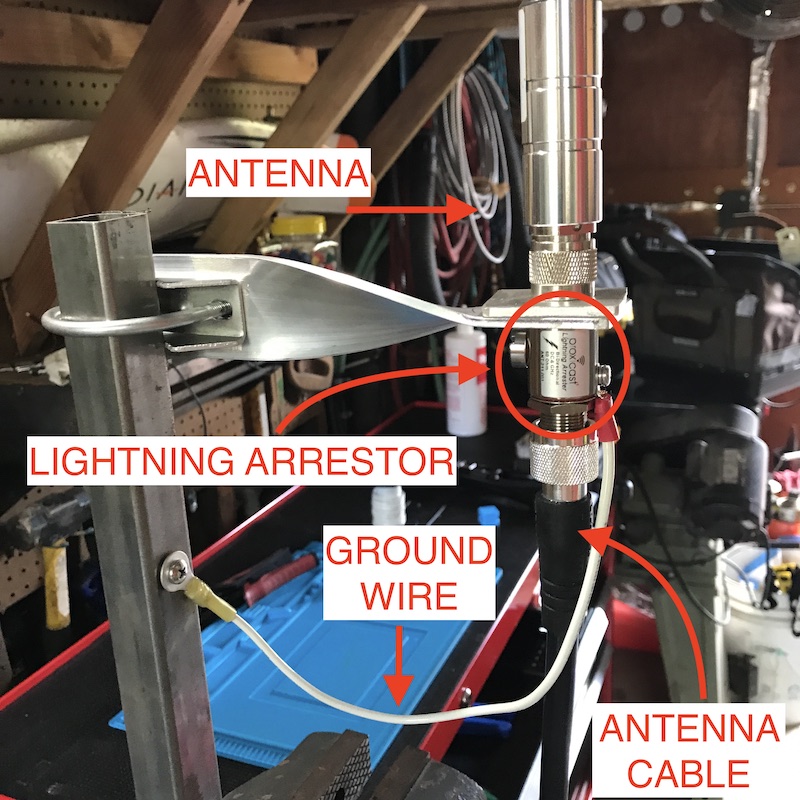
You can (and according to knowledgable ham radio operators) SHOULD connect the lightning arrestor at the other end of the cable, down by the miner. Another way of saying that is: Don't attach the lightning arrestor directly to the antenna like you see in the picture, attach it to a short piece of cable that connects to the miner, and a long run of cable that goes to the antenna. That didn't fit into my picture, so I did it this way.
Now, let's talk about what you can expect a lightning arrestor to do. Hint: Despite the blog post title, a lightning arrestor won't stop a bolt of lightning.
A lightning arrestor connects the antenna to the antenna cable. It passes the RF signal from one to the other through a medium that, when it gets too much power, it breaks, just like a fuse. RF engineers will probably lose their minds when they hear it explained that way; they'll start spouting about ionized gasses and fixed gas discharge tubes and input/output surge magnitudes. They're right, but you don't have to know all that to use a lightning arrestor.
A lightning arrestor will NOT stop a direct lightning strike. That would annihilate your house. While it would be awesome advertising to see a pristine hotspot miraculously protected in the middle of a charred and blackened house hit by lightning, it wouldn't be true.
All a lightning arrestor really does is protect your electronics against the static electricity that can build up during a storm. If the energy feeding into your antenna (don't kill me lightning scientists!) gets too high it zaps the gas in the middle of the arrestor, breaking the connection to the antenna cable, and all the energy is diverted to that ground wire (which is hopefully attached to your house ground.)
So, uh, how does it work? Just screw the thing in between your antenna and antenna cable, connect the attached grounding wire to a metal "path" that goes all the way to the ground and you're done.
Wait, you want more? What antenna is that? Where did I get that mount? What's the insertion loss on this lightning arrestor (make sure you get the right connectors!) vs the stuff the military uses when they don't want to fritz out a $40,000 piece of electronics? Psst, just get one from McGill that fits your cables.
I'll start with the antenna. I don't know what it is. A friend brought it over. He said he'd bought it on eBay and what did I think of it? I thought it would make a good demo for this lightning arrestor post, so I just gave him a Nearson 8 dBi I had laying around and kept his unknown antenna, which had the only thing that mattered: An N-connector on the bottom.
What about the mount? Made that out of aluminum bar, twisted, drilled, and ground to fit. Should've drilled first, but I made it work. The other super cool part of this project is the use of rivnuts. Stop here if you want to learn anything more about lightning arrestors, and refer to the above picture.
Just because I love building stuff and sharing knowledge, here's the journey. I started by clamping the aluminum bar in my vise, then twisting one end 90 degrees.
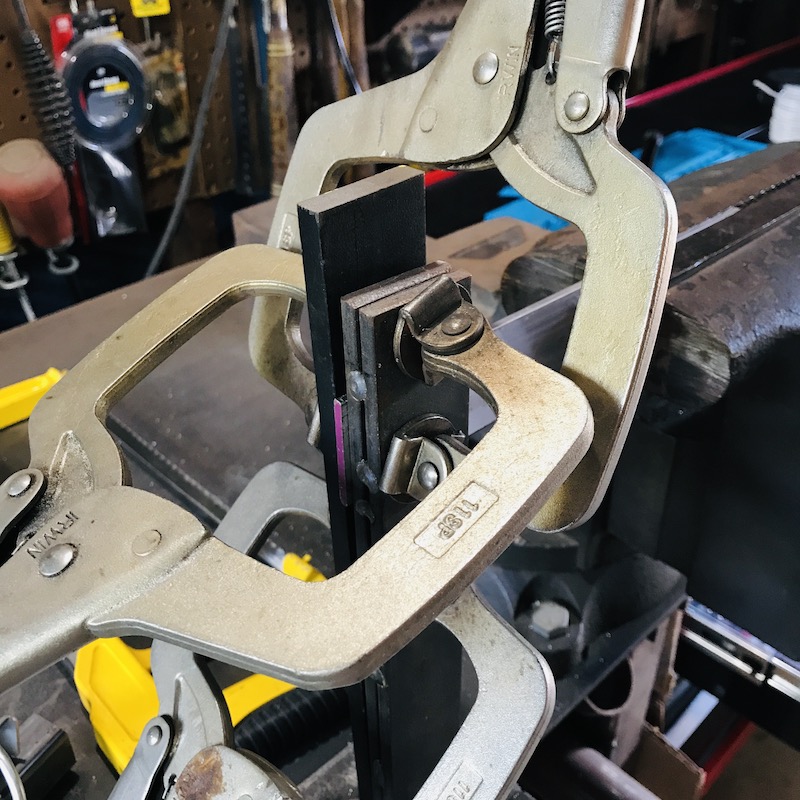
Twist complete. Nothing fancy, just simple and functional. I'll leave that pink paint on the end of the bar. Pink means you like to party.
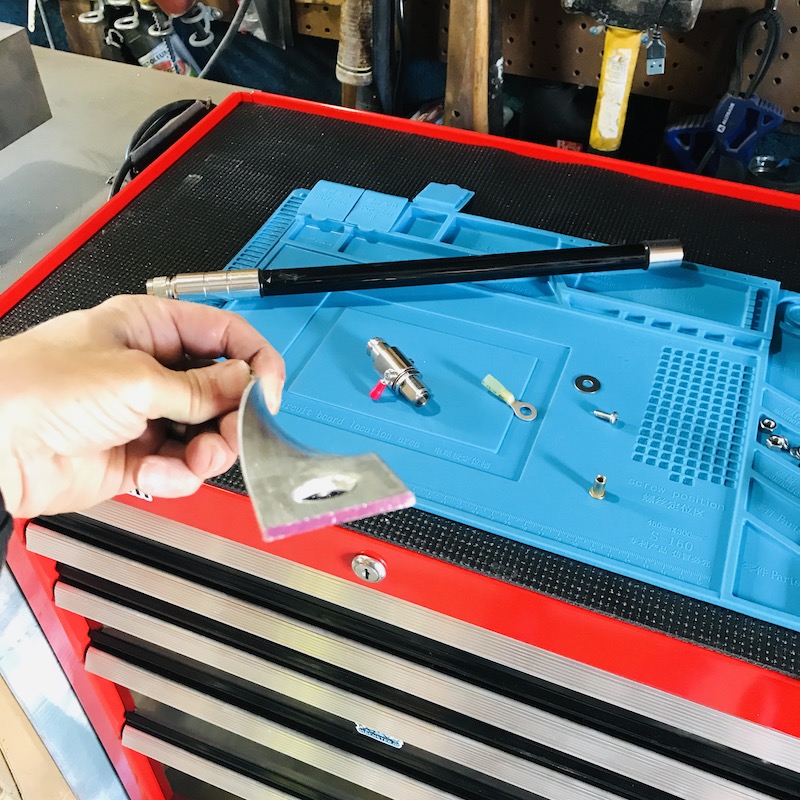
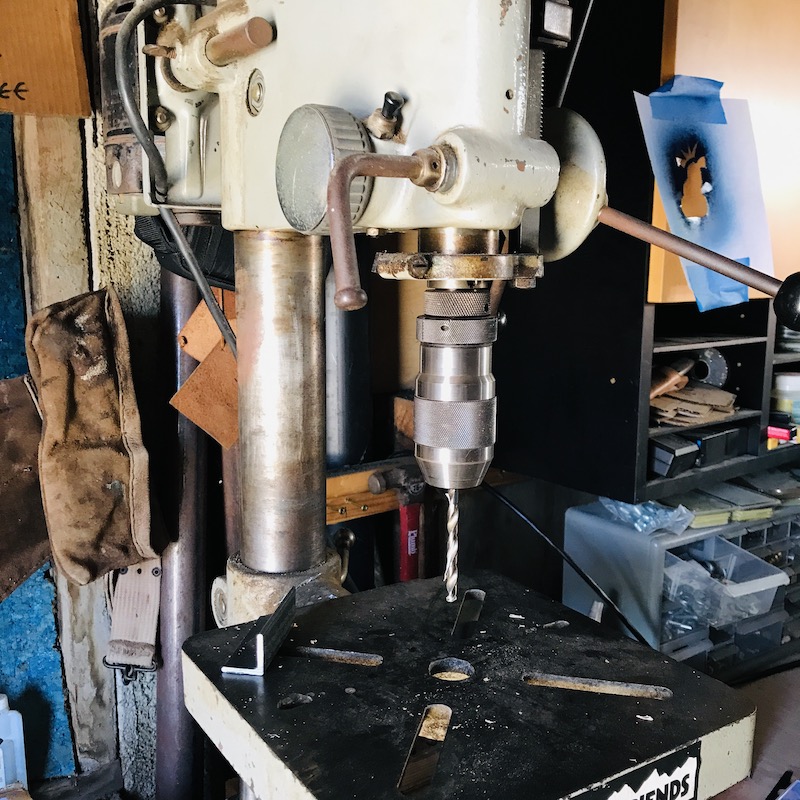
Then I drilled out the holes I'd need for the antenna mounts and the pole mount.
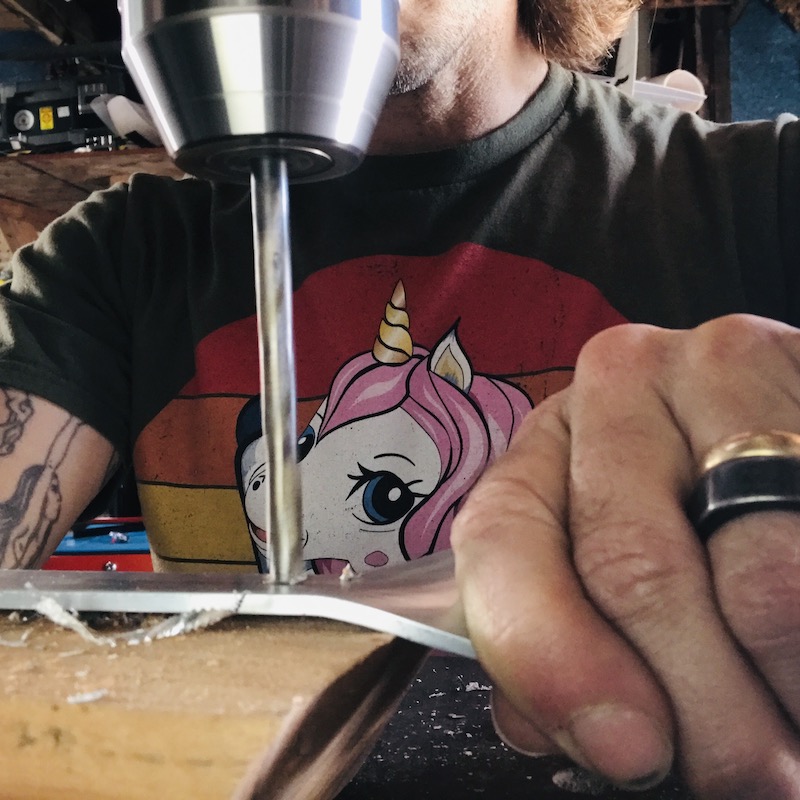
I love that drill press. A random guy gave it to me. I saw it in his garage and commented on how old and rad and heavy duty it was. He said, "That thing's dangerous, I watched my grandfather lose the end of his finger in it. Do you want it?" Yep.
It weighs about as much as I do. I love heavy metal.
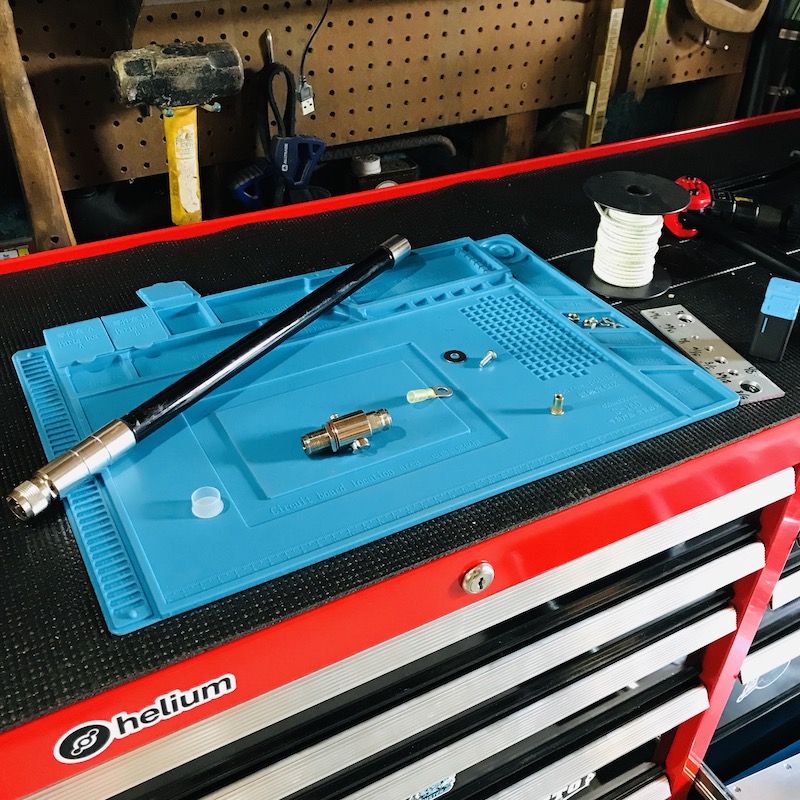
Next, I laid out what I'd need. Antenna, lightning arrestor, grounding wire, easy disconnect terminals, and a rivnut. Aw yeah, rivnuts!
Ok, what's a rivnut?
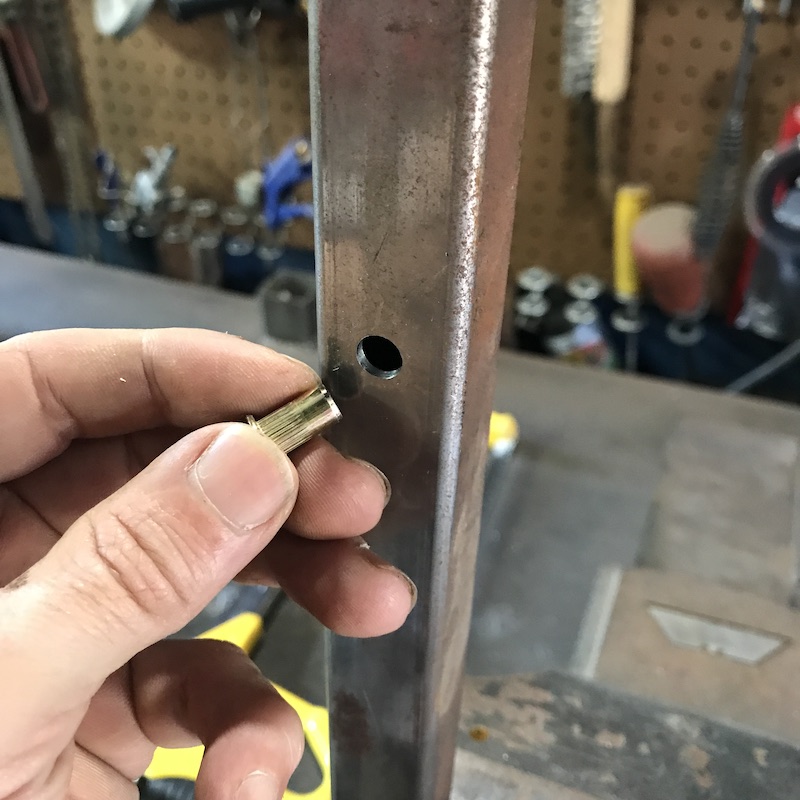
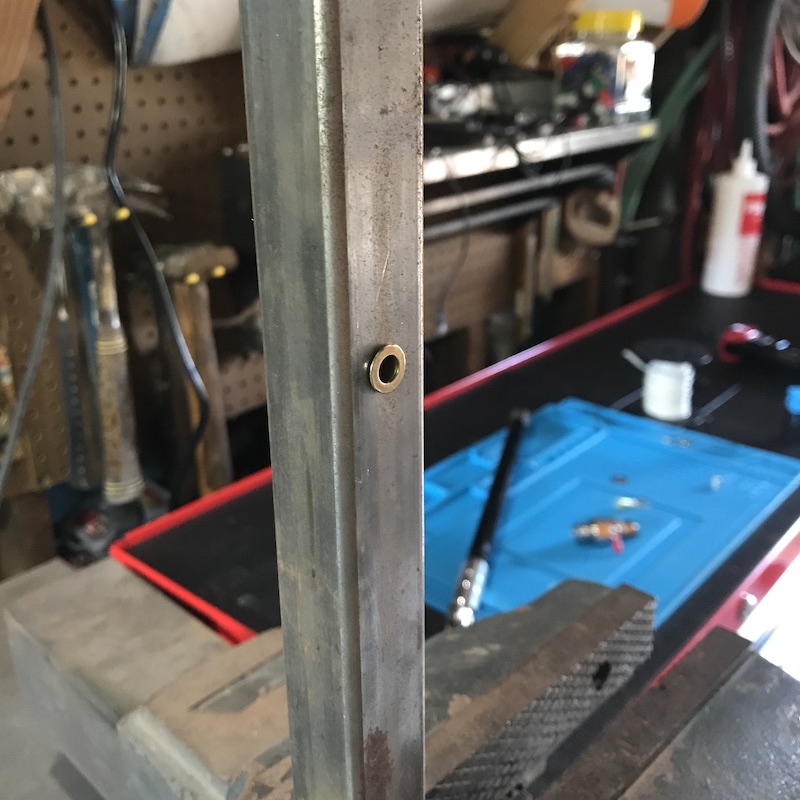
It's a cool little way to add a nut into a thin walled piece of metal. You drill out the hole, screw the nut onto a rivnut tool, insert the sleeve into the hole, then compress the sleeve of the nut, securing it to the wall of the pole.
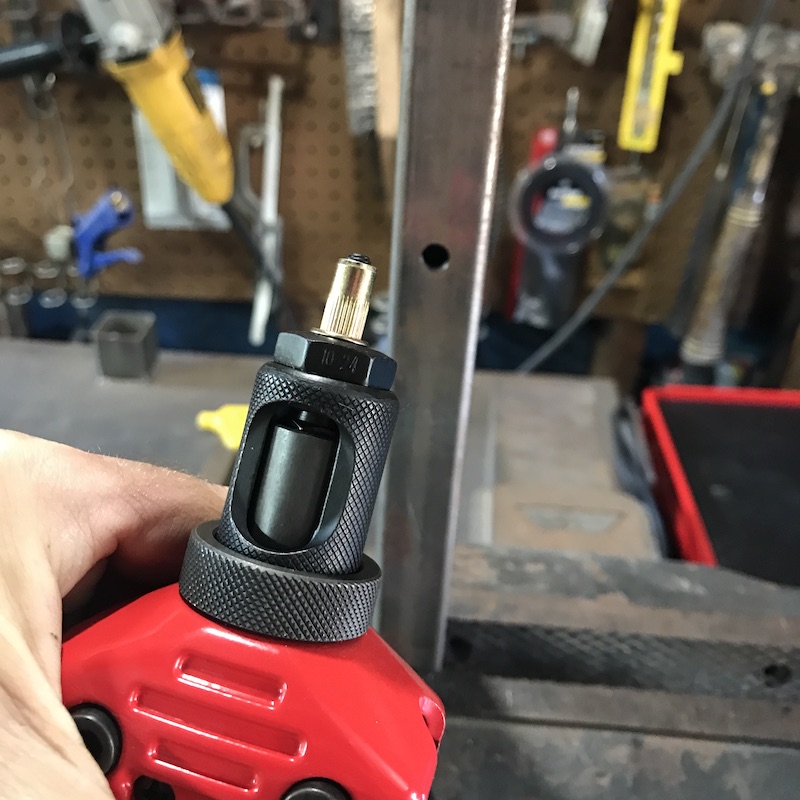
Here's what it looks like. That's ready for a 10-24 bolt, which I happen to have a bunch of.
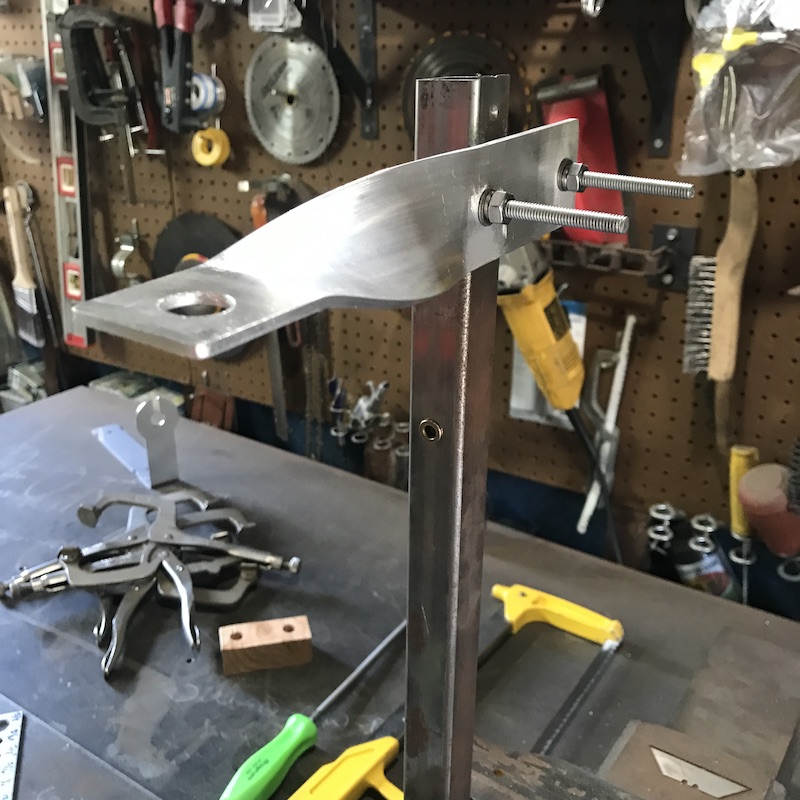
I used a u-bolt to clamp on my demonstration antenna mount.
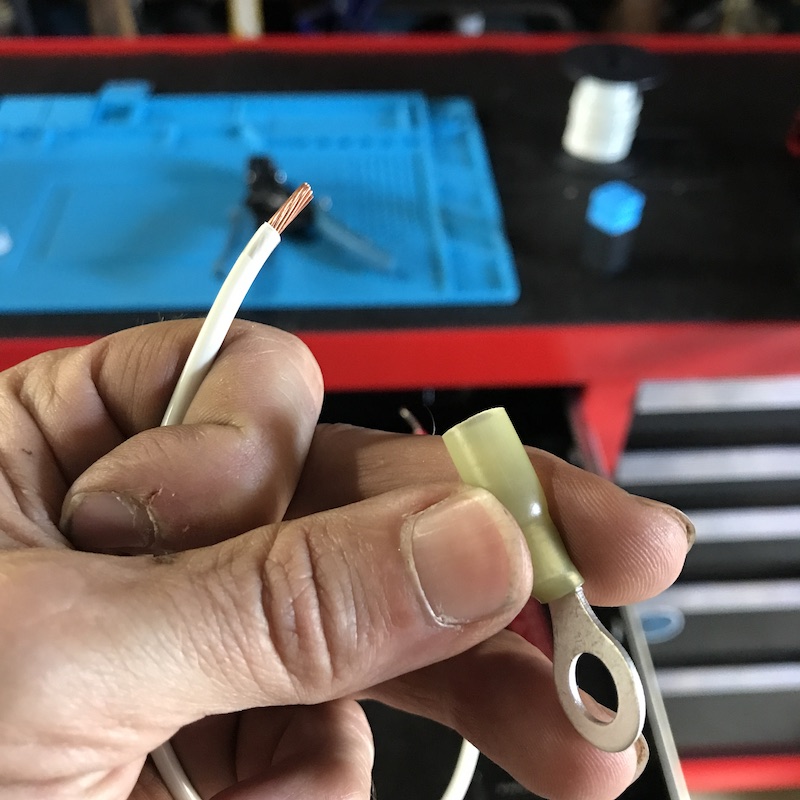
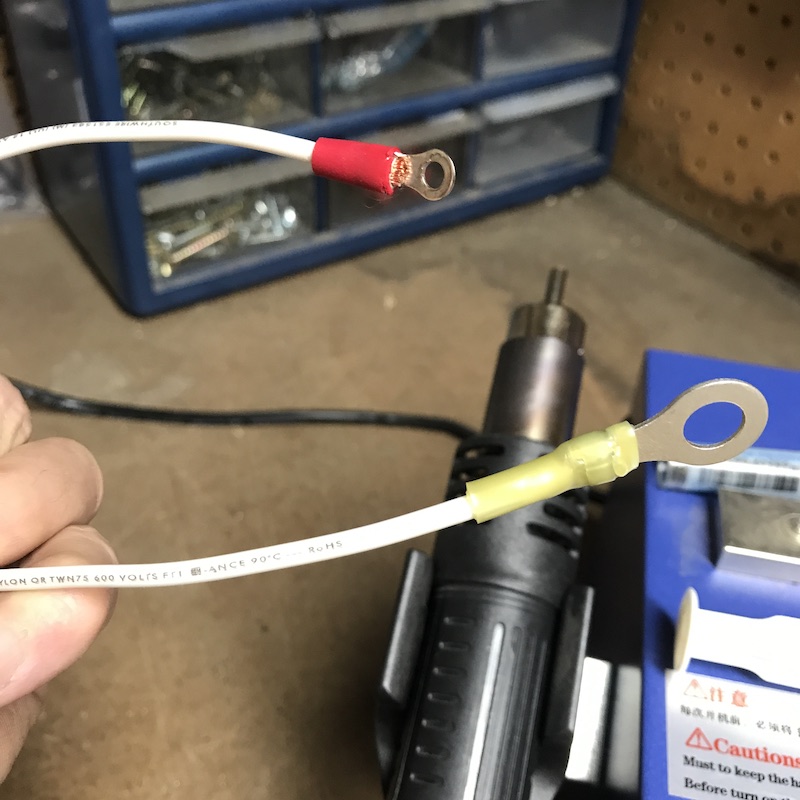
Then I had to make the grounding wire. I used 12 gauge cable for this demo, most specs require 10 or 12 ga. You need to crimp on quick connect terminals to both sides, then seal the heat shrink around 'em. Here's what it looks like with the wire stripped, before I made the connection.
Here's what it looks like once you crimp it.
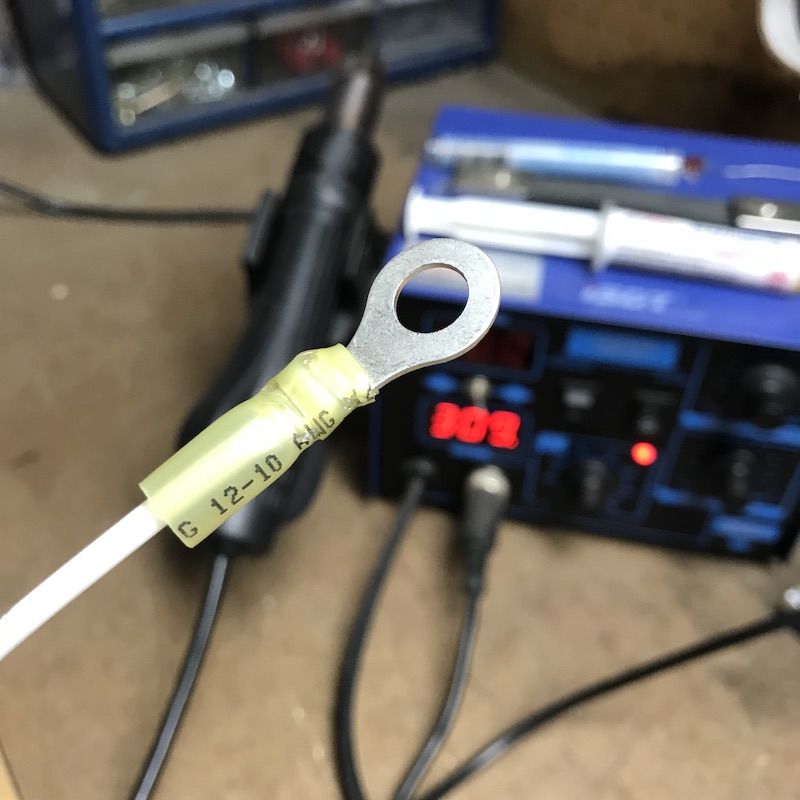
I crimped both sides, used a heat gun (Steinel HL2020E if you must know) to shrink it down all tight and pretty, and I had my grounding wire. You want these to be as short as possible.
All that was left was to connect everything up. Here's what it looks like without a bunch of words pasted in. Yes, I could've made the grounding cable shorter. I just didn't.
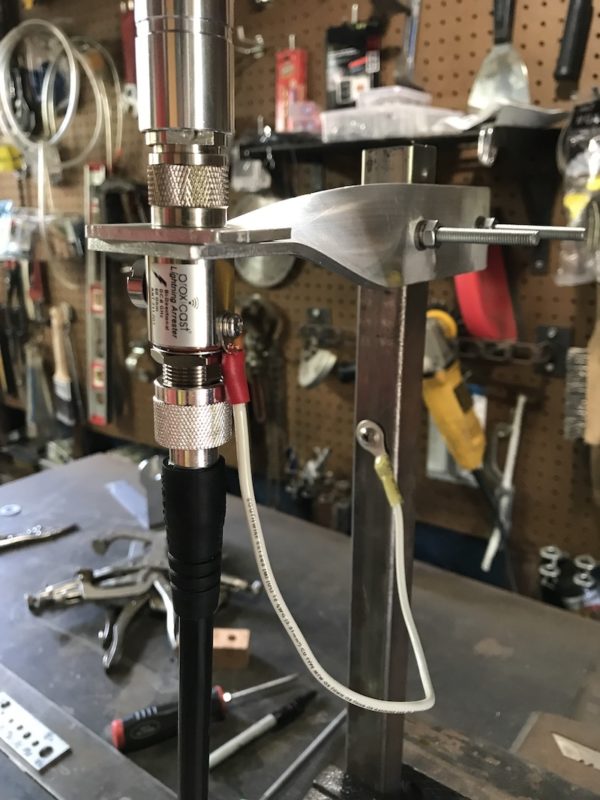
Pretty simple, right?
Oh, and the insertion loss? Let's be mean and call it .5 dB. If you're deploying for a critical application and want to drop $150 on a badass NexTek Surge Guard lightning arrestor with < .1 dB loss, you can do that because every tenth of a dB counts. But....you don't have to.
Ok, that wraps up lightning protectors. You don't need to do any of the building/light fab work I did, you can just screw it into your antenna and use the mount that comes with any decent antenna. It's simple. You got this!
Archived Comments
Larry - 6/8/2021
Hi Nik, would love to buy a couple of your home made brackets that mount to the pole. They look so different and obviously custom made. Nice to have someone in the HNT community explaining the correct way of doing things.
John Diprose - 6/8/2021
Great stuff as always Nik. Can I put the arrestor at the end of the cable near the ground where I will be putting a grounding spike? Or does it have to attach to the antenna. As my antenna will be on my roof and no place to ground up there.
Nik - 6/8/2021
Right on Larry. You can totally make 'em yourself with a vise and a few clamps. If you'd rather just have me make 'em for you, reach out via the Contact Form for a quote. Thanks again!
Dan Kiel - 6/8/2021
Can you ground it off anything that qualifies that is near by or do you have to ensure it is grounded all the way to your house ground or a newly pounded in ground rod? I've been prepared to run the ground wire all the way down the side of my house, but if I can ground it on something closer, that would be great.
Nik - 6/8/2021
John, shouldn't be a problem to put it lower down the chain.
Nik - 6/8/2021
Hi Dan, there has to be a solid connection all the way to the grounding rod/house ground. Can't just attach it to the nearest metal "thing". :)
John diprose - 6/8/2021
Thanks Nik
Stephen - 6/8/2021
Thanks for the great info Nik. I'm looking to put my antenna at the top of a wooden post (get's me another 4mtr above rooftop, in a very flat area), so how/what/where do I attach the grounding wire coming out of the arrestor? FYI I will be running power cable up the post as well, given the HS plug is only 2-pole (not earthed) could I potentially run a 3 wire cable and use the earthed wire to connect to the arrestor? Thanks in advance, S.
Nik - 6/9/2021
You'll need to run thick metal all the way to the building ground. The wire in a 3 wire isn't thick enough by a long shot.
Gary - 7/10/2021
Hey Nik. I have the lightning arrester and some solid copper 8 awg copper (I know it's probably overkill) this fits in the lightning arrester terminal perfectly! Is that ok that I use bare copper wire and no sheathing? I see you are using braided copper wire I think.l with terminal connectors. I want to run that from the arrester to the terminal clamp I bought to fit my mast. Then from there I was going to run a separate copper wire down to my copper rod and connect it to the grounding clamp there. I was going to go to house ground which is only a few feet away, I just wanted to make it tidier lol. Does this seem right?
Nik - 7/10/2021
You know, I'm not sure. I'd think the sheathing would be pretty important, but I'm not an electrician.
Bruce - 7/11/2021
Hi Nik, Do you know if the lightning arrestors on Amazon are of sufficient quality? Take this for example (https://www.amazon.com/dp/B078NT5M37/ref=cm\_sw\_r\_wa\_apa\_glt\_fabc\_EHQBTXA5T5T5N6GMWNFE?psc=1) They list the same specifications and signal loss as other, more expensive options such as Times Microwave ones.
Nik - 7/11/2021
Hi Bruce, typically you get what you pay for, though that can be offset by paying more for a name brand. I usually go with name brand just to be safe.
Ndu - 8/13/2021
Nik, I have this https://www.timesmicrowave.com/DataSheets/FamilyProducts/LP-GTV.pdf. What do you think about the insertion loss? Is this a suitable arrestor? Thanks!
Nik - 8/13/2021
Just a caveat: I'm not an electrician. :). That looks fine to me.
Aaron Ursulak - 8/16/2021
Finally someone to answer my simple question ... I finally received my HNT miners and antennas . Can I screw my lighting arrestor (with a female end) directly onto my antenna (with a male end), and avoid breaking the run and order two separate cables. or dose the lightning arrestor have to be a certain distance from the antenna? It looks like that is exactly what you are doing and that way I dont have to order a second cable and break the cable run correct? Thanks .
Nik - 8/16/2021
Hi Aaron, yep, that's totally fine to attach the lightning arrestor directly to the antenna.
Aaron Ursulak - 8/16/2021
Your the best thanks! Its tough to find co ax in my area. Looks like ill have to order them all on line custom mae. hey do you know of good place, quick shipping to ALberta Canada that can make up som 440 with N type female end and RP SMR male end at lengths of, 5' 10', 15' 25' and 30'?
Aaron Ursulak - 8/16/2021
Sorry for the type .. looking for some 400 co ax. not "som 440"
Nik - 8/16/2021
Hi Aaron, hmm, not sure of Canadian sources. Might try calling USACoax.com and see if they have Canadian connections.
Aaron Ursulak - 8/16/2021
Thx. That is where Im looking.
Michael - 8/17/2021
Hey Nik, I have an HNTenna 3 dBi antenna (tall, skinny one) and am placing it outside my bedroom window on the 3rd floor of my apartment. I’ve read that a 3 dBi antenna won’t need a lightning arrestor since it’s 1) not strong enough to send too much power back to the hotspot to fry it, and 2) I’m not hoisting the antenna up a pole 20 feet higher than the apartment roof. If that info is inaccurate and a lightning arrestor is needed, is it possible to ground the copper wire to my balcony floor? I won’t have access to dropping a 30 ft wire down the side of the building.
Leon - 8/18/2021
Hi Nik, straight donw the line and to the point post, freakin awesome. Here are some thoughts from days when we used RS485 as communication over long distances in South Africa where lightening was always a challenge. - Arrestor as close as possible to equipent to minimize the exposed wire becoming the next lightening / statis antenna. Any exposed wire has the possibility of receiving and inducing static into the system. - Rather run a new ground wire to a propper Ground pole - if the ground is not good then not even the fancy gasses will stop a static / lightening strike. Its a good idea to have a Ground pole near a rain gutter to keep the ground as moist as possible. - Buy good well known arrestors, its worth it Leon
Nik - 8/18/2021
Hi Mike, well, technically *all* outdoor antennas should have a lightning arrestor. Many don't. I'll probably get sued out of existence for saying it, but I wouldn't worry too much about a small antenna outside your bedroom window.
Nik - 8/18/2021
Right on, thanks Leon!
Michael Johnson - 8/18/2021
Hi Nik, I appreciate the honesty. My biggest concern is making sure my hotspot doesn't get damaged but you seem like an extremely honest guy with a TON of experience so I'll take your word on it. Thanks!
Aaron - 8/18/2021
He’s better off to buy a 5.8 DBI antenna and mount it in his window indoors instead of a weak three outside No grounding required and better range
Octavio - 8/23/2021
Hi Nik, I plan on putting my antenna on the side of my roof (about 20 feet high but at the same height as the roof). Like Mike, do you suggest grounding it since it's not 20ft about the house? Additionally, I have a few power lines near my house that are about 30-50 feet away. Would these create static and possibly damage my miner? Thanks in advance!
Nik - 8/23/2021
Hi Octavio, I wouldn't worry about static from the power lines. Technically you should ground every outdoor antenna. Practically you'll see that many people don't.
Aaron Ursulak - 8/25/2021
Hey Nik I now have 2 or 6 miners installed. I wish I had. Clone to do the installs . Anyhow Ive been asked a couple time now are Bobcat devises safe. What do they emit. Ive heard RF waves are harmful … etc and I can’t really find anything that states they are safe other than they are FCC approved .do you have any links or info uiu can send me. Many thanks Aaron Ursulak
Nik - 8/25/2021
Hi Aaron, yep, check this post over here on RF exposure.
Teodora - 8/25/2021
Hi Nik, it may be a stupid question here but better ask... :) We'll mount our antenna on a 6-storey building and the antenna will be 5 ft above the roof. The grounding of the roof (which is flat) is done with a metal grid that covers the roof. We are thinking about connecting the lightning arrestor to the grid instead of running our own rod all the way to the ground, which obviously is not possible. Just worrying that charge already collected in the grid may go up to the arrestor and damage the equipment. I don't know if this is ? valid concern... What do you think?
Nik - 8/26/2021
Good question. I don't think so, but I'm not an electrician. There shouldn't be any charge collected in the grid; it's grounded, right?
Aaron Ursulak - 8/26/2021
Hey Nik. I need another 10 5.8DBI antennas> I can order them from RAK but delivery is way out ...! Do you know of US supplier? Thanks Aaron Ursulak
Nik - 8/26/2021
Check Parleylabs, it looks like they have 'em in stock.
Ndu - 8/28/2021
Hi Nik, Have you come across other strong research/opinions against connecting the lightning arrestor directly to the antenna like you did? Do you have the arrestors directly connected to the antenna in most of your setups? I ask because I would like to follow best practice once and for all. Thanks.
Nik - 8/28/2021
Hi Ndu, I've heard from a couple folks that you should connect the lightning arrestor closer to the equipment being protected. I have 'em connected directly to my antenna.
Eli - 9/22/2021
Hi Nik, which "NexTek Surge Guard lightning arrestor" would be recommended for an outdoor HNTenna?
Nik - 9/22/2021
Hi Eli, The outdoor HNTenna has an N-type female connector, so you'd want an N-type male on one side of the NexTek, then whatever matches your cable or hotspot on the other.
Brad - 10/4/2021
Nik, I've learned a lot from your site. I appreciate it! My original plan was the mount the lightning arrestors at the base of the antennas and then running the cables back in the house...10', 20', or 30' or whatever the length for the application. However, now I've heard people on the AV and Ham radio forums say that since cables can also build up a static charge (not just coming in from the antenna) then static charge won't necessarily be disappated out that arrestor as you'd want, and it could just as easily go down the cable to the miner and so this is why you should have the arrestor/ground as close as possible to where it enters the house and also as short of a cable as possible to the ground rod. I guess you don't think that is necessary? What I'm worried about is that we THINK and HOPE we're fine with the arrestor at the end of the antenna but we don't KNOW for sure until it's too late and we have damage! These were also recommended to me, which ground the outer sheath but I assume not the inner wire of the cable. I wonder if this could be a good belt and suspenders solution since I've already purchased the cable and arrestors to do it as you said, but these could also dissipate static in the line closer to the building entrance. (Not sure if links are allowed but here it is if so) https://www.solidsignal.com/installation/grounding-supplies?custitemsg\_brand=Times-Microwave-Systems&pricelevel5=0.31to31.97
Nik - 10/4/2021
Hi Brad, That all looks good, and you can definitely put the lightning arrestor closer to the gear side (away from the antenna). I've always used super short antenna cables so a short ground wire hasn't been an option, but it's a fine way to build it. Let me know how it goes with the Solid Signal stuff, looks neat.
Mohammad - 10/21/2021
Thanks! My question is that if doing all grounding process is going to discharge the static electrical energy enough to prevent sparks or still a lightning may hit the antenna. In case of a big hit all the antenna and grounding system will evaporate but I wonder if grounding really prevents such a hit. My house is a one story house and the highest point is 15 ft up. My antenna is 6 ft long. I appreciate if I you advise me on this case. Many thanks!
Nik - 10/21/2021
Hi Mohammed, a lightning arrestor won't actually stop a lightning strike, it'll just discharge static buildup. A direct hit will destroy everything, including the house. :)
Carl - 11/1/2021
If youre deploying an off-grid hotspot is there any need to ground...as in a roof top deployment? Thanks
Nik - 11/1/2021
Yep, still need to give that static charge an easy path to the ground.
Illia - 11/15/2021
Hi Nik, Interesting post. I want to hear your opinion about the setup I am about to create. I have a two-story house with a chimney on top. I plan to install a 20ft flag pole as my mast to raise my miner as high as possible. I will use the original bobcat antenna, but I will be using the lighting arrestor with that. As far as I understand, I will ground the arrestor to the pole, and then I should also ground the pole to my house grounding rod. I am not particularly sure how to connect the pole ground to the grounding rod. My idea was to just drill a couple of holes and feed the ground through. After I would drop the cord down and attach it to the grounding rod. Let me know if I should reconsider. Thanks
Nik - 11/15/2021
That sounds reasonable.
Brett - 11/17/2021
I'd really like one of those bad-ass unicorn shirts!
Nik - 11/17/2021
I think we got 'em for everyone at my other business; you can buy 'em on Amazon. I may have to start doing GK Merch...
James - 12/30/2021
Hey Nik, I see many using Lighting Arresters and suffering from the DB loss since the higher quality is more expensive and the more affordable route is usually the chosen. Can you explain to me why one just couldn't use a HomeDepo grounding clamp (Link Below) and wrap that end around the metal base bottom of your antenna and run your 10 gauge wire from there (No Arrester Needed)? Wouldn't it be more advantageous, there is no DB loss, and the path to less resistance (to ground) is increased due to the increased conduction properties of the clamp. In theory or my mind at least, this should dissipate even static electricity just the same. What do you think? https://www.homedepot.com/p/1-2-1-in-Type-JH-Bronze-Ground-Rod-Clamp-for-8-to-4-AWG-Wire-JH-B1-10/203339353
William - 1/2/2022
Hi Nik, Question about when you ground your outdoor builds. I believe in order to have proper ground it should be an 8-foot pole buried into the ground. Are you able to do this in remote locations or are you using an alternate method of grounding?
Nik - 1/2/2022
Hi William, I generally don't ground my outdoor builds.
Angel - 1/7/2022
I’m Going to be running a outdoor POE set up with a M1 sensecap and outdoor HNTenna, I’ve seen conflicting information about whether to ground. For ease I’d like to not have to ground my set up, I see you mentioned you generally don’t ground your outdoor set ups, so would I be good to run it that way? “Safely”?
Angel - 1/7/2022
Sorry, forgot to add this piece of information. The outdoor sensecap M1 and HNTenna will be a home setup if that makes a difference as far as whether or not I have to ground the set up
Nik - 1/7/2022
Hi Angel, that's not technically "safe" and you should always ground electronics. I generally don't ground my "off grid" setups, which aren't connected to any buildings. The risk depends on what you've got at stake and the likelihood of getting static build up/discharge.
tixorama - 1/15/2022
Hey Nik, I've seen setups where the lightning arrestor is not connected directly to the antenna but further down the cable closer to the miner. Is there a preferred way to do it? Thank you. Mark
Nik - 1/15/2022
Hi Mark, yes, that's the recommended way. I need to update the picture and diagram to reflect that. :)
A Complete Guide on How to Ground Helium Antennas - 7/12/2022
[…] overthinking it, is the best way. Also, some helium antennas come with a lightning arrestor. A lightning arrestor makes a connection between the antenna cable and the antenna. With this connection, it allows radio […]
John - 11/15/2024
Nice -- do you ever consider galvanic reactions when you build? I've been trying to factor this in with my builds... here in Japan they sell little separators (I think they are Nylon) that can be popped in between metals with different hardness... Aluminum can be a bad one for this. Nice of you to give your friend a nice Antenna in exchange, and thanks again for info.
Nik - 11/15/2024
Hey John, I remember wondering about it early on, but my hotspots that are still out in the wild haven't had any issues with it. Might be something way more important in other environments, but I haven't had issues with it yet.