13 posts tagged with "helium tools"

View All Tags

How To Read An Antenna Chart

· 17 min read
Nik
Site Owner

Helium is a gateway into the world of RF, or radio frequency. While the easiest thing to do when you get your hotspot is just plug it in and set it in a window, most of the time you'll earn far more if you optimize a bit. Most of those optimizations are focused on improving the RF signal your hotspot can beacon (also called "transmitting") as well as improving the ability of your hotspot to witness (also called "receiving".)

I'll assume you've read the piece on antennas I wrote that covers some basics. Now, let's do a deeper dive into antennas and radiation patterns.

Let's start with a zero gain omni antenna. An omni directional antenna with zero gain will theoretically radiate RF energy in a perfect globe pattern all around it. Now, that's perfection. In reality, most low gain (say, 4 dBi or lower) antennas will do a pretty good job, but will have gaps directly above and below the antenna.

The way we "see" an antenna's RF pattern is by visualizing what it looks like from the top and the side.

Here's a lower gain antenna's RF pattern.
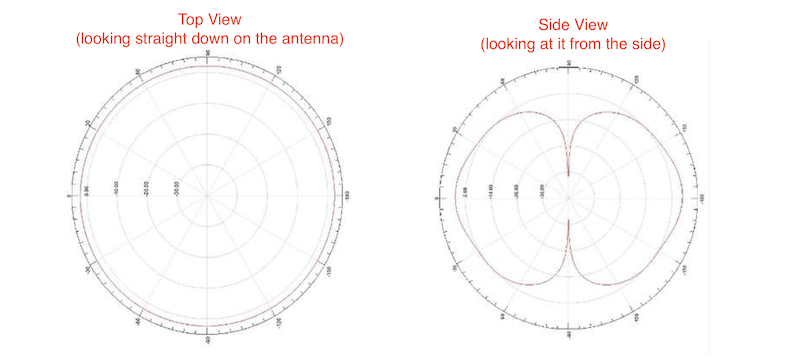
See how it radiates out evenly in every direction to the side, but directly above and below it there are gaps in the RF emitted? That's pretty typical for an omni directional antenna.

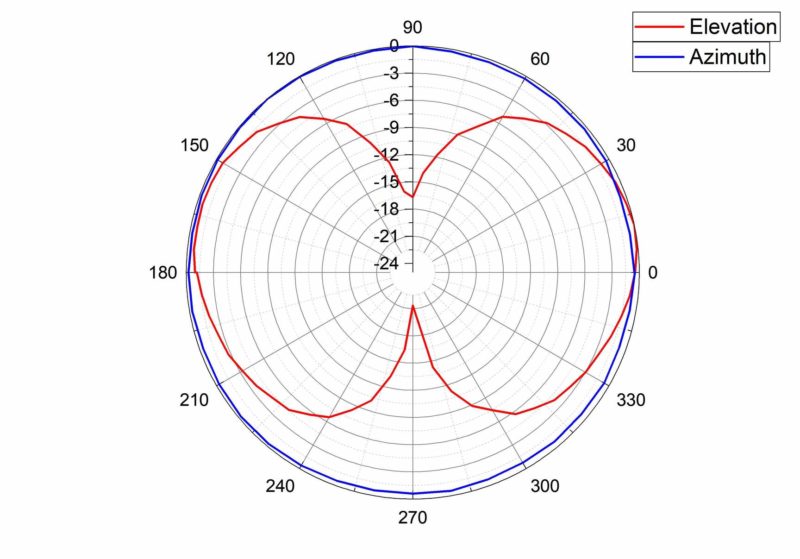
Here's another example from the antenna I use on most of my installs, the HNTenna. MP Antenna (the manufacturer of the HNTenna), puts both patterns together. The Elevation is what it looks like when you're seeing the antenna from the side (red line) and the Azimuth is what it looks like from the top down (blue line).
All manufacturer's will have a radiation pattern for their antenna, and most will share it with you. That pattern can change at different frequencies on the same antenna. Here's an example of a 3.0dBi L-Com at different frequencies.
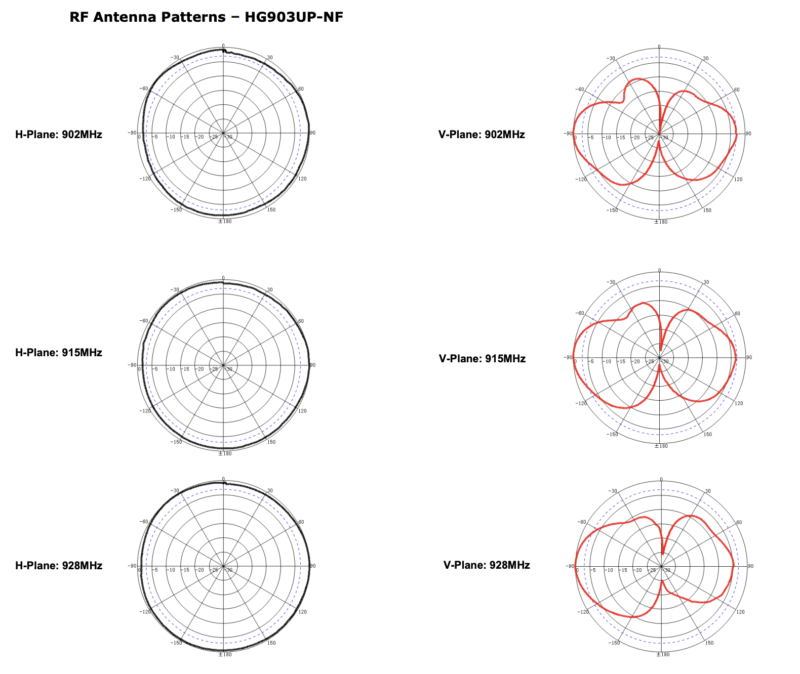
Now, all the antennas so far look pretty similar even at different frequencies, right? They're all "omni directional" antennas, meaning they're supposed to radiate antenna in all (omni) directions. What does it look like when you get a sector (also called a directional) antenna? Check this out!
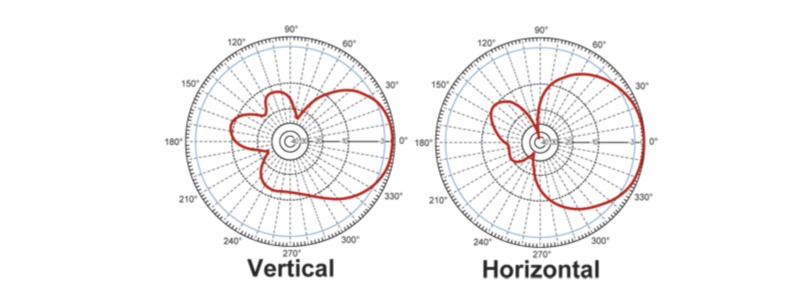
This antenna was designed to radiate most of it's energy in a vertical beamwidth of 60 degrees and a horizontal beamwidth of 70 degrees. This is the antenna you'd use if you wanted to punch through a thick brush line with a bunch of Hotspots on the other side of it and nothing behind you.


Antenna Polarization

Next up is antenna polarization. This hasn't gotten much press, mostly because damn near every antenna you can buy is polarized *vertically*. In simple terms, that means the RF waves it emit go up and down. A *horizontally* polarized antenna will emit RF waves that go side to side.
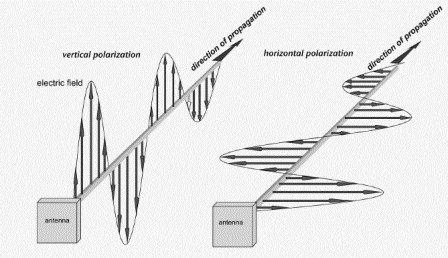
Why is that important? Well, if a vertically polarized antenna and a horizontally polarized antenna are trying to beacon or witness each other, they won't be able to, even if they're on the same frequency! That's because the "up and down" waves of a VP antenna won't intersect with the "side to side" waves of an HP antenna.

"OK Nik, so why should I care about this? If most of the antennas out there are vertically polarized, I'm fine, right?" Sort of.

See, when that radio energy hits an obstacle, it usually bounces off *and changes orientation*. That means a vertically polarized wave can now be a horizontally polarized one. If your hotspot is "listening" on a vertically polarized antenna, it won't witness RF signals that are coming in on the horizontal plane, unless...

Here's the last twist for ya: You can get a "multi" polarized antenna. This allows you to both transmit and receive multiple signal orientations. That comes at a cost of a slight reduction in power as the signal is radiated out on multiple planes, BUT...I've used a multi-polarized antenna and made 170km witnesses, so it's not an issue in the real world application.

I'll finish off with a quick way to think about what antenna you should buy.

Indoor antenna -- Use the stock antenna. Get it up as high in your building as possible and next to a window. If you MUST buy an indoor antenna, pick up the HNTenna indoor version.

Outdoor antenna, urban area, limited clear lines of sight -- You've got a few options.

HNTenna Outdoor - This is a multi-polarized antenna and what I recommend for most placements.

McGill 3 dBi - A great omni pattern antenna that'll do well in most urban deployments.

McGill 6 dBi - Want to try the middle range, as recommended in this video?

Outdoor antenna - Has Facebook/Reddit/Twitter convinced you that high gain is the best bet? If you're desperate for a "high gain" antenna, get a 9 dBi from McGill.

Brush Penetrator -- Ok, you really want this? Keep in mind, this antenna is almost never the right choice. But since you asked for it, here it is.

That's it! Now you know a bunch more about antenna radiation patterns and how to choose the right one for you. Rock on!

Archived Comments

Greg - 6/4/2021

Amazing article again! Is there anything like the HNTenna for the 868 band?


Nik - 6/4/2021

I'll double check with Adam at MP Antenna (the makers of the HNTenna).


Greg - 6/4/2021

Don't worry! I emailed and he said, in the future hopefully!


Travis - 6/4/2021

Nik - badass as usual my man.


Vis - 6/9/2021

Hi Nik, Is there a 5.8dbi antenna with multi polarisation or 3dbi will be good even for the suburbs where other hotspots are not close


Nik - 6/9/2021

Vis, MP Antenna is working on a 5.8 version but it'll be a while. They're current antenna will be fine for suburban deployments, just (like very antenna) get it as high as you can.


John - 6/22/2021

Hey, Quick question, if you already get 25 witnesses on beacon and as high as you can get antenna do different antennas affect witnessing or would that be the same? For example with a HNTenna get more theoretical witness events than a 5.8 dbi antenna in an urban setting? Just never understood that part. Thanks for the great information!


Nik - 6/22/2021

Hi John, good question. Depending on how many hotspots you have around you, you may see a *different* set of 25 with each beacon. An HNTenna is likely to pick up different witnesses due to the multi-polar receive. I wouldn't expect miracles, but every small improvement counts.


JB - 6/26/2021

im currently using a Rak 5.8 in the most optimized way I can given my situation. It appears I'm just on the cusp of a connection w/my neighbor, as we connect, but only rarely. They're 2.7 miles away. Do you think the 3dbi multi polar might help or should I wait for the 5.8 to be released. Btw, I've tried an 8dbi Rak and get nothing as I'm in the foothills


Simon Uxbridge - 6/27/2021

Hi Nik, I have a location halfway up the side of a mountain (2000ft up), with super long views of civilization and will be using the L-Com flat panel which as you say has a vertical beamwidth of 60, and which you advise to aim carefully. I am looking for points on roughly how to aim it. Would you think aiming the centre of the panel at the horizon would be too high? CIvilisation starts about 1 mile away from me


Nik - 6/27/2021

I'd aim it a little below the horizon, but check the pattern the mrf provides.


Nik - 6/27/2021

Check Line of Sight, that's probably more of an issue than antenna gain.


What To Look For In A Helium Antenna - One Man's Search - 7/5/2021

[…] An anten­na for Heli­um should be either ver­ti­cal­ly polar­ized or mul­ti-polar­ized. I’ve writ­ten about anten­na polar­iza­tion in this post on anten­na radi­a­tion pat­terns. […]


Sergio - 8/14/2021

Hi Nik, If you don’t have direct line of sight due to topography, will the hntenna help? Currently using the 6dbi from McGill but that doesn’t work. Currently can see witnesses far away, but not in the city nearby. https://ibb.co/VJJxb1Q Thanks! Thanks!


Nik - 8/14/2021

It can, the multi-polarization can help you pick up more signals.


Simon - 9/2/2021

Hi Nik I’m looking at a picture of an elevation radiation pattern, almost identical to the HNTenna 915 one above. (I can’t add a picture to this comment.) However in this picture the 0 degree point is rotated 90 degrees - so that it lines up with the “dip” in the pattern. Could this antenna: (1) Simply be the same as the HNTenna diagram (and I’m just overthinking it?) (2) Be totally different? (3) Or actually be an error in production of the diagram - so in effect the same? I hope I have explained this clearly? Many thanks. Cheers Simon


Nik - 9/2/2021

Interesting, what's the antenna?


Simon - 9/2/2021

Here you go Nik https://www.arcantenna.com/products/laird-antnex-tra9023np-m2m-902-928-mhz-ism-white-low-profile-omni-antenna Data sheet is halfway down the page. Very very similar - slightly smaller & lighter & cost effective. What do you think? Simon


Nik - 9/3/2021

First responder orgs love those because they're cheap and they "work", though they're definitely not the same antenna as the HNTenna. Remember, antennas don't really matter that much. Try this one, see if it works for you. For me the cost isn't a concern and I'd rather have the best on the market, but it *doesn't make a huge difference.*


Simon - 9/3/2021

Understood Nik - Many thanks


Chris - 9/7/2021

Hi Nik, Thanks for the more detailed inside of antennas. I was wondering what to look for in the specs of an antenna to know if it will be suitable for a Helium Hotspot. Does it specifically have to mention/support the LoRa / IOT /Helium technique or will any antenna that support the 868Mhz freq (I live in the Netherlands) work? For example https://poynting.tech/antennas/epnt-1/ or https://poynting.tech/antennas/xpol-1-5g/ Chris


HNTenna - Is it really the best Helium Antenna? | CoinPensation - 9/7/2021

[…] to Gristleking, a vertical-polarized antenna cannot listen to a horizontal-polarized antenna and vice versa. Even […]


Nik - 9/7/2021

Doesn't have to mention LoRa/IoT/Helium. That's a huge band the first one is listening on though, and the middle is definitely not 868 so it's probably not very efficient for what you're doing. 617 – 3800 MHz, whew!


Chris - 9/8/2021

I have seen a hotspot nearby having a Poynting antenna in it setup.It’s behind a window on the first floor with a LongAP hotspot. It has a beaconing average of 800-900 times (7d avg) and does 2-3+HNT per day. I was not sure if the poynting antenna was used for the miner or maybe a LTE router/modem. If used for the hotspot the MiMo technique seems help picknick up a lot of signals.


Nik - 9/8/2021

Interesting, I'll check out the Poynting. What's the hotspot name? Transmitting 8-900 beacons in 7 days is way over the top, you sure that's not witnessed beacons?


jeff - 9/16/2021

Hi, not much info about Hntenna , you ordered, all is fine ? with new POC i think this antenna might be a good option, a bit scared to order, I would appreciate it that you confirm if they are legit? thanks


Nik - 9/16/2021

Hi Jeff, I've ordered and deployed multiple HNTennas. I think they're the best on the market, and an excellent option for most hotspots deployments. High quality, made in Ohio, I've been to their manufacturing plant and met the staff.


Brad - 10/5/2021

Hey Nik, Any idea how a standard vertically polarized antenna would function if you mounted it at a 45 degree angle to the ground? Would it then function as a multipolarized antenna since the waves would be transmitting and receiving (in theory) partially both vertical and horizontal waves and everything in between? I'm sure that as an antenna's RF is bouncing around the world it's not purely vertical even if it's coming from a vertically mounted antenna, and as you mentioned, it seems that in the real world barring your antenna being in a very flat environment, it seems that RF would be bouncing and bending all over the place the further it got from the antenna and thus would be able to be picked up by an antenna mounted at 45 degrees. Also any idea how ground planes affect a vertically polarized antenna? There's a guy on reddit talking about how he mounted his 4dbi bobcat antenna on a bread pan and it increased his earnings and other people said they tried it and it increased theirs too. I wonder if a ground plane is making the vertical waves at least partially multipolar and thus allowing these antennas to perform better?


Nik - 10/6/2021

Hi Brad, it would probably function worse. Multipolarization is about multiple angles. For the Bobcat, testing in an RF chamber has shown that a metal plate at the bottom improves antenna performance.


Mike - 10/17/2021

Great info on the patterns. I have 2 situations I’m where I’m considering the HNTenna and I could use some advice on. 1. Prairie town, I have the high side about 60’ higher in elevation than the rest. 7-9KM to the furthest hotspots. Maybe 60-70 in the area and I witness about 30 with a Rak 5.8 on the peak of my house - 500 yards from me sits a giant brick school though. 3dbi Outdoor Hntenna going to provide any benefit? 2. Host location lower plane of the same town but restricted to indoor only with some line of sight challenges and using a Bobcat stock 4db - Hntenna indoor 3dbi claims it’s good at overcoming some of these challenges - thoughts? Have no issues spending the $ to find out but McGill is also in my considerations.. Thanks, Mike


Nik - 10/17/2021

Hi Mike, Always hard to say that one antenna will always do super well. I'm putting HNTennas up even on my mountain installs now. I don't think you'll see a huge improvement over the Rak, though you may see a slight one. The HNTenna indoor is supposed to be excellent, but I haven't installed it indoors. I've seen it work well outdoors. You won't go wrong with any of those antennas listed.


Evangelos - 11/14/2021

Hi Nik, Trying to understand if a directional antenna is beneficial over a omni-directional for a situation where the witnesses are only on one side (180 degrees of hex). I would think an 8dBi directional antenna would reach as far as a 8dBi omni-directional antenna but for only a few degrees. Is this the case or will the directional antenna see further?


Nik - 11/14/2021

Depends on where you are. In the US there's not a huge advantage with directionals. In the EU it may make more of a difference, all because of how much more dBm the US hotspots push out.


Jim Moran - 11/21/2021

I'm wondering... If I mount an antenna on my roof near the peak, does it make a difference if only the top of the antenna is above the Ridgeline, or should the full length of the antenna be above the ridgeline? Our HOA doesn't allow mounting an antenna on the roof, but if I mount it with only the tip above the ridgeline, I might be able to get away with it. I ask because I don't know if the antenna sends/receives only from the tip or the full length. I've tried reading everything on your site but cannot find information concerning the tip of the antenna vs. the length of the antenna. Thanks in advance if you choose to answer.


Nik - 11/21/2021

Full length. Hit 'em with OTARD.


Lukasz - 11/25/2021

Hey Nik, Question for ya. I've got the choice of mounting an antenna out my window, 3rd story townhouse so approx 9 to 10 meters high mounting point, that faces towards the majority of Hotspots or placing it in the attic space, approx 2 to 3 meters higher than out the window. Not possible to mount on roof due to strata. Suburban area with a not so bad line of sight other than a giant church directly across the street. Any recommendation as to which mounting point and whether a 3dbi or 6dbi would be best?


Nik - 11/25/2021

I'd go with a 3 dBi outside, but I'd also test it. :)


Robert - 1/15/2022

What panel antenna are you using on the pictures? I seen many pictures that showcase a panel antenna. Thanks


Nik - 1/15/2022

Hi Robert, I've used both 9 and 13 dBi antennas in various test deployments. I have one 9 dBi panel left that I just haven't replaced because I haven't made the time to drive over to it.


Mike - 2/4/2022

Hey Nik, 2 questions. I currently have a 12 foot lmr 400 attached to a 8dbi antenna. If I wanted to go 30 feet high with lmr 400 and stick with 8dbis worth of signal do I go with a 10dbi because of the signal loss? Also a miner just popped up in my hex :( he is still syncing, my rewards are already tanking is there anything I can do or just make my antenna set up significantly better? Thank you!


Nik - 2/4/2022

Nah, don't worry about offsetting with an 8 dBi and only 30' of LMR400. Enter the loss (about 1.4 dB) and let 'er rip. Nothing you can do about other miners in your hex (outside of filling in surrounding hexes to increase to density_max OR moving.


Mike - 2/4/2022

Roger that! Thank you for the fast response Nik!!!


Joe Gama - 12/29/2023

Hi, Your link to the multi-polarized antenna info is no longer valid... Would you, please, post it elsewhere? I'm dying to find out more about it!


Nik - 12/29/2023

Hey Joe, it was made by MP Antenna, called the HNTenna. You can probably find 'em on eBay.


Learn How To Use The Helium Network

· 22 min read
Nik
Site Owner

While many of you are hammer and tongs at the game of deploying hotspots, the real opportunity is beginning to shift from *building* the network to *using* the network.

One of the best ways to learn something is to do it. Let me show you how, for about $40, you can add your first sensor to the network and visualize the data.

Before we get there, let's think about why this is important, and how knowing how to do this will give you a competitive edge. This'll go into strategy and theory plus my own predictions, so if you just want to skip theory and get started, jump here.

Strategy and Theory - A New Network

Helium is participating in a movement that is the single largest jump in human evolution for the past 10,000 years or so. If you would wind back in time 10,000 years to the pre-agricultural era and talk to a hunter-gatherer, the information they knew about the world would melt (or at least temporarily re-form) your brain.

From odd aspects of sensing the world, like ocean navigators dipping their scrotum into the sea to feel very slight water temperature differences that indicated what current or part of the world they were in, to Native Americans who knew where the animal they were going to hunt and kill that day was well before they left camp, humans had a highly developed internal view of the world. This was based on paying attention to senses so finely tuned as to be unbelievable today.

That view is almost entirely lost, and any individual human will probably never experience it again. We will experience something even richer.

With the help of edge computing, a wide deployment of sensors and sensor types, and the burgeoning ability to both visualize and use data, we humans are beginning to re-understand our world. Helium is a part of this.

When you deploy a Helium hotspot, you're probably aiming to maximize your HNT earnings. That's cool, so am I, and on top of that I'd love to help you with it. Still, the thing you may not be thinking about is what's beyond the HNT earnings. What are the opportunities that are popping into existence just by you and a few thousand others building our own network that moves data from invisible to visible?

The simplest explanation is that by increasing the "data density" of a business, then by showing them how to use that extra data, you give them a valuable competitive edge. In some cases that edge will save them money. In some cases it will make them money.

This data density is the "new and improved" version of how we humans sense the world. As a quick (and non-monetary) example, imagine the hunter-gatherer from 10,000 years ago. She knew where to go that day to find the best food because of her individual sensory connection to the weather and season, but she couldn't really share that knowledge with you, other than to tell you where to go.

If you deploy a weather station network of 20 units over, say a few thousand acres, you will have created a far denser sensor network than any standard weather station deployment, and ANYONE IN THE WORLD can have instant access to that data. If you decide to help people visualize that data, now you have added tremendous value that is available to anyone who wants it. Maybe you charge for that data. Maybe you don't. Maybe you share it in a way that other experts can help you refine your understanding further. Whatever you do with a sensor network like that, you are contributing to elevating our human understanding of the world, and that's pretty damn cool.

Now, you can apply this data density idea any where you can imagine, so start imagining.

Is it useful for the local trucking company (or an Amazon DSP) to know where their vehicles are at 12 second intervals? Is it useful for your local restaurant to know the inventory levels in an off-site kitchen, and for every other company who shares that off-site location to also know their inventory levels based on weight-plate sensors?

Will FedEx see a use for tracking individual packages, or pallets, or trucks, or airplanes? Would a supplement company benefit from tracking the provenance of it's supplies, so you know the high-end collagen you bought actually came from animals humanely treated, and if you wanted to you could track from cow to coffee? You ARE putting collagen in your coffee, right? Wait, that's another article.

How about your local government? San Diego sure could benefit from knowing when wildfires were starting way before they get reported by human senses. Deploying a network of air quality sensors might save BILLIONS of dollars if we can stop a wildfire when it's only covering ½ an acre.

When it comes to deploying sensors, the only limit to creating and using data density is your imagination

So, how do you go about adding to this data density?

Let's get started!

Here's a broad overview of how the whole thing works:

  • Buy a sensor
  • Sign up for a Helium Console account
  • Provision your sensor (this just means you claim ownership of it digitally, so that you're the one controlling the data flow)
  • Connect that sensor to some kind of data visualization platform
  • Deploy the sensor

Step 1: Buying a Sensor

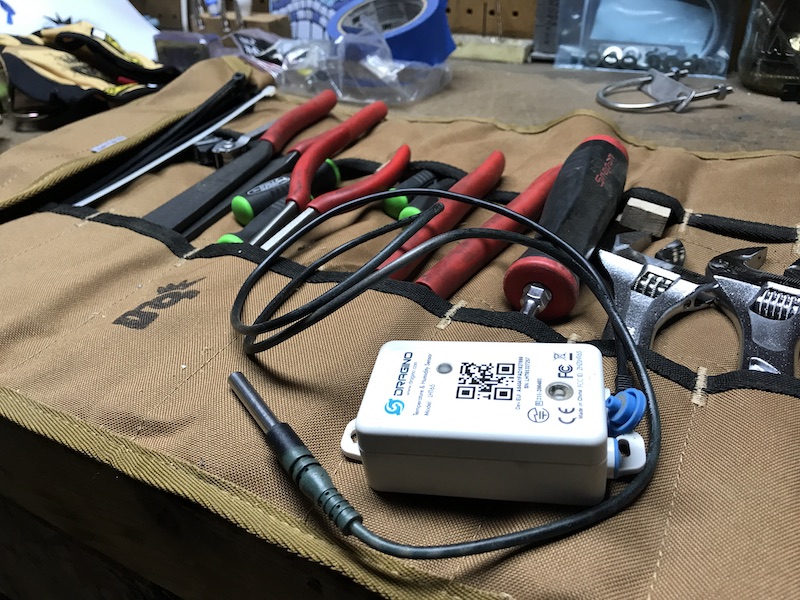
I suggest starting with something simple and cheap. I've deployed a bunch of the Dragino LHT-65 temperature and humidity monitors. I use them to act as a double-check on monitoring whether or not a hotspot is up. They're usually under $50 with shipping and don't use much data. Do NOT throw away the box with the DEV EUI sticker on it. You'll want that info. We'll see a quick tip to see a long list of sensors in the next step, Provisioning.

Step 2: Provisioning the Sensor

You'll need to set up a Helium Console account. Helium has an excellent set of instructions on their site for how to do that, head over there and follow the steps to get yours going. Helium has also done a great job of walking you through adding a specific device.

Since you already bought the LHT-65, we might as well follow the steps for that one, here. Yes, typing in the DEV EUI, APP EUI, and APP KEY is a PITA. The only shortcut is using the QR code on the device to give you the DEV EUI, which you can then copy/paste.

Ok, now that you've got a sensor, a Console account, and you've provisioned the sensor, you'll need to activate the sensor. In this case, that means you push the only button on the device for at least 3 seconds. Yeah, it's that easy. Here's the manual if you want to dive in deeper. It may take a few minutes for it to show up in Console. I recommend getting the LHT-65 outside and within direct Line of Sight to your nearest hotspot just to ensure this first process goes smoothly.

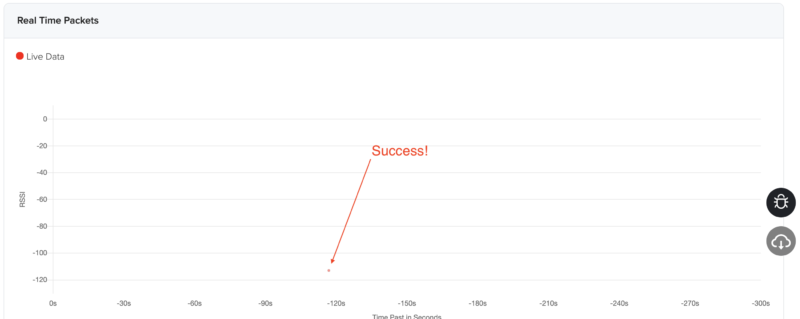
You can watch as nearby hotspots pick it up. Scroll down to the Event Log, open up an Event, then click on Hotspots. That's the hotspot that's "hearing" your device.

Now let's talk about integration with data visualization platforms.

Step 3: Connect & Visualize

As you've probably seen after following those steps, Helium Console is not built for the average person to just look at and visualize data.

For that, you'll need to connect your Console account to another platform. If you want the easiest version, just follow along with Helium's LHT65 instructions and use myDevices Cayenne. It's free and easy.

You can use other tools to visualize the data as well. From your Helium Console window, click on the Integrations menu on the left side and then look for all the pre-built integrations. Let's try Datacake.

Head over to the Datacake website and set up an account. Once you've got that, go back to Helium Console and look for Integrations on the left menu. Click on that, then choose Datacake. There's a full set of instructions on how to do this, so at the risk of sending you to the Helium site, you should go check those out.

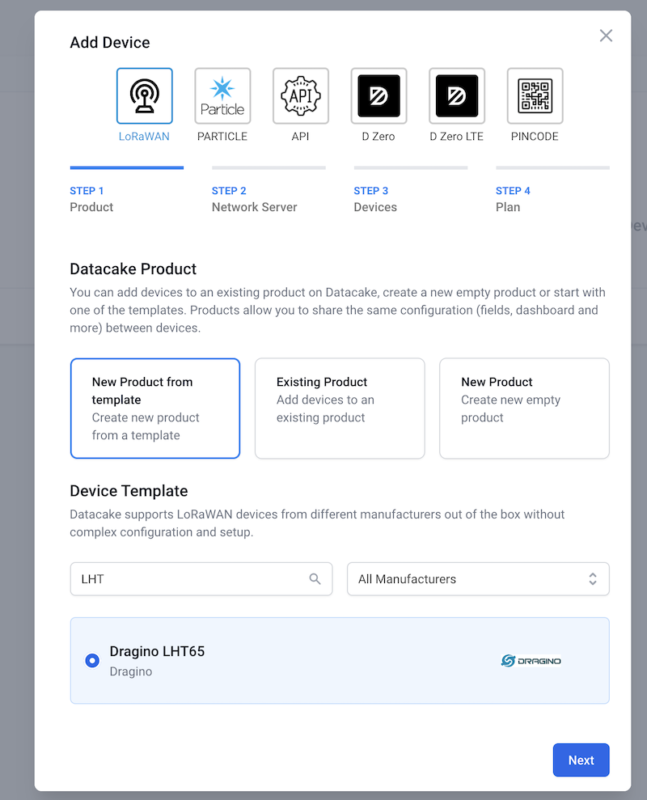
Ok, the next step is confusing. With the LHT65 provisioned in console, you have to tell Datacake AND Console what you've done. In Datacake, look for the blue Add Device button, then choose LoRaWAN --> New Product from template-->then search for LHT and click on the Dragino LHT65 radio button. Like this:

Next they'll ask you to choose the Network Server you want to connect. Look for Helium, then click next.

Now you'll need to put the DEV EUI in. Hot tip: Use copy/paste to pull it over from your Console account. It will look different than the DEV EUI you've typed in, don't worry. Just copy/paste. Trust me on this one.

For this first device, choose the Free plan and then connect away. That's it.

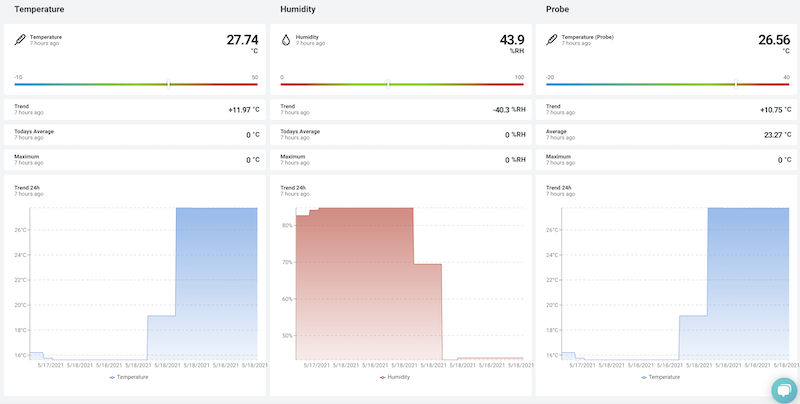
I've found that it usually takes a while to start actually SEEING the data. Be patient. It'll come.

Now the fun part starts: Deploy the sensor! A sensor is just one more tool in your toolbox as you help build this new world of IoT interconnectivity.

How will you use data to change your world?

Get 'em!

Archived Comments

Cristian H - 5/20/2021

Hi Nik, thanks for always sharing great content with the Helium community, I really enjoyed this post. In theory any LoraWan sensor is compatible with Helium, as far as I understand. But, is there anything in particular that I should look for other than the 915 (US) frequency band? Thanks!


Nik - 5/20/2021

I don't think so. Still the Wild West a bit, but 915 is my north star for now. :)


Gary Boudrie - 5/24/2021

Hello Nick, I am just getting started and waiting on my FreedomFi hotspot for delivery. My question, related to to question above, do the current models being or getting ready to be shipped come in at 915 default, or is this something you need to state and pay extra for in said configuration and components? One more quick question, I have a second hotspot on order also from Helium and FreedomFi, should I cancel the second hotspot and just put my money to better use in the system on other components? Thank you, Gary


Nik - 5/24/2021

Hi Gary, not sure about the FreedomFi, none of those have shipped yet and don't look like they will for a while. Should be pretty straightforward re. 915. As far as a 2nd FreedomFi hotspot, I've seen those slots on the waiting list are selling for a boatload on eBay. Tough call.


Ian c - 6/2/2021

Hi Nick, I have enjoyed your projects with the helium network. I live in the north bay area, and I have access to a mountain top. I would like to pick your brain on your mountain project deployment with the helium network, I'm currently following your setup as far as I can tell from your videos.


CHRISTOPHER FOOTE - 6/9/2021

Hi Nik; thank you for the great content. Im awating 2 of the bobcat miners that i have ordered and I have been thinking about how it is not enough for me to just put up the miners, but that the real longevity and acceptance will be centered on Using the network/finding ways to show potential users how they can use it as well! the temp/humidity sensor is something that I will buy as a use case scenario in order to show people the potential. I live in a small town, and most of my "neighbors" would be better served if I could show them a way to use it. We have a lot of people who are constantly "losing" their pets. I have been thinking that if i could find a device that they could attach to their pets collars, that would help them find their kitties and doggies, then I would be better able to promote the network as well as find volunteers to host my miners. Do you know of an application that is on the market that would meet this requirement? thanks for your help and for sharing your knowledge!!! chris.


Nik - 6/9/2021

Hi Chris, There's nothing super small and simple *yet*, but it's coming. Def. keep an eye out for new sensors. I'll write more about the ones I'm working on bringing online once I've got 'em up and running. You're def on the right track though, keep learning & exploring!


Greg - 7/12/2021

Another brilliant article. Definetely going to purchase a couple of the LHT65 units. Do you have any experience with the LSN50v2-S31 — LoRaWAN Temperature & Humidity Sensor? While larger, its only £15 more expensive but seems like it could alert you if your hotspot was in danger as it claims to have instant mode. Thanks again for directing me here!


Nik - 7/12/2021

I haven't seen those, but test 'em out and let me know what you learn. Neat!


Mo - 8/2/2021

Nik, Thanks for the great content. Is there any returns/rewards/economics for deploying sensors within the helium network yet?


Nik - 8/3/2021

Well, there's a cost in data credits to deploy sensors, but you can charge for access to that data, or to make sense of that data.


Marco Martins - 9/5/2021

Don’t you have to pay for the “traffic”?


Nik - 9/5/2021

Yes, you have to pay for the data on any sensors you "provision". If your hotspot is processing that data, it's basically a net zero cost. If someone else's is, you'll pay. If you turn around and charge a margin to the customers you're providing a service for, that's how you'll turn a profit.


Marco Martins - 9/5/2021

Does that mean that if I have hotspots running I can use my earned HNTs to pay that traffic directly from my earnings or I do still have to buy credits? How much does a device like this reporting every 10 minutes would “cost”? Thank you


Nik - 9/5/2021

Sure. You'd have to sign up for a Helium Console account and buy DC with HNT. I've had one running May 2nd to Sept 5th which has used 8,532 DC.


Marco Martins - 9/12/2021

That’s basically free ?


Nik - 9/12/2021

depends on what you call "free." :) It's definitely cheap, and especially if you're earning HNT off a hotspot, easily affordable to run lots of data.


Ben Swim - 11/25/2021

Anyone know what network PurpleAir uses? There’s a lot of those here in Ca. I’d be willing to put out the $ for it if I knew it would use my hotspot. Do you know of any other sensors that are already in high deployment that use our hotspots?


keith - 12/4/2021

is there a way i can see what sensors are in my area? is that on the console or another app? i. still waiting for my bobcat, but would like to see what sensors are in the area or what data would be flowing into my hotspot….. thanks Nik


Nik - 12/4/2021

Not sensors as far as I know, but you can see data flow in an area here.


Road - 12/5/2021

Ben, I have a couple of PA sensors, some for work, and they work pretty good compared to professional dust monitors. They are using local wifi of the customer. They're not cheap either, almost $300 a piece. When I use them remotely, I have to use a battery/inverter, and then use my cell as a hotspot. It would be cool if they made something that utilized the Helium Network.


James - 12/7/2021

Under integration and status in Helium console while running the temp sensor should it say no-status? I did set it up and added to data cake and it is being found by a hotspot


Nik - 12/7/2021

Hi James, I'd check over in #sensor-dev in the Helium Discord, although if you're getting data you're probably fine.


kyle p - 12/9/2021

hi nik Is there anyway to get your dc to the helium app?


GEORGIOS STYLIANOU - 1/11/2022

hi there, i have already installed LHT-65 and placed on the exact same outdoor box that is used for my bobcat. after 30 transmitted packets my miners has not heared any of them being 2 cm away from the sensor while at the same time 9 of them are heared by a hotspot many km away. is there any distance restriction ?


Nik - 1/11/2022

Hi Georgios, you may have the sensor in a "dead spot" not covered by your Hotspot's antenna. Try moving it away from the Bobcat box a bit (and shielding it from other directions.)


Bruno - 2/2/2022

Hey Nic, Do you know if there is a lag in the sensor data propagating through the network? I’m looking into using Dragino door Lora sensors for a home security setup, and transmission time would be important for that. Thanks Bruno


Andy - 4/29/2022

So, from what I've been reading, you wont earn enough HNT to even offset the cost of these sensors. Basically, the only reason to add sensors is to help the Helium network grow?


Nik - 4/29/2022

That's not how it works. Sensors will cost you money (in data credits) to use the Network. The reason to add sensors is because you have something that is profitable to measure.


Mr. Smith - 5/7/2022

Just thought you'd like to know that there are already some dead links on this (so, how do you use the helium network) page already: "Dragino LHT-65 temperature and humidity monitors" isn't truly dead, but it produces: Search results for 'LHT65' Your search returns no results. "follow the steps for that one, here" is dead and "Helium’s LHT65 instructions" is also dead.


Nik - 5/8/2022

Thanks Mr. Smith, will get those updated!


Erin - 5/9/2022

Nik, could you go into a little bit more detail. On how it sensor would earn income if I deployed just one or two in my own yard or do I need to spread them out and multiples across my city. To earn a second passive income. Suggestions of sensor's like proximity sensors for vehicles needing reporting back to homebase. Or just temperature moisture dust. Also It sounds like using the network is going to cost a variable amount depending upon the data being collected from the sensor and cost to sent it. Also now I need to market the information to earn something by selling the data to someone. This all-seams extremely vague on how to do that now. Do you have any insight to those questions.


Nik - 5/9/2022

Hi Erin, It all is super vague for now; this is the next step of Helium and no one has it dialed yet.


Paul - 5/25/2022

I'm interested in connecting some items like a Sonde receiver or an AIS receiver. Currently have a LORA 433MHz receiver , using "custom" firmware, collecting data on Sondes to at least 120Km away. The antenna was tuned on a VNA , it is about 2"/5cm stubby antenna. However my interest is installing another receiver 150Km away to detect Sondes coming from another launch station. They have a low data rate and are only transmit for 2 hours twice a day. Any ideas on a practical LORA interface to Helium. I haven't set up a Helium hotspot of my own ,yet.


Nik - 5/25/2022

Check out the work Starwatcher aka Matthew Patrick over at NovaLabs (formerly Helium Inc.) More on him here.


Marlan - 8/3/2022

Hello Nik (and his followers as well), Have you ever heard of a situation where no matter what you do you can't get a sensor to provision on the network until you power-cycle (not a SW reboot) your basestation? I'm a lone wolf out in the country with a Bobcat 300. The sensor is LDS02 Dragino door sensor.


Nik - 8/3/2022

Hi Marlan, I haven't seen that, but you might check in on the Helium Discord #sensor-dev channel, as they may have some better answers for you.


Lior Kvatinsky - 12/9/2022

Hey Nick! Great work in Europe. Me and my business partner followed you for awhile and learned a lot from your content. We heard your advice for finding ways to use the Helium network. We are building a company which provides IOT sensors to small businesses (currently restaurants are our main target). Our first client asked for 10 sensors and is very happy with our service. Unfortunately, both of us doesn't have a lot of technical knowledge, and everything took awhile to figure out.. But now we face a new challenge: Helium Console let us operate only 10 devices and one organization ? We try to go over our options for increasing the limit but it's very technical and complicated (running our own server). Do you have any idea what should our best course of action should be?


Nik - 12/10/2022

Hi Lior, Three options: 1) Short term you can reach out to Helium Foundation and ask for access to a Console with more devices. 2) Reach out to Paul over at disk91.com and ask about pricing for running this for you; that's his expertise. 3) Dive into Chirpstack and be ready when Helium makes the switch. That'll be a longer term play. Best bet if you're not technical is probably Paul. Good luck with it, and if there's anything I can do to help, please let me know!


Lior Kvatinsky - 12/12/2022

Thank you my friend I appreciate your response! - I'm trying for weeks to reach the Helium Foundation and no response/: is there a specific person from the Foundation you know I can contact? - I assume that there's some I'm not aware of: What is the switch you mentioned? Does the console gonna merge or discontinue?


Helium Network Guide 2024: Top 10 Tools, Tips & Solutions - 6/14/2025

[…] network has evolved considerably with specialized units like the Helium Mobile Hotspot, which bridges traditional cellular connectivity with blockchain rewards. Technical […]


Helium Tools, Part 1: Helium.Vision - For Power Users

· 4 min read
Nik
Site Owner

Let's start with the basics: When it comes to Helium, most people radically underestimate the importance of Placement and get distracted by antennas and cables. If that's you, read the Rough Guide to set you straight.

Trust me, I've been there. The first hotspot I put up was successful, and while I'm very pleased with its success, it was an accident of geography, not a determined, strategic effort to maximize the most important aspect of any deployment: Location.

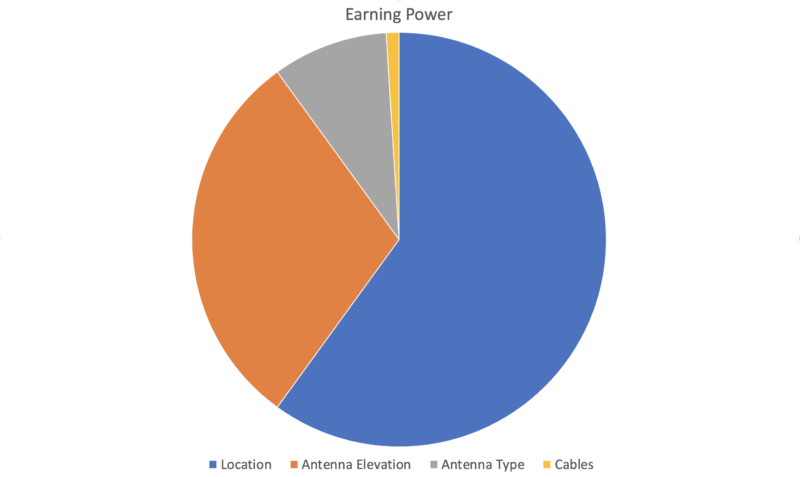
Let me break it down this way. When I think of earning power split out between location, elevation, antenna, and cables, the pie chart looks like this:

Are you still thinking you really need that fancy antenna?

Location is king. If you're in the right place, and if you can find that golden scenario I call "Canyons and Crags", you stand to have the highest earning hotspots in the world. All the elevation, the fanciest antennas, and the lowest loss cables won't make a twig of difference if you're not in the right location.

That's where Helium.Vision comes in. One of a few services that have sprung up to help hotspot owners max out their deployments, this one is aimed at "power users", hotspots owners with multiple hotspots who have the energy and resources to find the best locations and secure them.

I sat down with Helium.Vision owner Nick Hough to have him walk me through how to use this powerful tool. If you're the "just tell me what to do type", this is not for you (I can help you with that, just not in this post.)

If, on the other hand, you've got 10+ hotspots coming in the mail and want to make sure each one of 'em is a top earner, well, this 40 minute video deep dive on how to use Helium.Vision will probably be the difference between having high earning hotspots and just sprinkling 'em around Auntie Irma's and Grandma Betty's.

https://www.youtube.com/watch?v=PM\_diqfr\_Lk&t=6s

HV combines topography, hotspot locations, Cloud RF, and buildings to help pick the absolute best placement for your hotspots. We cover how and why you'd use the different layers, the use of Placement Query (the heart of the tool), how you can track hotspots both in and out of your stable, and how to keep an eye on what's going on in your region. This last one has been interesting; 2 hotspots have been brought to my attention in the last 24 hours here in San Diego.

This is the first in a series of posts I'm doing on Helium tools you can use to improve your deployments. From other software offerings to how to make your own cables to how to run your signal through a coax-lined house, I'm pumped to share ways that you can optimize your Helium hotspots deployments. Let's build this network!

p.s. I don't do affiliate links or referral programs. If I'm given something by a manufacturer (like that Bobcat hotspot), you'll know about it. These reviews are intended to help YOU optimize your deployments and learn about Helium. Rock on!

Where to find:

Helium.Vision

Helium Consulting

The Rough Guide to Hotspot Optimization

How to Choose A Helium Antenna

Archived Comments

How Do You Find The Best Site For Your Hotspot? - Gristle King - A Guide to Helium - 9/5/2021

[…] an alti­tude lay­er to make sure you’re only look­ing at islands in the sky, or you re-watch the demo I did on Helium.Vision and make sure you know how to use all aspects of that super […]