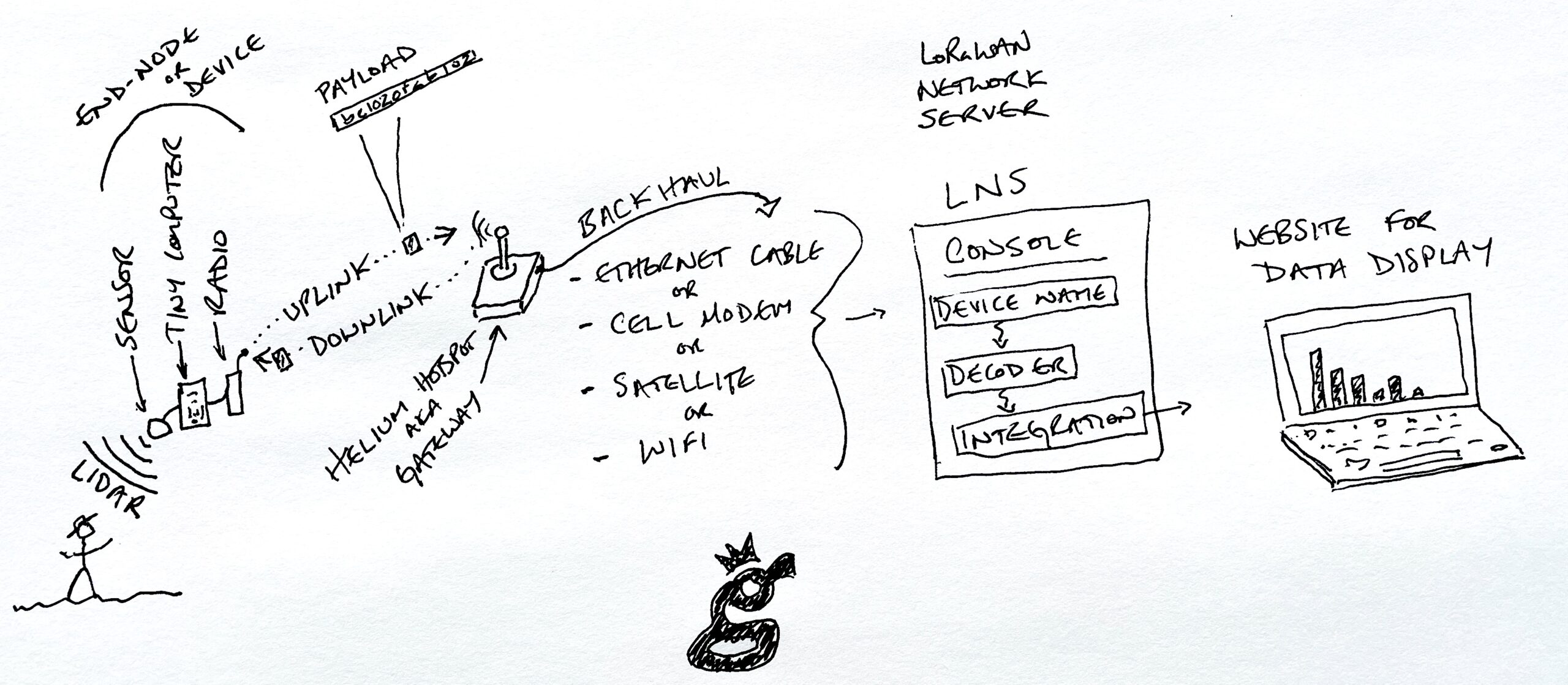
This was written in late 2020/early 2020 for folks curious about optimizing a Helium Hotspot placement. Some statements are out of date, though the meat of it all is generally correct.
Most start with their antenna, which is (almost completely) the wrong approach for maximizing earnings. The only way you could make a less efficient improvement at the start is to focus on what cables to buy.
There are four fundamental aspects of an optimal Helium hotspot placement; antennas and cables are at the bottom of the list for importance.
Before we get there (relax, it's only a few paragraphs away), let's get a few important points out of the way:
First, while I think everyone reading this should buy at least one hotspot and place it as optimally as you can, over the long run you'll earn far more by figuring out a way to actually use the network and not just provide coverage.
Second, if you follow and read through every link in this article you'll be ready to make excellent decisions about the best possible hotspot placement. The whole thing (Helium, antennas, optimum hotspot placement) will take about an hour to digest and understand.
Third, if you don't want or have the time to figure out Helium on your own, for a long time I offered both courses and consulting.
ASSUMPTIONS
- You know that Helium is a network of Hotspots that transmit and receive radio signals, then pass those signals onto the internet. In general, the more signals a given hotspot receives, the more HNT it earns. When this was written, Helium was on its own chain. It's now on Solana. Hotspots record transactions on a blockchain and reward owners for providing coverage with HNT, a cryptocurrency token.
- You have, or have ordered, or are thinking about ordering, a Helium hotspot.
- You haven’t read every last post and thread on the internet about maximizing a hotspot placement. :)
There are only a few things that really matter when it comes to your hotspot placement. Some of them will change over time, some of them are fundamental. All are driven by just one goal over the long term:
ADD VALUE TO THE NETWORK
FUNDAMENTALS FOR OPTIMUM PLACEMENT
In order of importance:
- HOTSPOT DENSITY
- ANTENNA "VIEW"
- APPROPRIATE ANTENNA
- MINIMIZED & HIGH QUALITY CONNECTION LENGTH/CABLES
HOTSPOT DENSITY: Optimum density is determined using Uber's H3 map. At the low end, hotspots won't earn from other hotspots less than 300 meters away. At the high end, hotspots can "witness" other hotspots 50 km out.
Back to the Uber map. The map uses (mostly) hexagons to form grids of different sizes. Each size is called a “resolution” or “res” for short. Each hex size has an appropriate density for its resolution.
Here is a dated interactive map (it stopped being updated in late fall of 2020) of density and hotspot placements. It's color coded and fairly intuitive. Green means good density, red indicates too dense. Here's a quick screenshot:
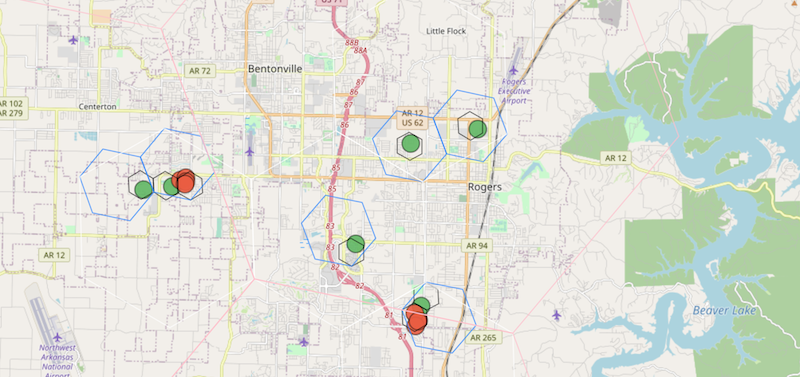
At each "res" there is an optimal number of hotspots per hexagon. That number can change. It is determined by a base rate of hotspots per hex plus the number of hotspots in surrounding hexes. Go ahead, read that sentence again a few times. The details are in HIP 17, look for "Proposed Chain Variables."
Yes, it’s a bit complicated. It was made this way in order to programmatically account for density differences between cities, suburbs, and rural areas.
Here's a screenshot map of San Francisco (pulled from the HIP 17 Visualizer) to give another perspective.
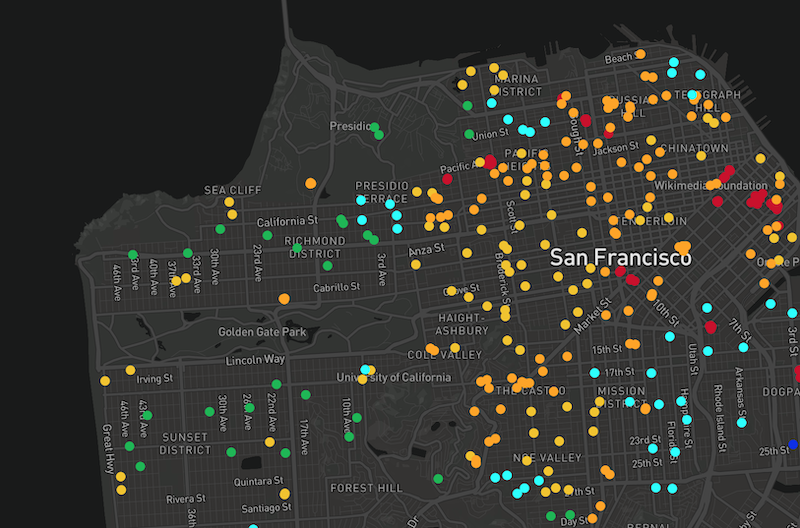
Notice the green hotspots don't have other hotspot as close to them as the orange and red ones. Red is the worst; they're basically on top of each other and providing duplicate (or triplicate or worse) coverage, which isn't useful to the network.
If you want to know if your location will be good, you'll need to study HIP17.
If you read HIP17 until you understand it, you'll be in the 1% of Helium Hotspot owners who don't really have questions about optimum density.
It looks complicated at first, but it's actually straightforward. If you've ever read about Goldilocks and the 3 Bears, you'll have an understanding of hotspot density: Not too dense, not dense enough, but just right.
If you need to visualize things, use HeliumVision or Hotspotty. Use the options for hex overlays in HeliumVision or just zoom in and out on your Hotspot with Hotspotty. If you need help with HeliumVision, consider taking my HeliumVision Master Class.
If you don't have the time or just want to skip that part, you can hire me and I'll help you pick the best option for your area and circumstance.
BOTTOM LINE: You need to have optimum density for maximum earnings.
ANTENNA VIEW: Before you go ordering the latest and greatest super-hot antenna (more on that later), make sure your antenna has a view. A "view" has three important aspects.
- Outside. Walls and even windows will block radio waves.
- High above other obstacles.
- Clear view to as much as possible.
The view of your antenna is far more important than upgrading your antenna. A higher elevation "stock" antenna (the one that comes with your hotspot) will outperform a super fancy antenna that's low down EVERY TIME. You can see the line of sight of your antenna to specific spots using RF Line of Sight or Helium.Vision.
Get as high as reasonably possible. How high? From the American Radio Relay League's document on antenna placement:
“To a distant receiving station, a transmitting antenna at 120 feet will provide the effect of approximately 8 to 10 times more transmitting power than the same antenna at 35 feet.”
You may be thinking, "I'll never get my antenna 120' high." That's OK, do the best you can, but know that until you get it high, you'll be missing out on earnings.
A good rule of thumb to start approaching 90% of optimum earnings is at least 20' above your roof and surrounding roofs.
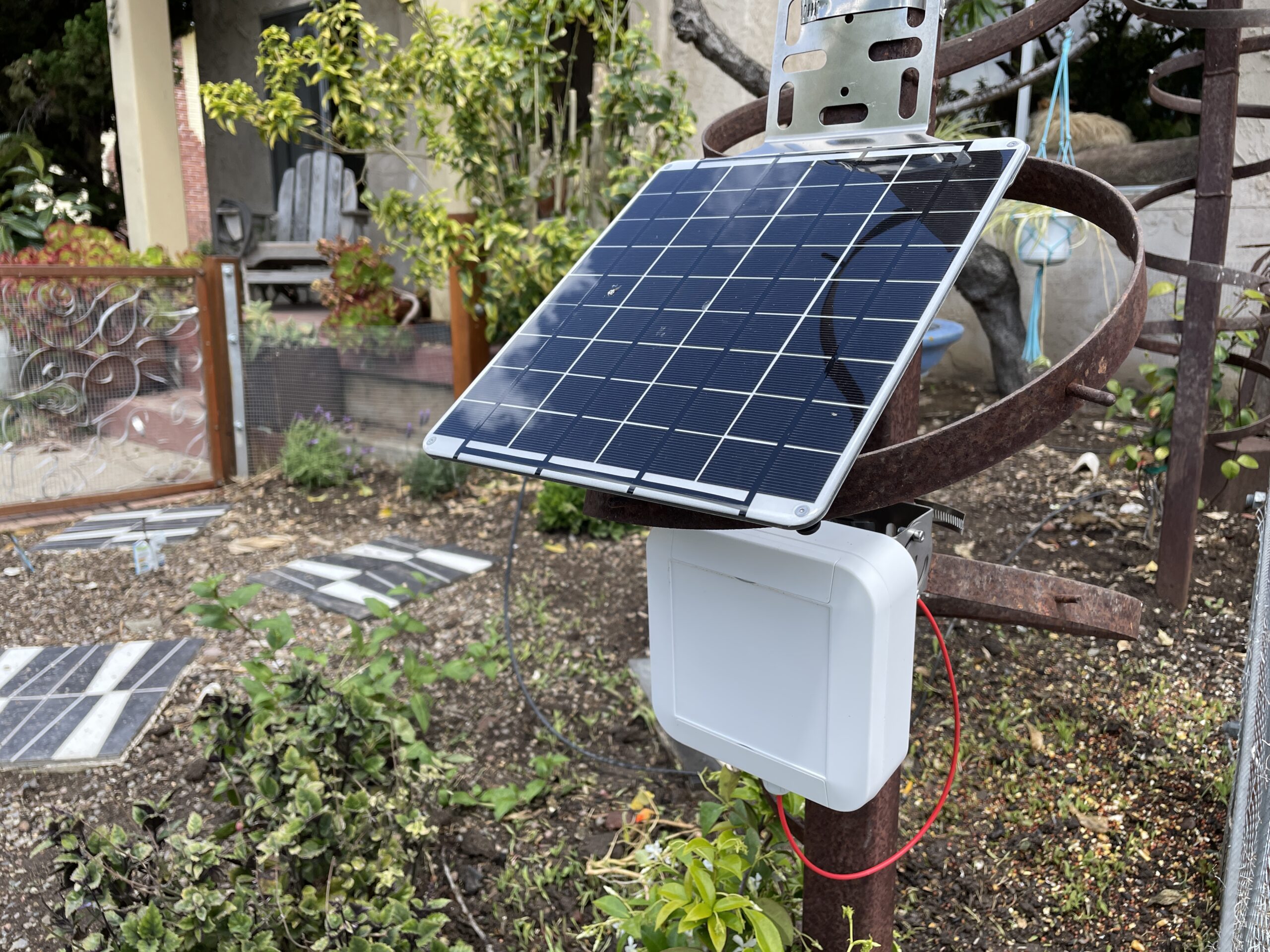
Here's an example of a good elevation placement:
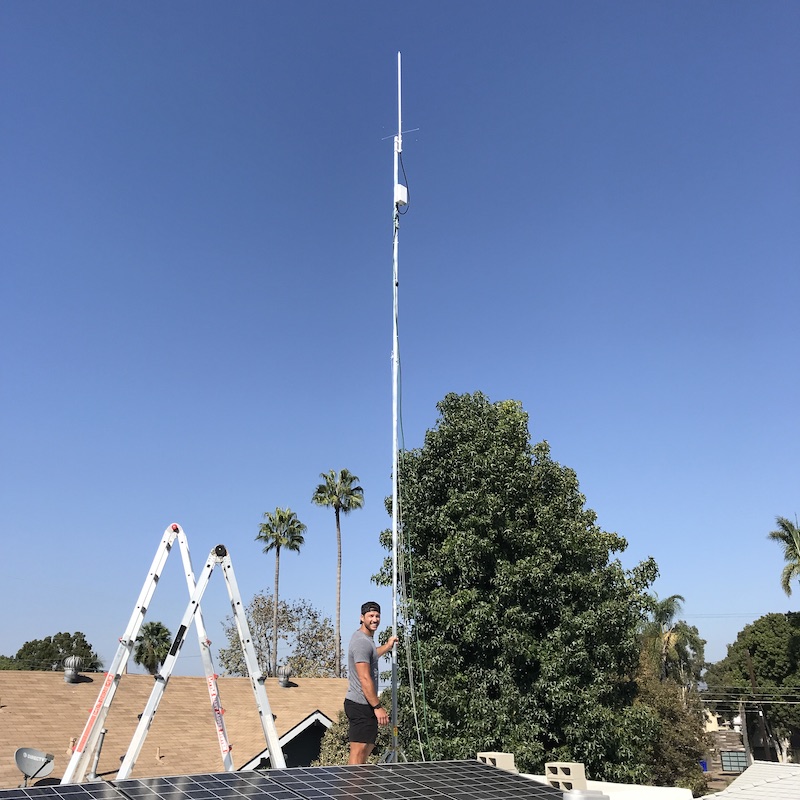
That antenna is on top of a 23' pole on top of a 15' high roof in suburban San Diego.
Anecdotal reports show that even a *1 meter* elevation difference can noticeably affect earnings.
Get as clear a view of as much “civilization” as possible. Remember, the network is only as valuable as the USEFUL area it can cover. A hotspot on top of a mountain with clear views of nothing but nature for 30 miles is not covering (to the network, anyway) USEFUL territory.
A hotspot on a suburban roof surrounded by a few million people and lots of data opportunities will provide far more useful coverage.
Correct elevation is vital for maximum coverage. LoRa is more or less a line-of-sight radio technology. While the radio waves will go through a few things (a wall or two, a window, or a leafy tree), for the most part you want to be able to have a direct line of sight to both your coverage area AND other hotspots.
APPROPRIATE ANTENNA: The antenna is what most people focus on, thinking that if they just have the "best" antenna they'll make the most HNT.
The antenna shipped with any purchased hotspot is already pretty good. However, as many Heliites are both tinkerers and driven by earnings, many will “upgrade” their antenna in order to reach more hotspots.
Antennas do 2 things: They transmit (tx) and they receive (rx). Most folks get wrapped up in how well an antenna transmits, but in the long term that doesn’t matter that much, as the value of Helium is in how well an antenna can RECEIVE.
Remember, the Helium network offers value by being able to receive transmission FROM sensors TO hotspots, then push that information onto the blockchain via an internet connection.
While there is and has been a place for being able to transmit powerfully, that value will diminish rapidly over the coming year.
What the heck is "dBi"? It refers to the focus and shaping of the energy an antenna transmits and receives.
Here's a quick dbi gain visualizer:
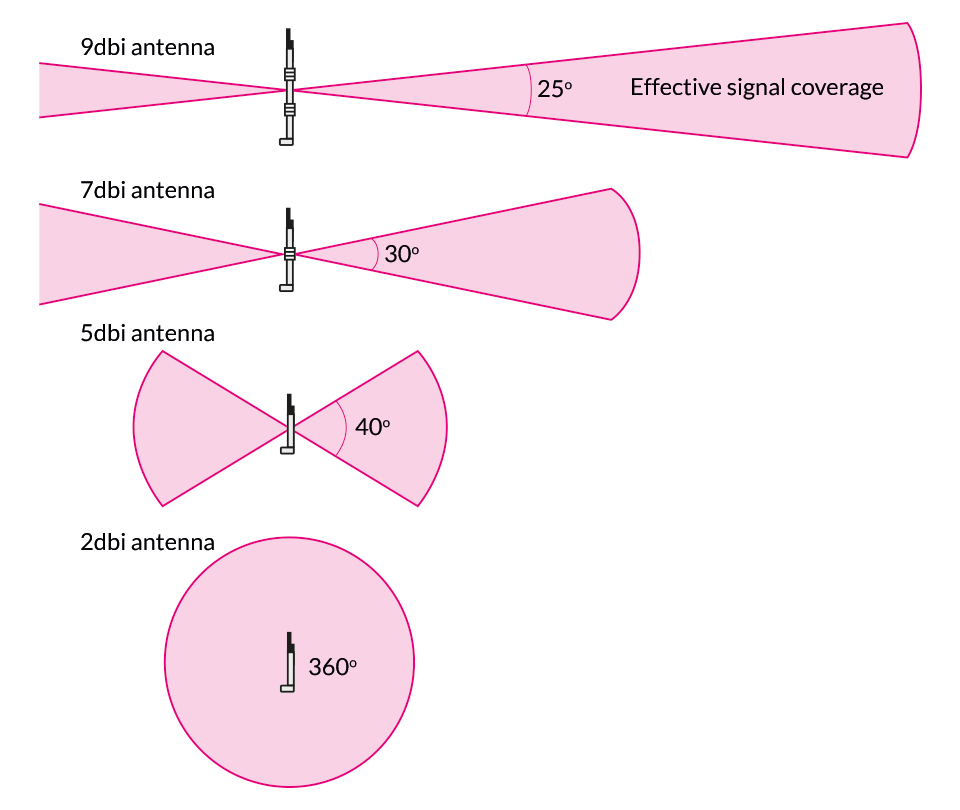
I can hear you now: "Ok dude, but what antenna should I buy?"
You can read this in-depth article on how to match your placement with an antenna, but you've basically got 3 options.
First, and recommended: Don't buy anything, just use the antenna your hotspot came with. Get your density and view squared away first.
Second, if you've got a great placement with the right elevation, buy either an HNTenna or anything in the 3-6 dBi range from McGill.
Third, if you feel like you need something higher gain and you understand the trade offs of a higher gain antenna, get a higher gain antenna from McGill.
"But, but, what about the [insert fancy antenna] I read about on the Discord chat? Shouldn't I get the most powerful antenna possible? I want more money!"
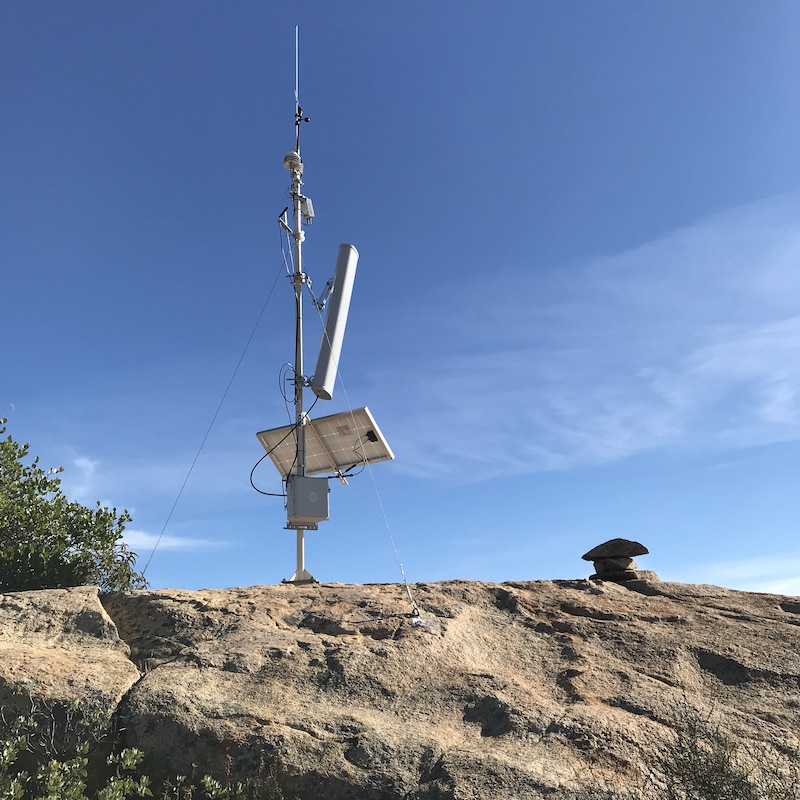
No. Re-read the above piece on having a "too powerful" antenna.
The one pictured above is a high gain sector (directional) antenna on top of a mountain. Despite having an enormous "view", it does worse than many placements that are much closer to other hotspots. I replaced it with a 3 dBi omni, no difference in earnings. Density matters more than antenna.
Even "hot" antennas that are tuned to fit within Helium guidelines (decreased transmit and receive power) won't radically outperform other antennas.
One Hotspot owner I know ran a Nearson 9 vs a Rak 8 dBi in early 2021 and kept track of earnings between the two. The RAK beat the pants off the Nearson.
MINIMIZED CONNECTIONS: Ok, now we're coming to stuff that doesn't really matter but you'll ask about and geek out on anyway. How should you connect your hotspot to your antenna?
This is RF 101 (Radio Frequency): You want a thick, clean, short (ideally 5' or less) cable that goes from your hotspot to your antenna. I recommend and use LMR400 from USACoax.
If you're running a cellular backhaul you'll probably be fine with another LMR variant for the cell antennas (each setup is unique) but you will want to place those cell antennas external to the enclosure.
Get your hotspot up high near your antenna to keep cable runs to the antenna short. Run power and ethernet to the high hotspot, then have a short antenna cable to the antenna. Do not (if you want max earnings) place your hotspot in your attic then run 20' of thin crappy coax cable to your antenna. That will create more radio power loss than you want.
If you MUST have long cable runs, spend the money on good cable. If you do that, you may (but probably won't) get the same results as Docile Bone Pony, which uses 60' of LMR 400 and is on top of a 16 story building in the middle of a large city.
So. That's most of what you need to know about a optimum hotspot placement.
ADDENDA
What else should you know about when it comes to Helium hotspot earnings?
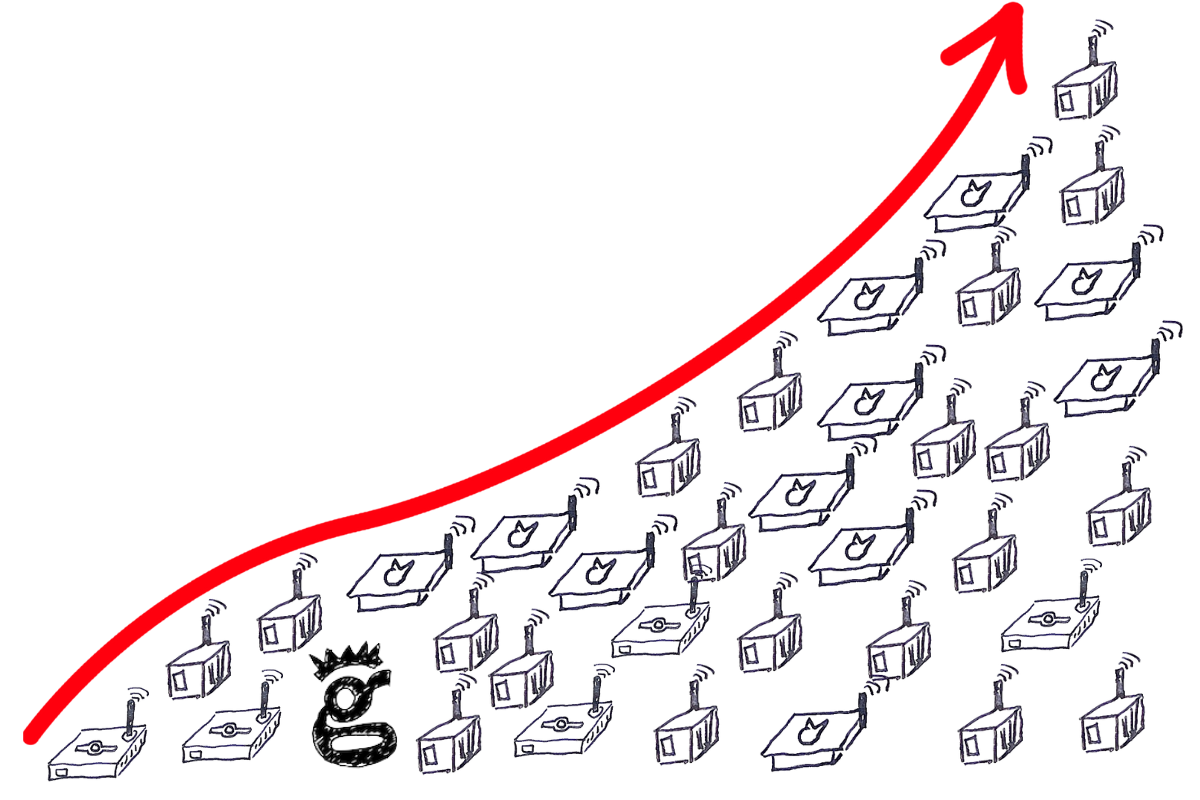
How much HNT you get per witness/beacon transaction will change as the network develops more fully. With a limited amount of HNT made available (2.5 million per month until August 2023, when it drops to 1.25 million/month) to reward transactions AND many more hotspots coming online in the next few months, earnings will steadily dilute.
Yeah, but how much can I earn? Check here for a very rough estimate. This can change significantly, so it's just a starting point.
No matter what, with the growth of the network your HNT earnings will CONTINUE TO DROP.
This MAY be offset by an increase in HNT price. It may not.
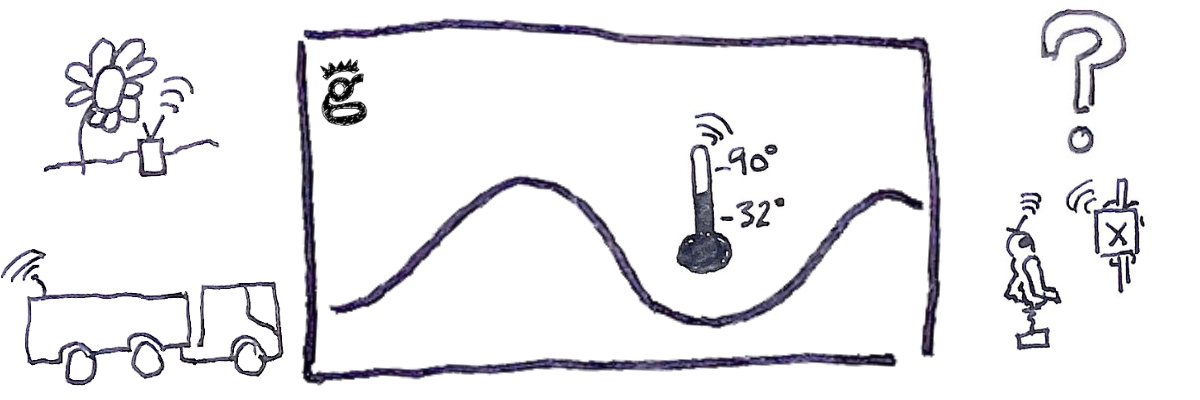
How can I earn even more? The long play with Helium is to figure out how to actually use the service. What kind of data can you collect, what kind of sensors should you use, how can you offer that as a service?
If you want help with that or with optimizing your hotspot placements, I'm available for hire.
How much power and data do hotspots use? Hotspots use about as much power as an internet router, and as much data as heavy Netflix user who watches 2 or 3 movies most nights (100-150 GB/month). This will continue to increase until Light Hotspots come online sometime in early 2022.
If you live in the First World and have a broadband internet connection, having a Helium Hotspot will be basically unnoticeable to you from an energy cost/data use perspective.
I'm ready to buy a hotspot, where should I order? I'd recommend ordering a hotspot from ParleyLabs.
Is there a difference in hotspots/miners/radios? Not really. It's not like you can get a more powerful miner that'll earn you more. The biggest difference is when they'll arrive, which is a function of how fast they can be manufactured.
Is it really worth it to put up a Helium hotspot? I sure think so. Will it be for you? If you have an optimal placement and follow all the advice above, probably. This isn't investment advice. You could lose all the money you put in.
How much can I make? If you do a good job, between .5 - 1 HNT/day as of March of 2022. More on that here. Or just go to Sitebot and start poking around to see what the current maximums are.
How do I turn HNT into cash? Open up an account on any reputable exchange.
Is this a safe investment? No. This is cryptocurrency competing with giant telcos (Telecommunications Companies). It may be a boomer (like when Uber competed with cabs or Airbnb competed with hotels) or it may be a flop (like every other startup company that tried to take on the big dogs.)
You should not re-finance your house to put up hotspots. You should be able to lose all the money you put into hotspots without putting yourself, your family, or anyone you know at financial risk. Sheesh.
Should I just hire you to do all the work for me? Maybe. If you don't like to read or geek out, or you just want to try Helium without spending a few months researching it, I'll walk you through the process of setting up the best possible placement for your situation. You can take my courses (look on the top of the page under Courses) or go here to get started.
RESOURCES
Software
- Helium Vision - Paid service w/free trial for assessing locations. Definitely try this out!
- Hotspotty - Excellent way to visualize density issues AND to manage your fleet
- HotspotRF - use code
gristleking for 20% off your first month.
Mapping
Hardware
Cam - 2/14/2021
Looking to get in touch about hiring you for a helium miner project im working on. please shoot me an email.
Thuong Nguyen - 2/19/2021
Thank you for this resource. I live in Lake Forest. I am interested in your services. May I please get a quote?
Nik - 2/19/2021
Cam, done. :) You can also fill out my form here.
Nik - 2/19/2021
Hi Thuong, sure, fill out the Helium Consulting form here.
A Rough Guide to Hotspot Placements by Nik – Parley Labs - 2/24/2021
[…] post was originally written here by Nik. With his permission we are reposting here because the information is just too good! You can reach […]
Buster - 2/27/2021
Great job here NIK! Quick question....with regard to the Helium.Place....Of the 3 locations I had planned, 2 have 1 miner in the hexagon, and 1 had non (2 just barely outside it) Is it better to have them inside the hexagon or outside?
Nik - 2/27/2021
Do you mean the other hotspots are in the red hexagon? Definitely don't place 'em there. :). If you mean that you're seeing other miners in the larger hexagon grid (outlines, no color) that Helium.Place generates when you click any location, you're probably fine. Just as a rule of thumb, in almost every case under say, 5 km distances, it's better to have hotspots further apart rather than close together. Remember that the overall goal is to add value to the network, and that translates as providing broader, unique coverage.
Nana - 2/27/2021
Great piece. I just placed an order for an indoor miner and stumbled on your write up. When I checked my address, I would be the only one in the red hexagon but it still says it's too close to witness, even though others are at least 5kms away. Does this mean I shouldn't place the miner in my house?
Nik - 2/27/2021
Hi Nana, Hmm, I'm not clear on what you mean. When you click on any location in Helium.place, it'll always put your spot in the center of a red hexagon. The hexagon is meant to show you if you're too close to any other hotspots. If you see any other hotspots within that red hexagon, you won't be able to witness them, nor they you. Sounds like you'll be fine; if the closest miners are at least 5 km away you're going to want to make sure to get your antenna up high. Best of luck with it!
Sanyi - 2/28/2021
Hello! Do you think it will be good that way? 3 pieces will be placed in the village where I live. Distance from each other: 1.2km - 1.3km - 1km Thank you for your response!
Nik - 2/28/2021
Hi Sanyi, If those are in a rough triangle and have clear line of sight to each other, that'll probably work well. Let me know how it goes, sounds pretty good. 4 would be better... :)
Sanyi - 2/28/2021
Thanks for the quick reply! I'll write how it goes. One more question!:) Do you think there is a difference: Outdoor Hotspot vs. Indoor Hotspot? thx
Marko - 2/28/2021
You say "you’ll earn far more by figuring out a way to actually use the network and not just provide coverage"... can you provide some examples of what you mean by this? Are you suggesting users start up some business based on using IoT devices? That's quite the step from plugging in a hotspot and letting it sit there.
Buster - 3/1/2021
Ok, so rule #1 - never put a router in a hexagon with another router....good stuff, thank you for this info.
Buster - 3/1/2021
Hello......also, should a location allow you to put the device in their spot, but are uneasy about connecting it to their network because they are paranoid about security, would an alternative be a cell signal hotspot to connect the miner to?
Nik - 3/1/2021
Buster, totally dependent on what resolution of hex. At resolution 8 you can have up to 4 HS without penalty. This is one of the most confusing issues for most HS placements, but a thorough reading of HIP 17 will clear it up.
Nik - 3/1/2021
Marko, yes, that's the best long term play (as I understand it.) The easy money days of plugging in a hotspot and watching it earn a ton just for providing coverage are rapidly waning (March 2021). This doesn't mean we can't still make money with Helium, but it does mean we'll have to work a lot harder for it.
Nik - 3/1/2021
Other than one can be put outside and be weatherproof and the other needs to be protected from the elements, no. Equipment is generally the last thing to optimize and gives you the least bang for your buck. If you have a stock hotspot in a bomber location you'll outperform a completely tricked out mega-antenna setup every time.
Nik - 3/1/2021
Sure, you could use cell backhaul to connect your hotspot. Realistically, the point of entry for an attacker is just as likely to be a wifi printer as your hotspot, and the printer would probably be easier. You could set up a separate WiFi network on your router just for your HS.
Isaac Keller - 3/2/2021
Hey Nik, awesome article. This has me really pumped up! Quick question. There are no other hotspots within 10 miles of me. However, I own 2 properties and have 2 family members, that when you map out our locations roughly forms a rectangle that is 4 miles by 2 miles. Are we simply too far apart? Or if we get our antennas up high enough will we be able to communicate with each other? Thanks so much for any advice you’re willing to offer!
Nik - 3/4/2021
Get 'em high enough and you'll be fine. LoRa stands for Long Range; 4 miles is no problem if you've got line of sight.
Billy - 3/8/2021
Hi Nik, thanks for the article, i am about to order 5 devices, my city doesn't have any hotspots, would it be ok to set them up 5-7km away from each other? i have family and friends places that are approximately 4-7 Km away from each other, and can put the hotspots higher than any other buildings, need you advice, thanks in advance
Nik - 3/8/2021
Billy, that should be fine. Keep me posted, psyched to see how it turns out!
Billy - 3/8/2021
Thanks for the quick replay ,so i calculated the exact distance , its as follows, A----B is 1.6Km B---C 2.7 km C----D 7.1 Kmm D---E 5.3 Km E---F 6.5Km the are aliened like a straight line or more like a zig zag what are your thoughts, Gratitude .
Billy - 3/9/2021
so the exact distance between each points is as follows, from A to B is 1.2km B-C 2.3 Km C-D 7 Km D-E 5,6 Km E-F 4,5 Km would this be fine? thanks in advance
Nik - 3/9/2021
Hi Billy, those all sound well within LoRa capabilities. Nice job measuring it out, now you have to make sure you have as clear a line-of-sight as possible between the hotspots.
Billy - 3/11/2021
Thanks for the replay Nik, i have 2 other questions , the distance varies between 1,5 km to 7 km max between points, some points has 1.5 km between each other and some has 7km and some has 5,5 km would it be ok ? 1- would it be profitable in a 3rd world country? where people use only social media and basic gps apps 2- can i hide my signal from the helium map so no one can know my address ? these questions are so important for me to decide weather to do it or not. Thanks a lot for the help
Nik - 3/11/2021
Billy, no problem. 1) It *should* be profitable anywhere as long as you have enough hotspots and are eventually passing data through them. 2) For now, you can't hide your location on the Helium map. That may change in the future although no guarantees, and there are minor workarounds for privacy-minded invididuals. If you'd like more help I'd be happy to set up a consulting session with you and walk you through a superb deployment.
Billy - 3/11/2021
Thanks again, for the replay, the problem is that dealing with cryptocurrency is prohibited in my country (which sucks of course) that's why i was trying to figure out if it is possible to hide my location in case some haters or sick people try to do me harm , i mine Ethereum with 20 gpus and enjoying it and really loving HNT , i didnt understand what you mean by "there are minor workarounds for privacy-minded invididuals" how to setup a consulting session ? i left my email, give me a way to reach you please thank you
Nik - 3/11/2021
Hi Billy, here's the consulting option: https://gristleking.com/life/helium-consulting
How Much HNT Will My Hotspot Earn? | One man's search - 3/18/2021
[…] This should help you get a rough idea of how much you’ll make. For more on Helium Hotspot Optimization you can read my guide over here. […]
alf0 - 3/20/2021
Hey Nik, I've read it twice. Really nice guide. As I understand you are not fan of indoors. I'm trying to setup LoRA to my village with friends where currently there is no hs at all. Range will be max 2 km where some of them will be 400-500 meters to each other. We already bought indoor once. it is flat area and there is no high buildings around. Do you think it is gonna be problem if we keep them indoor ?
franco habre - 3/20/2021
Hello, I know in general that it is advantageous to have a VPN established. Do you recommend having one while operating the helium hotspot at home?
Nik - 3/20/2021
Hi Franco, Good question, I'm not sure of the answer. If you're already running one you're probably fine to just add your HS onto the network, but again, I'm not totally sure.
Nik - 3/20/2021
Thanks Alf0! Depends on what building material is, where they are (wall or window), how high (second floor/first floor), how far away they are from each other. I'd spend the extra money & effort to get 'em outside and up high.
Ben - 3/24/2021
Hi Nik, really appreciate the time and effort you've put into your Helium posts. Quick question - why do you recommend Parley Labs over the other manufacturers? cheers, Ben
Nik - 3/24/2021
Bryan at Parley Labs is the only one of the manufacturers/distributors I've physically met and talked with. I've made multiple purchases from them, both before and after meeting Bryan, and have always gotten fast service, straight talk on what to expect both on tech & shipping dates, and very helpful advice. The other manufacturers aren't bad, they're just less known to me.
alf0 - 3/28/2021
Hey Nik, Thanks for the reply. I'm confused about something. You said there is no need to change default antenna as a first step. But in the photos you put, they use different antenna in the top of the pole and connect it to the hotspot. If we are using default antenna, is that mean put the indoor one into ip66 case and locate the case itself at the top of the long pole in the roof? Or are we gonna take the default antenna on the device and put it top of the pole?
Alexandre Herculano - 3/28/2021
I Nick first of all really good article! Congrats. I live in Portugal and the helium are staring now here, I ordered a 5x nebra indoor and I will put them in a small city with 5 different locations +300m away but no more than 2km what you think about that? The indoor antenna will work good? I Dont have anyone here with hotspot and I will put 5.
alf0 - 3/28/2021
Hey Nik, Thanks for the reply. I'm confused about something. You said there is no need to change default antenna as a first step. But in the photos you put, they use different antenna in the top of the pole and connect it to the hotspot. If we are using default antenna, is that mean put the indoor one into ip66 case and locate the case itself at the top of the long pole in the roof? Or are we gonna take the default antenna on the device and put it top of the pole?
Nik - 3/28/2021
Depends on your set up and constraints. Your two basic options are to run a long ethernet cable to an outdoor hotspot, then have a short antenna cable run to the antenna, OR have a short ethernet run to an indoor hotspot and then a long antenna cable run to the the outdoor antenna. If you put your hotspot outside, there's extra work and expense that goes into weatherproofing it, but your antenna cable will be shorter. If you put it inside you don't have to weatherproof it, but your antenna cable will be longer. The photos are of hotspots optimized specific to their location. I've always felt it's worth it to go through the extra effort of weatherproofing everything and having a short antenna cable run, but other hotspot owners have made it clear through their earnings that a short antenna cable isn't essential. Again, remember the order of importance for earnings: Placement/location, elevation, antenna, cables. If you're near (let's say within 2 miles of) a bunch of other hotspots, the stock antenna will probably be fine if you get the elevation up high and have good lines of sight. If you're further out you'll want to really start looking at different antennas and their radiation patterns in order to find the one that works for you.
Nik - 3/28/2021
Hard to give you a definite "Yes that'll work" or "No that won't", BUT if you're putting 'em in a small city with locations between 300m - 2 km apart AND they all have clear line of sight to each other, you should be fine from a placement perspective. See the Cypress example at the bottom of the "How much will my hotspot earn" article. As far as indoor vs outdoor antenna, it's always better to get your antenna outside the building. If you need specific help with this deployment, check out my Consulting page.
alf0 - 3/28/2021
Hello, It's nebra indoor plastic 2dbi tiny antenna. I haven't seen any example in youtube or google using it as a outdoor antenna. Is it gonna be fine to put it top of the pole? Thanks
Nik - 3/28/2021
Sorry, I misunderstood. Check with Nebra to make sure. In this case you’re probably better served with an outdoor rated antenna.
Helium, Explained (ELI5) | One man's search - 3/28/2021
[…] Will a Helium Hotspot be able to penetrate low?e glass? Yes, but the signal will be dampened. It’s always best to get your antenna outside and up high. More on that here. […]
Illhireyou - 3/29/2021
I just spent way too much on a second miner after tremendous success with a shared miner with my friend. I should have a decent spot but am literally mining 100x less than my first spot even though I seem to have a better location. How much does it cost to hire you??
Nik - 3/29/2021
Consulting services found here.
Anton - 3/31/2021
Hey man! Thank you for this update its much needed! Why do you think that mining will become harder and dilluted? Isn the reason for better rewards wider data transfer? So the bigger the network the wider the data transfer, the wider the data transfer the bigger the rewards? Did I miss something? Thank you for your answer in advance!
Nik - 3/31/2021
Rewards will dilute in large part due to the massive growth of the network. Over time we may see the data start to pay off, but it won't be anything like the first, oh, 12 months of rewards for HS on Helium.
Anton Prekpalaj - 3/31/2021
So becouse of the exponential grow of the network the rawards will be lesser becouse of what? Data will be scarced or what? Can you elaborate a bit, becouse i thought "the bigger the network the bigger the rewards"?
Nik - 3/31/2021
In the long term and depending on network growth, we may see higher data-related rewards, but... not for a while. With 100k hotspots online in the next few months, the same size witness/beacon rewards pie will be shared amongst a much larger group.
Nils - 3/31/2021
I’m just saying... this guy is the real deal. Solid understanding of Helium and an interesting, honest chap as well. Nik will sort it.
Nik - 3/31/2021
Thanks Nils, glad it's been helpful for ya. Stoked to see you light up your town. ;)
What's The Best Antenna For Your Helium Hotspot? | One man's search - 4/2/2021
[…] stock antenna that came with your hotspot. Also, find a better placement location. You did read about that, […]
How to take your Helium Hotspot off grid | One man's search - 4/4/2021
[…] A Rough Guide to Helium Hotspot Placement — Before you get all hot and bothered about going remote, see if this’ll help you find an easier, better location. […]
Bryan - 4/4/2021
Hi, I’m considering the indoor device from Parley Labs but wondering what you think about the Bobcat device shown on the Helium website. It looks to have more storage and a better cord, so was wondering if the Parley Labs device would perform less optimally.
Richard Street - 4/5/2021
Hi Thanks for the article. The best I have read. I wonder if you can help. I have 5 box's coming next month. I live in a small town my house is on a hill so I guess I am lucky there. We have no hotspots for 25miles. My questions are. 1. Would my best return be to put all my 5 box spread out in the town? or would I be better putting 3 in one town and 2 in another? 2. Do you get a much greater return in a higher populated area? 3. Is it best to spread out your box's as far as possible (as long as they can still see each other) or as long as they are 350 meters away from each other the result will be the same. Any help would be appreciated. Richard
Nik - 4/5/2021
Hi Richard, exciting news about the hotspots you have coming! Read through the Earnings post to get an idea of how much or how little you might earn in areas with dense deployment vs sparse deployment. I can do a custom dive into this for you if you'd like. Very short version: *Probably* better to have 5 in your town, but that's without really knowing any of the details.
Nik - 4/5/2021
Hi Bryan, both the Bobcat & the indoor Nebra from Parley should perform the same when it comes to earnings. As soon as I have either in my hands I'll do a quick review of 'em, but this is a case of placement and elevation being far more important than what model of hotspot you have.
Bryan - 4/5/2021
Awesome, thank you Nik
Peter - 4/6/2021
Hi Nik, great read! I've looked at the helium map you linked to see hot spots around me, there is 1 hot spot in the red are around me, 1 on the verge of the red and green zone and 1 perfectly in the green zone, there are then a few outside it bit not by much. Does this sound okay? I have ordered an indoor miner last month but I'm considering ordering an outdoor one to put on my roof(no large buildings or mountains around me) Any advice would be greatly appreciated, thank you
Nik - 4/7/2021
Hi Peter, on Helium.place, the red zone is really the more useful of the two, as the potential green zone is far bigger than what is shown. As long as you're not sharing the red zone with another HS you're off to a good start.
Christopher - 4/7/2021
Hey there! I live in a desert basin. Most everything around me is same elevation for ~7-15 miles depending on the direction, so I’m considering attaching an antenna to my roof. Do you have a recommended antenna mast? Thank you in advance, and thank you for all of your posts. I’m learning a lot. Waiting on my bobcats to arrive.
Nik - 4/7/2021
Christopher, I've used 4130 .095 thickness 1 ¾" diameter pipe, often recommended by ham radio types and usually comes in 18-25' lengths. With your setup you won't need a fancy antenna, and the stock one should do fine depending on how close other hs are to you.
Peter - 4/8/2021
Hi Nik, sorry I think I explained incorrectly - there is 1 hot spot in the red zone, it keeps changing the place that It is within a few meters but it's 250~ meters from where I'd be putting mine up, does this mean my rewards would be greatly diminished? Thanks again
Christopher - 4/8/2021
There are 10 hs within 3-7 miles of me and ~100 hs in the major city 12 miles north (only one building in the way 3 miles out). So stock bobcat should be fine placed properly in my home? Is it also wise to put my second one in this helium.place green-ish area of my neighborhood at a family members house? They’re about 1200ft away (another is about 1500ft away). It’d be the closest hs to me. Otherwise I have a handful of other options throughout the northern area of my state.
Peter Thompson - 4/8/2021
Hi Nik, I apologise as I probably didn't make myself clear. There is 1 hotspot in my red zone already, it's 200-250 meters away but definitely there Would this greatly diminish my earnings?
Oliver Parkinson - 4/8/2021
Hi Nik, I am from the Uk and I am expecting to get my Nebra indoor miner this month. There are a few miners in my area but I am unsure of the range I am likely to achieve I have read the they can reach up to 10 miles depending on the topography of the area. I have put a range of 10km into helium vision and looked at the line of sight there seems to be a direct line of sight with about 8 other miners in the area. Does this sound feasible to you if there is a direct line of sight? I am thinking of placing my miner in the top room of the house next to the window which should be opened and connected to the internet router through an ethernet cable. I have read the article but it is a lot to take in so I bet I will read it a few more times. Can you offer anymore tips specifically to my circumstance? Thank you very much, Oliver
Nik - 4/8/2021
Hi Oliver, putting it inside your house will decrease the range you can reliably connect with others. Outdoors within 10 km is reasonable, indoors it’s a little more of a crapshoot, although direct line of sight is a very good thing. Best of luck with it!
Nik - 4/8/2021
Hi Peter, check the hex map to see if you'll be sharing a Res 8. If so, your earnings will be clipped due to overdensity. Even if you don't share a res 8 hex, you and that other HS won't be able to witness each other. If you can both provide unique coverage that doesn't overlap each other you'll make slightly more, or if you can provide significantly better coverage you'll earn more, but in general you shouldn't put another hotspot within that red zone.
Nik - 4/8/2021
Hi Christopher, a 12 mile shot is out at the edge of a stock antenna. Focus on the 10 that are closer to you. Double check the hex res 8 on Helium.place to see if you'll be sharing a res 8.
John - 4/8/2021
Hi Nik - I am new to Helium, and have been doing research, and thankful to have found you! So I just moved into a goldmine of all hotspots locations in NY. I now live on the top floor of the building and own a part of the rooftop where I plan to install my antenna. On the rooftop, there is definitely 360 coverage and you can see the manhattan skyline from where I am. I may have to extend the height for another 10 meters more to be safe. There are tons of hostpots all around me, but noone in my building has one except me. My question really is this - would you recommend me installing multiple hotspots on the same rooftop? Will I earn more if I do this or will it be shared between all the hostpots? I was thinking of maybe ordering 2 or 3 more, but not sure if it's worth spending for more hotspots if the earnings are the same. Super excited to get started. Thanks in advance.
Nik - 4/8/2021
Hi John, Pumped to see how excited you are, Helium is a pretty energizing thing to find! Installing multiple HS in the same location will not earn you more, it'll actually earn less because you'll clip your own earnings but won't make enough with the multiple hotspots to offset the difference. You'll earn more by finding other locations, preferably outside of NYC since it's saturated, and then work on optimal deployment strategies for those. One thing to think about is that since NYC is so saturated, it's likely that at some point in the next year (or less) Helium will further adjust the density chain vars on HIP17 to disincentivize those super-dense areas. I did get your other comment but deleted it just so you don't have a double-post. ;) ~Nik
The Top 5 Mistakes to avoid with your Helium Hotspot | One man's search - 4/8/2021
[…] Putting your hotspot in the same res 8 hex as another hotspot WITHOUT providing significantly better coverage is a recipe for low earnings and wasted effort. I’ve gone into this in depth over in the Rough Guide. […]
Peter Thompson - 4/8/2021
Hi Nik, thanks again for your reply! There is no one sharing my hex 8, but also no one in the green area of that hex 8 that I'm in also So I won't get to witness his and vice versa, but with other hotspots in a few mile radius would this still be sufficient? I'm a kinesthetic learner so I've read everything on your site but struggling to absorb it completely, I'm going to give it a read again tomorrow morning and try and wrap my head around it more - thanks again a million
Nik - 4/8/2021
Don't sweat the green areas on Helium.place, those are confusing. The big thing is to not be in the red zones. You can witness anyone outside of your 300m radius as long as you can make radio contact with 'em. That comes down to placement (outside) elevation (up high) and then antenna (depends.)
John - 4/13/2021
Cool story, thanks, Nik! Soooo, I ordered my indoor Nebra miner on Saturday. The confirmation page offered this link. I soon began to panic which turned to suicidal! (not really, hehe) But I learned my location, here in the river valley surrounded by neighbors who like their trees, may not be ideal. Oh well, I may have to park it at my daughters house. I'll try it out and see what happens. Question about location and coverage: Suppose I have two miners with hi gain/directional antenna mounted so their coverage profile is perpendicular. Could that defeat the 'too close' problem? They would each have a different audience, so to speak. Another question, if I may. Did IoT devices expect to communicate just via WIFI before HNT? What motivates them to convert to LoRaWAN? Maybe that's for new devices, going forward. Hmmm.
Nik - 4/13/2021
Thanks John! The "too close" issue will be first determined by where you "assert", or set, the location of your miner. This will be confirmed/verified through the RSSI/SNR validation curve set by Helium. Putting two miners to close to each other on the assertion side will be a problem, even if they cover different areas. I'm not sure what the plan was for IoT as far as rapid expansion before Helium. Probably just on a business use case scenario. What Helium has done so far is an amazingly good job of aligning incentives in such a way that we're going to see IoT coverage followed by use grow in the kinds of patterns Silicon Valley types like to see. At least, that's my prediction.
Danny Maloney - 4/14/2021
Hi just wanted to say thank you for writing this Nik. Super informative and with all the mis-information that is now running rampant this truly cleared up a ton for me! I recently jumped the gun and was a dummy and purchased 12 dbi antennas for my units coming in June. I now will be returning them and getting 8 dbi ones! I unfortunately can’t get in there and tinker with it like you mentioned. Don’t want to chance me hurting the units! I’ll test for a couple weeks without the antennas first then see if the 8 dbi antennas help out! Again truly appreciate the great read!
Nik - 4/14/2021
Right on Danny, glad it helped you out!
Doug - 4/17/2021
Great stuff Nik! I just pre-ordered/purchased my first HNT miner. I live in a small ski resort town in Colorado. Some enterprising person has 4 miners set up on their side of town, set up in a square about 400m apart. My place is about 500ft in elevation higher and 3km away. I'm thinking I should orient towards his grid as best I can. The other choice would be to orient towards the downtown corridor of town, but there are no miners there, yet. of course this could all change in 4 months when I get my Nebra. What do you think?
Nik - 4/17/2021
Hi Doug, you're probably best off with an omni antenna unless there's nothing but mountain behind you. Even then, the directionals can cost you coverage. I'd start with the stock and see how it goes. As of today (4/17) there are a few new antennas about to come on the market that might change the game, so stock for now is a good call. :)
Juan Vicente - 4/18/2021
Hi Nik. I purchased my miner (a bit impulsively I admit) and now discovered that have 2 other miners in the red zone! One active, and one inactive. I went on a walk in the neighborhood and didn't see any exterior antenas. Does this mean that I can improve my earning odds increasing the hight of mine? I think my location is ideal. On a hill (over 150 feet) and across the river from a big city (2 miles) I'm all in now!
Nik - 4/18/2021
Increasing the height is almost never a bad idea, but putting 2 miners in one res 8 hex usually is. Can you find another placement? Check out the Helium.Vision post I just put up, that may help with figuring out where you might be better off placing it.
Juan Vicente - 4/18/2021
I wish I could find another placement, but I live in suburbia. I doubt that somebody will lend me their house. Pity. Seems that all res 8 hexes have a miner already.
Nik - 4/18/2021
I get it, though it's not like they have to lend you their entire house. :) All you need is a connection to their router and you can *probably* pay their entire cable bill in exchange. No guarantees on that, but it might be a good place to start.
Juan Vicente - 4/19/2021
Hi Nik, In searching for a better placement I have noticed that all three of the maps show active hotspots in the middle of the Hudson river! How is that possible? Thank you for your time and patience with me! https://explorer.helium.com/coverage https://helium.place/ https://app.helium.vision/ show active hotspots in the middle of the Hudson river!
Nik - 4/19/2021
No prob. Those are most likely either gamers or folks who are falsely asserting their location to maintain privacy.
Mahaney - 4/20/2021
Thank you, for this article very well written; and extremely helpful!!! I ordered a few hotspots which who knows when they'll actually arrive. There are currently none showing in my city, I imagine in short time that'll change. I plan to place the few I ordered approx 1.5 mi apart from one another. Can you advise if this is a good plan, or should they be closer/further away? Thanks in advance for your insight.
Nik - 4/20/2021
Hi Maheny, check the Helium.Vision video I posted, that'll help with planning. I also do custom consulting on this, more info on that here.
Brien - 4/22/2021
Nik, As an application developer, What is the cost to use the Hotspots for the transmission of collected data. I'm in agricultural area that I believe is ripe for the exploitation of this model for "Smart Agriculture" applications. Thanks for writing a great piece on this interesting technology. BH
Nik - 4/22/2021
Brien, DC (data credit) cost is fixed at $0.00001 per 1 DC. Check how much data/data credit you might be using here.
Jasper - 4/22/2021
Hi Nik, Really good stuff here. I also ordered my first indoor miner thats due to arrive in July 2021. My town only has 2 miners thus far and I live at least several miles away from them. This may be a silly question but when I use helium place to determine best placement I find that my own address is in RED zone. I tried some other places around me and getting the same result? Is this user error or have you gotten questions like these before? Thanks in advance for your feedback sir!
Nik - 4/22/2021
Hi Jasper, your placement on Helium.Place will always be surrounded by red; that's where you want to make sure other hotspots are not. Does that make sense?
Kashif - 4/25/2021
Hi Nik, how are you buddy? First of all, I found your post very helpful. I am really thankful to you, may GOD bless you!!! My question is, do you think this will be okay if I use 20 meters extension cable for placing the default antenna (of Nebra indoor miner) on a pole? I mean using an extension cable doesn't affect the performance of Nebra hotspot indoor miner. And can I do the same with an outdoor miner? I will be very thankful to you :) Best Regards.
Nik - 4/25/2021
Hi Kashif, glad you found this helpful. Check over on my Antennas post, but a 20 meter extension cord for *power* won't be a problem. A 20m antenna cable is workable as long as it's low loss, say LMR400. You can use those indoor or outdoor.
woody - 4/25/2021
Hi Nik, great info by the way. I live in the UK and intend to do either of the following with my internal nebra. 1. Place it next to a window with a patch lead through the frame to take the antenna outside. (very high quality cable, no more than 500mm) 2. Suspend it high in the roof eaves in the loft (concrete tiles) and use (if needed a good quality higher db aerial) I am taking advice from a radio specialist shop near me) What would you suggest please thanks
Nik - 4/25/2021
Hi Woody, sounds like #1 will get it outside. Depends as well on the "view" each placement has. Sounds like the loft with concrete tiles will attenuate the signal more than you'd want. Let me know what the radio specialist shop comes back with, always keep to hear other opinions!
woody - 4/25/2021
Thanks for quick reply. I will post info I get from radio guy. He had not heard of these miners, save someone asking for an upgrade and mentioning mining without going into details. I have promised to send him a brief description and some links for him to get his head around it. He says he has better quality cable than lm400. I think first off, I will use the stock aerial inside the window for a few days, then try same aerial with up to a metre of h/q cable attached to gutter line & running back through bedroom window to device. Not sure about putting a dirty great mast up because lightning grounding.
Greg - 4/27/2021
Hi, I have a question ,cannot find it myself so i am living in small country Latvia town Riga and i see that in my town are 4 hot spot distance 5-6 kilometers away from me for example i live in street named Bukaisu iela and other HS are on Matisa iela and Lejas iela and Juglas iela would it be possible for me to reach them ? is it a good investment ?
Nik - 4/28/2021
As long as you have a clear line of sight to the other locations, 5-6 km is an easy shot. Whether or not it's a good investment is up to you. Check what the other hotspots are earning to get an idea of what you might earn.
Greg - 4/28/2021
in that case is 4 dbi antena will be strong enough or should i get stronger 5 or 8?
Greg - 4/28/2021
ill checked and 2 of them earning approximately 50-60 HNT every 30 days which is fine for me ,my question is if you will be so kind just confirm for me if i can earn about the same those 2 hotspot are located in Latvia Riga and addresses are Mat?sa iela, R?ga and Br?v?bas iela, R?ga or the hot spot names Short Hazelnut Raccoon and Strong Holographic Mink . I live in the same town street name is Bukaisu iela i checked on website https://www.scadacore.com/tools/rf-path/rf-line-of-sight/ and its showing kind of green ,can yo have a look and thank you for your time .
Nik - 4/28/2021
Hi Greg, I'd be happy to go through a Standard Consult with you and dive deeper into miner earnings, strategy, and placement. You can book that here.
Greg - 4/28/2021
i will think about it ,just before i decide to do that can you at list tell me knowing my position and the distance from me to other 2 hot spot to earn as much they do 50-60 HNT how much i would have to invest excluding your price ?
Nik - 4/28/2021
Typical costs for an outdoor setup run $800-1,200. You can get away with cheaper, it's all dependent on how high you want to go. After placement, height is everything.
Ed - 4/29/2021
You mention mention docile bone pony’s setup on top of a 16 story building. Are they just using the stock antenna or something else. I live on the 10th floor of a building with a balcony. If antenna is on balcony, would it only receive signals away from building? Would my own building prevent signals reaching antenna from opposite direction? Thanks
Nik - 4/29/2021
They're using an antenna bought off of eBay, I thought I put a link to it. Will go back and check. Your own building will certainly dampen the signals, but LoRa can punch through a wall or two.
kat - 5/4/2021
I am very close to a hotspot that is at 600 m of my house. that hotspot is on the 1st floor, I am on the 3th floor and in between there are no houses but there is about 100 m of forest in between (with leaves). Is it worth to place a hotspot or will the trees prevent good coverage. both hotspots will have a 5dbi antenna.
Nik - 5/4/2021
Kat, you should be fine at that distance. Keep me posted when you get it up!
bsap - 5/4/2021
So there's one other active node not far from me, but that's it for my city. I need to look into this over the weekend, but in my situation is it possible to profit? Or is this something an area really has to have a few people participating in to see any returns?
Nik - 5/4/2021
You'll want at least 4 for a shot at max profits, but going from 1 to 2 is the single biggest jump.
JR - 5/5/2021
I live in the UK and have 3 indoor Nebra miners on the way. I have locations ready for setup. They will all be within a 2.5 mile radius but not in the sweet spot (just outside 300m). Would this drastically affect profits or should the radius suffice? I have also ordered 8dbi glass fiber antennas for two of them. Would this optimise profits or would it be better to keep the stock antennas (3dbi)? Really appreciate your advice and I found this article incredibly informative.
Jacob Coody - 5/5/2021
So, how much do you know about the privacy of the hotspots? If I were a company wanting to utilize the network, how worried should I be that someone could hack my IoT devices?
Nik - 5/5/2021
Hi Jacob, from a home network perspective they're considered about as safe as a wireless printer, so if you use one of those there's no reason to not use this. As far as hacking the device to get to the data, let's put it this way: If you could do that you'd be working for the NSA, not cracking IoT devices. :)
Nik - 5/5/2021
JR, don't worry about that "sweet spot" on HeliumPlace, that's misleading. Even a 4dBi antenna can reach over 100 miles, although generally you can assume that a stock antenna with clear line of sight will routinely hit gateways 8-10km away. Try switching out the antennas to see what happens, usually the RAK 8 is overkill and has too narrow of a pattern, but they can also work really well. RF is weird. :)
Pete - 5/6/2021
Hi Nik, Great info. I live in the Bonita area 91902. I went through my HAAT calculations and got a number of about -126 using a 6 meter pole on my one story house. There are two other home in Bonita that I calculated have about a -90. They are about 1.5 miles away in two different directions. I have a few questions if you don't mind answering. 1. I would expect I need a low dbi antenna considering my location. Is that about right? Any specific one you can recommend? 2. Is having a -126 HAAT considered bad or does the type of antenna compensate for that? Thanks, Pete
Nik - 5/6/2021
Hi Pete, HAAT is a little deeper than most go with calcs, nice work! Check it with LoS on HeliumVision, that'll probably be way easier. :). Low dBi is usually fine, especially with a 6 meter pole. Rock on!
Helium Nieuws #3 - 8 mei 2021 - Helium Nederland Community - 5/8/2021
[…] voor een uitgebreider antwoord deze ‘rough guide to helium hotspot placement‘ (in het Engels) van Nik Hawks, waarin hij voorbeelden geeft wat een optimale setup is voor […]
Trey - 5/8/2021
I ordered a bobcat that should be here in 12 weeks or so (hopefully). I plan on mounting my bobcat in a nema4x enclosure on the side of my chimney and then running 10-20ft of cable from that up a pole to my antenna. Your article says 5’ is ideal. I guess my question is without testing it which is more ideal, the height of my antenna or the length of my cable?
Nik - 5/8/2021
I don't quite understand the question, but in general the elevation of the antenna is far more important than the length of the antenna cable.
David - 5/9/2021
Hey Nick, my home is within 300 meters of a neighboring hotspot. As you mentioned my earnings will really suffer by 50%? That sounds like my home wouldn't be a viable place to put it at this time, although there are about 10 hotspots within a few kilometers of my address.
Nik - 5/9/2021
Not all your earnings, but the transmit rewards would definitely get cut.
Kate York - 5/9/2021
Awesome article! Thank you for the clarity!
Nik - 5/9/2021
No prob Kate, always cool to help people understand this whole complicated beast a little better.
mark - 5/10/2021
What about security? Can the hotspot be hacked? Or router and home network a s a result of setting up a node?
Nik - 5/10/2021
Hi Mark, a hotspot poses about the same threat surface as a wireless printer to your home network.
Helium Hotspot Miners Antennes - Wat is dBi? - Helium Nederland Community - 5/13/2021
[…] voor een uitgebreider antwoord deze ‘rough guide to helium hotspot placement‘ (in het Engels) van Nik Hawks, waarin hij voorbeelden geeft wat een optimale setup is voor […]
stan - 5/13/2021
Hi, how will be the signal if I am at the first floor in downtown part of the city and around me are only high buildings? Is it worth to invest in case like this?
Nik - 5/13/2021
Hi Stan, depends on whether or not other hotspots are close by and have some kind of Line of Sight to yours. Definitely not the best case scenario.
Pantelis Ambatzis - 5/13/2021
Can I serial double or multiple the units
Nik - 5/14/2021
Nope, that won't provide any benefit to the network or your spots. Get 'em at least 300m apart.
Nick - 5/14/2021
Hi Nik, I've purchased a RAK Hotspot and it'll be placed in the UK which is 868 Mhz. I have also purchased an 8 dbi antenna which is a RAK 8dBi Fiberglass Antenna Kit (For 915 MHz Gateways). Have I purchased the wrong antenna dbi for the UK and so must I swap it for an 868 Mhz antenna ? Thanks
Nik - 5/14/2021
Should be fine, those are close enough to not be an issue.
JM - 5/14/2021
What type of connectors should I get? I have a rak miner now and will be getting a nebra soon. I am trying to order the LMR400 cable. I an in NY, live on the first floor of a 2 story building, pretty good clear line of sight as it is residential and most of the houses are only 2-3 floors high. I will be putting a 5dbi antenna on top of the second floor, maybe a few feet higher if I am able to. Thanks in advanced.
Nik - 5/15/2021
Always check with the manufacturers to see what connectors you need. Typically that'll be an N-male to RP-SMA male for most antennas and miners, but again: ALWAYS check your specs first.
Kashif - 5/17/2021
Hi Nik, hope you are doing best :) I have a question: Do you think there will be any difference in HNT earning if I place a miner on my roof directly, or I just place antenna on my roof with 20 meter extension cable (LMR 400) and miner placed inside my home ground floor? Hope you got my question, sorry for my weak English :) Thanks in advance.
Nik - 5/17/2021
Depends on the antenna. A low gain antenna will probably be pushing it at a 20 meter cable run. If you're using anything above 6 dB gain you'll be find.
Rodolfo Reyes - 5/19/2021
Hi Nik, if i use the original antenna from my hotspot do i need to ground it? Or just connected directly.
Nik - 5/20/2021
If it's plugged directly into the unit I wouldn't worry about it, but if you're using an antenna cable and getting the antenna up high, I'd ground it.
Chase - 5/26/2021
Hi Nik, great beard combined with great info. I'm browsing the miners available and leaning toward the Bobcat + included 4dbi antenna, but depending on your feedback, I might land on another and upgrading the antenna. I live on the 2nd floor (14 ft from the ground) of a hollow, rectangular apartment building with a balcony that faces inward. The building has a public balcony on the 4th floor facing outward with room to diffract. However, unless there's a way to lock the cables, the miner's fate would be left to chance that the apartment staff overlook it AND no one steals it. Considering that there is already one other hotspot within 81m of my address and 6 others roughly between 500m - 1km away, would it be reasonable to expect significantly different results if it faced the inside of my building vs. the 4th floor facing outward?
Nik - 5/26/2021
Thanks Chase! The Bobcat should be fine.
Adam - 5/27/2021
Hey Nik - amazing article, very informative - thank you :-) I am in the UK and live in a town which is very hilly. I have looked and the best place to put my BOBCAT 300 miner will be in the loft. I am looking to run a cable for my antenna from the miner to the chimney where I intend to attached the antenna. The houses are very close knit so putting it on my chimney would be best. I was wondering if you could help me with a few questions to maximize the potential of the miner? 1. Which Antenna (UK) would you recommend and the dbi? 2. which cable is the best to connect the miner to the antenna externally? 2. I have a Bobcat 300 & will be getting a Kerlink Helium Compatible Wirnet. Will the antenna, cable etc work for both or would I need different ones? Thank you in advance.
Nik - 5/27/2021
Hi Adam! 1) Any antenna should be fine. 2) I use LMR400, I believe McGill Microwave sells those in the UK but you'd have to double check. 3) Hard to say re compatibility. Kerlink lists both RP-SMA & SMA on their Wirnet listing. Bobcat uses RP-SMA, at least in the US.
Francois Lapierre - 5/27/2021
Thanks for the Great article, very instructive ! When the antenna and the cable are hook up is the signal lost change the angle of coverage of the antenna, or just reduce the power ? I think its the second But just want to confirm my thought. Found a 6 dbi and will need around 30 ft of cable. I live in the suburb and plan to put a 10'-15' mast to my chimney (The oil furnace is remove so it will be my pipe to the Roof ;0) I am not in a dense Helium But hoppefully I cand reatch those close some in the Montréal city like some in my town... I will fallow your Post!
Nik - 5/27/2021
Right on Francois. Yep, you're correct, the pattern doesn't change, the power just goes down. Keep me posted on your deployment!
Matthew - 5/30/2021
Thank you Nik for this great information. I have 2 bobcats and 3 Syncrob.it ordered, the bobcats should be getting here first. I live in a typical suburb, 2 story houses and trees, in northwest Ohio. It’s flat here and no other miners close by (nothing within miles). I was going to go with the antenna that they come with, but they’re indoor antennas. I think a setup of an antenna mounted to my chimney would work best. For the 2 bobcats that arrive first, would you recommend just using the included antenna by a 2nd story window (no screen) with them placed in houses about 850m away from each other? Doing that would obviously give me an answer to see if I need to upgrade, but I’m just trying to plan ahead. Thank you again for all the great information.
Nik - 5/30/2021
Matthew, yep, that's how I'd start if nothing else is nearby. Once you start seeing the area fill in, then you can work on getting your antenna outdoors and up higher so you can reach those other spots.
Anna Romanov - 5/31/2021
Hello! Please please please help me: there was an option "set up location later" - NO THANKS, I'LL SET UP LOCATION LATER - i decided to go on that as first i wanted to sync and then decide where to place it. Now i cannot find a way to fix it and to set up the location. I'm sure you know everything - let me know please please please)))) My best, Anna
Nik - 5/31/2021
Tap on your hotspot in the app, look for the gear icon in the top right corner, then set location. ;)
Jose - 5/31/2021
Thank you Nik for this great article. On the reward aspect, As the network grows, is there any kind of seniority for the hotspots already in place?
Nik - 5/31/2021
Nope, every hotspot is evaluated on its own with no regard for seniority.
C. Biggums - 6/1/2021
Hi Nik, I checked my metro area and a 7km area. The 5 within 6-7km are earning less than 3 per month. Found others in town the same, then some around 23 per mo and then one out of the entire metro area was earning almost 100 per mo. Is placement most likely the difference? Is it possible they're connecting to every hs within a 10mi radius? Thanks.
Nik - 6/1/2021
Yep, WUPU placement and antenna elevation.
When [Bobcat]? - One Man's Search - 6/2/2021
[…] months ago, Ann at Bobcat reached out to see if I’d like a hotspot for review. She’d read the Rough Guide To Hotspot Optimization article and liked it. She thought it might be useful to get a Bobcat hotspot into my hands ahead of the […]
Kerry Prudhomme - 6/11/2021
Hi Nik, Thanks for the information in this article. I've ordered a few Bobcat miners and even after reading your article have questions on antenna placement. The following facts may impact my placement of the antenna. Flat elevation - No more than 50' change in elevation for 20 miles Lots of tall trees surround my house. My roof is 22' tall. I plan to install a 40' pole to mount the antenna. (From ground level) Should I consider the outdoor enclosure for the bobcat therefore reducing the length of antenna wire? Which antenna would be best for this situation?
Nik - 6/11/2021
Any of the outdoor ones will be fine. Try and keep antenna cable runs as short as possible. Scroll to the bottom on this page.
Rocco Monteleone - 6/12/2021
Hi Nik, AWESEOME post thank you. If I am the first to deploy 10 correctly positioned hotspots in a town that had none to begin with, will that earn good income ?
Nik - 6/12/2021
Hi Rocco, thanks! Being the first in an area doesn't do anything extra for you. Having 10 correctly positioned hotspots is the main thing. Get 'em!
corey huguley - 6/15/2021
I would like more information about your setup on outside helium miner. I I own 66 aces of land and I would like to use my land. I would like to create my own network. Also, currently its none located in my area.
Nik - 6/15/2021
Sure, cruise over to the "Helium Off Grid" blog post. ;)
Chris reid - 6/17/2021
Dude Nik you sir are a god ole brother, I didn't realize until I read this whole article and went to the bottom and recognized your face and realized I just read up on your whole adventure off grid and up the mountain, if I ever cross your path brother i"d like to buy you a beer or two if that's alright. And your right there's far more things that these hotspots can utilize, practically endless opportunity if you read up on it, sadly not enough people take up that opportunity, but hopefully with your words of wisdom people will!! I do have a question for ya that i have yet to find info on, one of my HS are in a ruralish area, closest one to it is roughly 4 miles then about 14 others ranging from 6-12 miles that I pick up, but i have a 280' commercial radio tower 1/4' mile from me, would this creat any kind of signal decrease or loss trying to "compete" across the waves or am I thinking all wrong? I know a few cell company's have antennas there, along with a few railroad companies, a water company and a few "not listed" antennas there aswell. Didn't know if something like that this close would cause any type of interference. Thanks again brother for all you do, keep it up, look forward to reading more, hopefully hear from ya soon.
Nik - 6/17/2021
Hey Chris, thanks! Shouldn't be issues with interference at that range. Mostly the problem is that you're too far away from other hotspots. While they *can* communicate over long distances, they *like* to communicate right around the 600-1,200m mark.
Chris - 6/18/2021
347.5 HNT per month WTH?! 36.076849452137076, -115.28299816633508 is my location and my neighbor (Polite Shadow Chimpanzee) is making over 300 HNT monthly! BUT it looks like many others in the area are only making about 10-30HNT monthly. The terrain is pretty flat, and I'm about 1/2 mile away from them, Using the RFhotspot estimation tool it predicts about 240 HNT monthly for me, which sounds too good to be true at HALF that amount. I have a Bobcat enroute from china (due here tuesday 22nd june) Do they make an enclosure to allow me to put it on a pole on the roof?? or should i stick it in the window and hope for the best? LAST question, Can I move my miner once it's been set up (like put in the window first then later raise on a pole outside after buying proper wire and possibly enclosure) I'll drop you some HNT if you can get back to me to help, thanks!
Teodora - 6/19/2021
Hi Nick, I purchased a RAK miner and I am planning to place it on a roof. I'm also thinking about buying a RAK outdoor enclosure from store.rakwireless to be able to fix the miner as close as possible to the antenna as you advised. I have doubts about how extreme temperatures can damage the miner. In the area I live in temperature can vary in the range 5 to 105 F. The enclosure will be exposed to direct sunlight without any shade and that makes me nervous with summer approaching :). Do you have any advice as to do we need to provide additional protection to the enclosure to avoid overheating or freezing or it should be good to go as it is? Many thanks in advance :)
Nik - 6/19/2021
Hi Chris, sounds like you'd benefit from a consulting session; I go into all of that in detail. In general, 300 HNT is totally achievable but depends heavily on location and antenna elevation. You can put any indoor miner in an enclosure, lots of enclosures are available for different setups. You can move your miner once you've set it up; you do that through the Helium app and it costs ~$10 to do each time.
Nik - 6/19/2021
Check with RAK about the miner & enclosure; both should be fine. I've heard of hotspots in sealed enclosures live through the summer in Texas. I'd provide some kind of shade for the box if I could, as every little bit will help. I wouldn't worry about the cold; computers love being chilly. :)
Teodora - 6/19/2021
Thank you so much! That was very helpful! :)
Bryan - 6/19/2021
I’ve seen that building a hotspot is no longer allowed because people were taking advantage of the system. What were they doing? Just putting a bunch in one spot and say they were other places? Doesn’t seem very smart. Seems like the same IP address would give them away pretty quickly. Plus wouldn’t the signal be really strong and throw up res flags?
Rabih - 6/20/2021
Hello Nik thank you for this very helpful informations. I live in a village in the mountain with high population but a lot of hills up and down. Does this matter for the hotspots? I mean if i put one on the top of a hill will the one down the hill connect to the one on top? Thank you a lot for your reply?
Pascal - 6/20/2021
Hey Nik! Great post and thank you for sharing your knowledge. I just received my RAK HNT miner and I am trying to find where to place it. I have 2 other miners coming hopefully anytime soon (Nebra & SyncronB.it) I have two options: 1. I place the miner in my apartment in Manhattan. Based on helium.place I have 6 other hotspots (orange and red color coding) in my "invalid witness zone" and 15+ hotspots in my "sweetspot" (green area) - I checked some of their rewards and its not more than like 20-30 a month. 2. I can place the miner at my in-laws outside the city. Based on helium.place I would be the only hotspot. I only see two hotspots around me but 1.2-1.4 miles (2KM) away. Not sure if they would see each other. Would love to get your opinion. Thank you very much for your help.
Nik - 6/20/2021
Hi Bryan, basically a slightly more sophisticated version of that. If you look way back in Discord for "Modesto" you'll see the discussion on it. In one case a gamer made 70k HNT in a day; it was a real problem.
Nik - 6/20/2021
Hi Rabih, If they have a clear line of sight they'll be able to communicate. Does that make sense?
Nik - 6/20/2021
Hi Pascal, Definitely don't put any more in Manhattan; that place is way overcrowded. Try looking for a third option, where you have at least 4 miners within a sweet spot of 6-1,200 meters away.
Pascal - 6/20/2021
Thank you Nik. I really appreciate the quick reply. Unfortunately, I don't have a third option at the moment. I checked the addresses of all my in-laws (LOL) and no one has other miners in their sweet spot. At least for now. I will keep looking but I think I will place the miner at my in-laws. There are only two around me but not within the 1,2km range you recommend. Once I get my second miner I would place it near my first one in a sweet spot area. What do you think?
Nik - 6/20/2021
That sounds OK; do you have any friends, co-workers, or know any business owners in better locations? Location is king in this game, so it's important to get that right.
Pascal - 6/20/2021
I need to check but my entire life is in Manhattan - LOL. I checked the location of my friend in D.C.. He has 3 miners within the red zone but based helium.place they have all a 0.5 to 0.8 reward scale. There are 15+ miners in the sweet spot zoon. Does that sound better than placing it at my in-laws outside the city?
Nik - 6/20/2021
Time for a road trip and making new friends. If you're going to move it, move it to a great spot, not just one step up from yours.
Alex - 6/21/2021
Can you do an article on antenna transmission patterns? I have an antenna that is a dipole with the joint in the center, would be curious to see how this fares in the city.
Nik - 6/21/2021
Sure, check this out.
John James - 6/21/2021
Hey Nik - not sure if this is a good idea, but I would like your opinion on it. What if I set up 2 nebra miners in the same building (top floor). One from my apartment, and another one from a neighbor. Each will have it's own wifi connection, but here's the difference - one will have the stock 3 dbi antenna, and the other will have a 5dbi antenna. This way the 5dbi overshoots the 3 dbi preventing them from competing with each other. I live about 20 miles from NYC, and both of my miners are facing West. The 3dbi miner should be able to reach Manhattan, while the 5 dbi should reach New Jersey with plenty of miners for both to witness and challenge. Because I live on the top floor, I have no issues with line of sight, and should be able to reach as far as the antennas can reach. Do you think this will work? Thanks in advance.
Nik - 6/21/2021
Hi John, Depends on what you mean by "will this work?" By having 2 miners in the same res 8 hex, you'll clip your earnings for each one by 50% in most cases. They'll still earn, but at less capacity than they otherwise would.
Kashif - 6/22/2021
Hi Nik, Thank you very much for your continued support of us. I have a question, How much long extension cable I can attach with a stock antenna of bobcat miner? Do you think this will work fine with up to 15-20 meters extension cable? May God Bless You !!!
Nik - 6/22/2021
Hi Kashif, there are two (well, 3) types of cables. First is the power cord; standard rules apply there. Second is the ethernet between your router and the hotspot -- max is 100m. 3rd is the antenna cable. That's the one we really want to keep as short as possible, but has a few variables to it. Check over here for more.
Jerome Nadeau - 6/27/2021
Hi Nik, Here is my problem with finding businesses to accept having one on their property. They all want rental $$ for space and a lease. My question is, what is normal in your opinion to entice a property owner to accept. Most I run across want $400.00 a month plus a year commitment. Total cost at this site would be $500.00 per. $100.00 for internet access.
Nik - 6/27/2021
That's more than I'd pay, for sure. Check out the Getting Your Hotspot On A Commercial Building post for more on this.
Ernestoxx - 6/28/2021
can you make a post about the connectors for the LMR400 for each miner. For example i have a bobcat miner ordered. and i want to use it outdoors by putting a cover. so i will have an lmr400 instead of the one that comes with the Antenna. But what connectors should i put on the lmr?
Nik - 6/28/2021
Will this help?
Todd Eide - 6/28/2021
What if I life on a farm and i can run lora cable 1000-1200 feet in multiple directions and leave the actual box in my house connected to ethernet. Would this work?
Nik - 6/28/2021
Nope. You don't want to have multiple hotspots on the same IP (looks like gaming to Helium), nor do you want long antenna cable runs.
JT - 7/1/2021
Any advice for non-penetrating roof mounts for atennas on an normal residential roof? Haven't found a great solution that doesn't require drilling holes in the wall or throwing cinderblocks up on a roof which probably would work well for a commercial grade roof but probably not all that safe for a standard home
Nik - 7/1/2021
Hey JT, you can skip a few of the cinderblocks if you're not going to add a 20' pole to the non-pen roof mount. You might also look into clamping options like chimney straps.
Tyler - 7/1/2021
Hey NIK, I appreciate the thorough information you presented! I was wondering what your opinion was for those looking to start now? Knowing that the earning amount is going to take a sharp decline in August, and that I wouldn’t be getting my hotspot for 3-6 months.
Nik - 7/2/2021
Tyler, it depends on your goals & expectations as well as the placements you have available. IF you have a great placement, it's worth watching eBay for miners in hand. Prices will continue to drop there, and you'll get it faster than one ordered from the factory. If you want to play the long game and have an actual use case, that would be the driver for a "purchase from mfr" decision.
Tyler - 7/2/2021
Thank you for the reply! I honestly don’t have a great placement. I’m in a city with only a few, and the nearest one is a few miles away.
Kashif - 7/9/2021
Hi Nik, how are you buddy? I come again with another question, hope you won't mind ;) Can you please, is there any option to hide the privacy of the helium miner location? I mean on the helium coverage map when I see my hotspot then this should not show the exact home location. Like it should show it's on the next street or so, although it's planted on my home. Hope you got my point. Because I don't want that my neighbours or relatives should not know what I am doing at the moment. Best Regards.
Devon - 7/9/2021
Hi Kashif it seems your issue will be resolved with https://explorer-beta.helium.com/ which we will be transferring to shortly, currently it is in BETA getting ready for it's full release. This will only show amounts of hotspots in a given hex, rather than showing exactly where you are. Hope this helps you out with your question.
Nik - 7/9/2021
Sure, I think it's reasonable to assert your location anywhere within 100m of where it actually is. I usually tell clients to assert it in the middle of the nearest intersection that's within that distance. In time, that strategy and tolerance may change, but for now that's the best option.
Kashif - 7/9/2021
Hey Nik, you are awesome. You helped me a lot by saying I can assert my hotspot location around 100 meters away from the actual location to hide my privacy. Tell me if I have two locations for two hotspots, and the distance between these two locations is 200 meters. As you know we should place hotspots away at least 300 meters away from each other. So, in this case, if I assert my first location 100 meters away from the actual location and in this case both hotspots now show 300 meters distance, then will it fulfill the minimum 300 meters target to get proof of coverage. I am sorry if this is a silly question, but maybe someone also has the same question in their mind :) Best Regards.
Nik - 7/9/2021
Hi Kashif, you *should* assert your miner where it is. Now, with that said, I think it's OK to assert it within about 100m just to retain privacy. As of July 2021, Helium doesn't have a great way to protect your privacy. Asserting a miner in a location it isn't actually in for reasons other than privacy is frowned upon (although I'm sure plenty of people do it). If you have 2 locations that are 200m apart, you really only have one location. At least, that's how I see it. Think about it this way: 2 miners that are actually close together but are asserted 300m apart aren't really providing the network any benefit. They're more of a gaming setup. You're better off finding a new and completely different location.
Helium Hotspots & EMF - One Man's Search - 7/12/2021
[…] go back to the Helium Hotspot one last time and just think about where it’s placed. While I recommend always placing it outside (NOT for RF exposure reasons, but to provide the best coverage), some people can’ t […]
Nojeem Bakare - 7/23/2021
What a great write-up!
Nik - 7/23/2021
Thanks Nojeem!
Jim - 7/30/2021
I live in a sparsely populated area 3k and next town is 25k but I am willing to move to Eugene OR to do this hot spot gig. and on a waiting list for equiptment. And will get your help. when time gets closer. Am I correct in my assumptions ?
Nik - 7/30/2021
Hi Jim, that sounds reasonable. Keep an eye on average rewards to make sure it'll be worth it. Any time you can set up a miner that provides Wide, Unique, Proveable, and Useful coverage you're getting the fundamentals correct.
Trevor - 7/30/2021
So glad to have found your site! Seems like getting the antenna up high, def in my location, is a theme here! So how does one do that? Any special requirements for a pole? Can it sway in the wind? If higher is more important than antenna ( usually). Id like to get 20’ past my roof- Is that too far to cable from my bobcat? Hope thats not too many ?’s. Thanks for a great blog Nik!!!
Nik - 7/30/2021
Hi Trevor, check what height will do on Helium.Vision; sometimes just a few feet makes a difference, sometimes 100' makes no difference (radio shadow from hill). It *can* sway in the wind, but definitely better not to. Make that pole sturdy! I've used 20-25' of 4130 steel, .095" thick, 1 ¾" diameter. That's a good, albeit expensive, way to do it. More on antenna gain & cabling here. Rock on!
Darcy - 7/30/2021
Great write up! You mentioned putting the miner on the pole close to the antenna (unless I misread?) but what if you live in a cold climate where temps go below the Operating Temperature (e.g. 0 C on a bobcat)? Any advice for keeping the miner safe while close to the antenna to minimize cable length?
Nik - 7/31/2021
Hi Darcy, thanks! Hmm, you could insulate the box or just keep the miner inside and run longer antenna cable, keeping it low loss. More on that here.
Marco Martins - 7/31/2021
Thank you so much for providing this useful content! Question: can I use the default antenna outside?
Nik - 8/1/2021
Hi Marco, I don't think so; the stock antennas are probably only rated for indoor use. With that said, they'll probably work fine for a few days to a few months, depending on weather. :)
Marco Martins - 8/1/2021
That's what I thought :D Mine is currently under light rain but I've put some plastic film protecting the connections while I do not order an outdoor one. BTW, just to confirm what you are saying, my 2.8dB stock antenna can have a witness that is 19.2Km away, because it has line of sight. I'm on a hilly zone, and I'm up the hill, I have as witness 80% of city HS. My goal is to put the antenna higher and I'll probably order a 3dB outdoor antenna or would you recommend 5dB?
Nik - 8/1/2021
Yep, with Line of Sight you've got pretty long range. 20 km no prob. I'd go with an HNTenna (that's what I'm using on all my installs going forward.)
Jim - 8/1/2021
Is there a place to see the miners or hot spots in OR. ? web-site with maps
Nik - 8/1/2021
Hi Jim, they should show up on Explorer at the res 8 hex level. If you want to see exact assert locations you'll need to use a paid app. I recommend Helium.Vision.
Lorenz - 8/3/2021
Hey Nik, Love your Blogs! One question left for me though, for now at least. I also have been trying to get information on that in the past weeks, but didn't really find anything valuable: What do I need to look out for, when trying to maximize the RF of my antenna? Is the multi-polarization really that much better for receiving signals? Any other parameters or values to look out for? Cheers Lorenz
Nik - 8/4/2021
Hi Lorenz, try this post on Helium antenna choice, it should lay out what you're looking for. :)
Jim - 8/7/2021
Helpfull suport, Is it better to be the first hot spot in a town of 25k or move to a bigger one with 4 or 5 already, ( Grants Pass) ? Thanks Jim
Nik - 8/7/2021
No advantage to being a "lone wolf". You need at least 4 other hotspots to be able to earn maximally, though you probably want more, just to give your hotspot(s) more chances at witnessing beacons.
Harold - 8/8/2021
Your posts have been fantastic and very informational, so thank you for that. Back in the late 60s and 70s, I built a lot of ham radios. I basically remember NOTHING from when I actually knew anything. Could you bifurcate the coax with a splitter and use multiple antennas for these hotspots or would that make it worse? Thanks again.
Nik - 8/8/2021
Hi Harold, from everything I've read, there's no good way to do that; you just lose too much energy when you're splitting the signal in half. Better off getting one antenna high with clear lines of sight to lots of other hotspots.
Thomas - 8/15/2021
Nik: We discussed this once before, and I wanted you to share it for everyone’s understanding: do the enclosures protect the miners from the elements of winter, rain and snow? Or should we add something to the enclosure for the miner’s protection? Please advise.
Nik - 8/15/2021
Hi Thomas, yes, enclosures protect the miners from the elements. You can use a vented or sealed enclosure. Considerable discussion around which one is better. If you go sealed, make sure to include dessicant, and from what I've seen be careful of overheating, especially with the Bobcats. If you go vented keep in mind that dust is an enemy of electronics, so have some kind of mitigation for that.
Marco Martins - 8/15/2021
And moisture!
Nik - 8/15/2021
indeed, and moisture. :)
Marco Martins - 8/16/2021
Putting the miners into this enclosures with them generating heat I wonder if they won't create condensation when humidity rises outside if we have a hole for ventilation. What's your experience Nik?
Nik - 8/16/2021
I've got a couple that have been up for months (through the "winter" in San Diego, complete with rain, fog, clouds, etc) and they're still doing fine. My guess is you'll have to replace the electronics every 1-2 years anyway, just like you do with almost every electronic thing.
Thomas - 8/16/2021
The Bobcat miner has an overheating issue? My roof is all sun. No shade. And it cooks like an oven during the summer months. My aim is for all my miners to be on rooftops near the antenna.
Nik - 8/16/2021
Yep, that's what I've seen in the forums; Bobcats seem to be more sensitive to overheating than, say, the RAKs.
Thomas - 8/16/2021
Wow. That’s not good. How would you suggest elevating the Bobcat during the summer?
Nik - 8/16/2021
I'd keep it in a shaded and well ventilated spot if I had to put it outside. Bobcat has made a point recently of saying not to put the things outside in the heat.
Thomas - 8/16/2021
The attached articles are very helpful. It does change my approach. I wanted all my miners to be airborne (20 feet) above the roof. I will need a longer cable instead— slight signal loss.
Easy Helium Outdoor Antenna Upgrade – Tea and Tech Time - 8/19/2021
[…] What’s The Best Antenna For Your Helium Hotspot? A Rough Guide To Helium Hotspot Placement […]
Reggy - 8/22/2021
HI, i bought (5) Bobcat hotspots not realizing that I can't have more than 1 in my home. I live in California, I have a spot for 3 of them around my city and work, but I was thinking about putting 2 in Canada, can I do that? I know they just have to be 300 meters apart, but is there any restriction to how far? They would all be connected to my app that I would set up and monitor them with so it shouldn't matter right? I just purchased today and can't find any info on this, and i'm sure I can cancel a few of them if I can't pull this off. If you have any info on my situation, it would be soo helpful!
Nik - 8/22/2021
Hi Reggy, Keep reading through the site for more info on how to optimally deploy 'em. 5 is manageable. No restrictions on how far apart they are. Yes, they'll all be connected to the "wallet" in your Helium app, so you can monitor them from there. If you'd like to just skip to the front of the line when it comes to understanding what you've gotten yourself into, I offer consulting for Helium, more on that here.
Don - 8/24/2021
Looking to possibly hire you, if affordable, for an opinion on my location.
Nik - 8/24/2021
Right on, check over here for rates. Thanks Don!
Benji - 8/24/2021
Awesome content Nik. I appreciate you sharing! My setup will be going on my roof with great visibility and elevation relative to the rest of my city. Is there a hotspot you would recommend? Does the hotspot need to be placed on the roof as well, close to the antenna? Thanks!
Nik - 8/24/2021
Hi Benji, thanks, happy to share. The RAK V2 seems to work best if you're putting an "indoor" hotspot outdoors. Check out more on the Anatomy of a Hotspot post, here.
jjlomar - 9/5/2021
Hola , se habla de 120 pies de altura , yo dispongo de un lugar con 350 pies de altura , la pregunta es , puede perjudicar tanta altura , gracias
Nik - 9/5/2021
Depends on what you're running. Ethernet cable going 300' shouldn't be a problem, but going anymore than 60' on LMR400 (ANTENNA cable) can significantly reduce power transmitted. Check this post for more on EIRP and cable loss.
LaRoc2121 - 9/7/2021
What if you're in line of sight of a cell tower
Nik - 9/8/2021
Usually a good thing, though if you're too close you can be subject to interference.
Winning At Helium: The Right Way To Get Started - Gristle King - A Guide to Helium - 9/8/2021
[…] whole train. The better the coverage you provide (pages and pages have been written on how to provide excellent coverage), the more HNT you earn. HNT is a cryptocurrency and can be traded for many other […]
Andrew - 9/16/2021
Hey Nik, thanks for the awesome write ups. It helped me learn so much. I just had a few questions. I read one of your earlier comments that we would need to be replacing electronics every 1-2 years? So the miners would only last around that amount of time? Would the same go for the antennas? Also, I am currently deciding between the HNTenna 3dbi MP or the McGill 6dbi Tune Antenna or the Diamond Antenna 9.3dbi. I am wedged in around some mountains and the max elevation I can place the antenna would be around 27 feet. My stock 4dbi antenna is currently reaching witnesses as far as 20 km but that is only within the line of sight. I am missing out on a big cluster of witnesses due to a mountain that is about 80-90 feet taller than my elevation, blocking my line of sight. I am leaning towards the HNTenna 3dbi MP but I would have to keep my miner indoors and dbi loss would be around 1.5 dbi. So I am deciding the McGill 6dbi is my best option. Are there higher gain MP antennas you could recommend? I know they are the best for hilly situations and I have quite a bit of hills around my area. Thank you so much for all that you do!
Nik - 9/17/2021
Hi Andrew, the most bang for your buck will be getting extra line of sight, though that sounds very difficult for you with the mountains. If you're stuck with an indoor placement, the 6 dBi will probably work better just to punch out through the walls. I don't think HNTenna has a higher gain antenna on the market yet.
How To Use Hotspotty To Crush - Gristle King - A Guide to Helium - 9/18/2021
[…] talked a bunch about optimizing your hotspot placement (see my Rough Guide for a deep dive), but it can be complicated to run all the numbers hotspot by […]
Flavio - 9/19/2021
with a 10 meter long lmr 400 cable I lose a lot of power?
Nik - 9/19/2021
Depends on frequency. Loss at 915 will be ~1.5 dB at 10 meters
Arun Manjila Purushothaman - 10/3/2021
Thanks a Ton, Nik! Glad your friend Nick from Helium Vision recommended you and read a lot of your blogs which are extremely useful. So far I am struggling to find a 'Subscribe forever' button but hope one day will click the 'Hire me' button for large-scale implementation. Great write-up, one which is more entertaining than a video! Thanks, Arun
Nik - 10/4/2021
Right on Arun, glad you've found it all useful. Keep charging!
ali - 11/3/2021
thank you, great insighting points.
William C Calderon - 11/14/2021
Good stuff. Thank you very much. I wish I had an antenna expert to mount an 8 dBi antenna on my roof, and also guide me how to get out of my Bobcat 300 miner with RELAYED STATUS. Can you recommend a person in the Chicago Suburbs area? Thanks a million
Nik - 11/14/2021
Hi William, Any local electrician or satellite dish installer will be able to mount your antenna. As far as getting out of relay, it's more a question of doing it right and then not relying on Helium Explorer to check your work, but rather Helium.Status.
Lessons Learned From A Year Of Helium Deployments - Gristle King - A Guide to Helium - 11/15/2021
[…] 6 months into this, after writing the first few articles (the Rough Guide and the one on choosing an antenna specifically), I started getting phone calls from […]
Richard - 12/17/2021
Do you have any concern a large antennae like that on the top of your roof makes you a target by potentially broadcasting to the passerby you're miner?
Nik - 12/17/2021
Sure, it's definitely an identifiable thing. Not sure what to do about that; I just leave mine up high and let 'er rip.
Francisco Costa - 12/28/2021
Hello first I want to congratulate on such a good video. I recently got into helium mining and there is a couple things I cant seam to wrap my head around. I live in a small town and there is already around 8 helium miners set up, but fairly spread out. The ones in the central area are mining around 2HNT monthly, then there are 2 that are placed almost in the middle of nowhere and are mining 15+HNT monthly. This is really making me question where I should chose a urban area with plenty condos or just plain suburbs. Could use or opinion on this one!
Nik - 12/28/2021
Thanks Francisco. I'd recommend using HeliumVision for assessing locations and making those kinds of decisions. I've built a Master Class for using HV; it's powerful but can be complicated. Rock on!
Dino Patel - 1/1/2022
Hey Nic thanks for this. Super helpful! My question is more about devices. I’m in Africa and curious about how to know if you’re getting a legit device or not. Can I build my own? Or buy from anyone building raspberry Pis and just configure it to connect to HNT? Or does HNT only allow approved devices to connect to its network? There are a lot of resellers entering the market and trying to figure out how not to get scammed. Thanks!
Nik - 1/2/2022
Helium only allows approved devices to mine HNT; you can't build your own. I'd start on Helium's page about approved hotspots/makers.
Alvaro - 1/11/2022
Hi Nic, Thank you for all the information you are sharing with us. I have one question, in a few days I´ll receive a new device (Pisces P100) and I want to locate it as good as possible. I´m living in a 7th floor flat (from 8, 20m aprox. from the floor) with a balcony, where I´ll instale the antenna. My question is, in a balcony you don´t have 360º view (maybe 180º-220º), do you think it can be a big disadvantage? Thank you
Nik - 1/11/2022
Not a huge disadvantage. Just get the antenna outside and you'll usually do much better than if it's inside.
Al Wormininski - 1/11/2022
I must have read this article a hundred times and it's spot on with exception to recommending Parley Labs. After this last Nebra update I really hope you all take your business elsewhere. I didn't think Nebra could be beat for poor service but Parley holding my funds for 10 months and then offering a consolation prize is a slap in the face. I'm sure this will get deleted but this is still a comment for the Helium Network and a red flag posted for future miner purchasers. Good luck all!
Antenna Selection Guide For Your Helium Hotspot | SEKOSD Wireless - 1/15/2022
[…] as high as reasonably possible. How high? as Nik Hawks quoted from the American Radio Relay League’s document on antenna placement: “To a distant […]
Lars - 1/27/2022
Hi nik, Im in a area with very few hnt hotspots at the moment. Theres 1 at approx 3 hexagons away, others are even further away. Im have also on 2 sides big cities at 25km away. How important is it to connect yo those cities with plenty of hotspots in comparisation 2 close coverage in my own Town with only 2 other hotspots in the Town it self. As i understood, coverage is more important than distance, but its hard to change the mind thinking i could ezrn more by being able to connect to the big cities, instead of coverage where not a lot people use allready helium. Do to specify more. Im located in a hexagon without other miners, closest miner is at 1km approx to connect with, 1 big city in the north of me at 20km, 1 even bigger city in the South of me. Could you please give some advice on how to upgrade my situation. Im not connected yet, but im looking first to get all the boxes correct. Kind regards Lars
Darius - 2/15/2022
Hi Nik, is the loss you experience when using long cables really that much of an issue? I don't have electricity in my Attic, so I am planning getting like 5m long cable(lmr 400) from my window to the top of my roof. Do you have a better solution? Thanks :)
Nik - 2/15/2022
Hi Darius, you can just calculate it using any online calculator. In general, 5m of LMR400 is not a big deal.
jean-francois - 3/2/2022
Hi, Where you buy and what is the model of this 23 feets pole. i would!!
Nik - 3/2/2022
Local metal shop, 23' of .095 4130 steel IIRC.
Hayden B - 3/4/2022
Do you have any cable recommendations for a flat cable to run through my window so I can get my antenna outside? I am aware of losses but I believe the benefit of having it outside outweighs losses in the cable. And I am in an apartment so my options otherwise are limited (i.e. non-existant). I've been researching but I haven't found any YouTuber who sounds remotely intelligent who has covered this and I struggle to trust any random source.
Nik - 3/4/2022
Sure, try this one.
Jeffrey Addison - 3/8/2022
I have watched many of your video and read this tutorial multiple times. I will be mounting both of my Nebras this weekend using a 30' pole on one of my peaks (27'). After the 2' loss for the bracket, I should reach about 55'. I will be using 3'of LMR400 and mount both Hotspots in an outdoor weatherproof box 52' in the air. The boxes will have 2 fans each with a thermostat and an IOT thermostat and humidity reader that will use the network for monitoring. My area is awesome and HotpotRF says I should be in the 12-14 HNT per month range. While there are more Hotspots being added in my area, it is rural and I hope to reach into the city with my 8.5 dbi antennas. My question is this... Should I have one fan blowing in and one fan blowing out, or both fans blowing out? They will have vent covers. I have seen arguments on both sides. Also, I will have silicon packs inside of the boxes to catch any humidity that will find its way inside. Thanks for your time and awesome teachings.
Nik - 3/9/2022
Don't need both fans & dessicant packs; they dessicant packs will quickly saturate and be useless. 1 fan blowing is fine, either in or out.
Dave Steele - 3/24/2022
Hello Mr Nik , I really appreciate the info here . I just started mining helium. My location is excellent in all resolutions except 1 the " too many devices" resolution 4 . If I move my placement 600 meters I will gain 1.00 on that too but will that be too much I read here and there the most is 300 meters. Thank you
Will - 3/29/2022
First of all, love your site and your knowledge. Far superior than most sites out there. Question - with these metal poles so high up, what do you do to protect against lightning strikes?
Nik - 3/29/2022
Hi Will, you can't really protect against a direct strike, but you can add a "lightning arrestor" that'll dissipate the static charge before it hits your expensive equipment. I cover that over here. Rock on!
Will - 3/30/2022
I live in MN and am wanting to put my Bobcat 300 in an outdoor enclosure. I'm looking to get it 20-30' above my roof. I'm wondering what kind of enclosure to use based on weather. Our Summers can be hot (90s for 2-3 weeks) & more so very humid. Our winters get cold, below 0 Fahrenheit. Do I build an enclosure with a fan & vent to circulate air in/out OR should I keep it sealed to keep the humid & cold out?
Nik - 3/30/2022
Hi Will, Great question! I'd add heat sinks to the Bobcat, put it in a sealed enclosure in the shade, use dessicant packs and monitor temp & humidity with an LHT65.
Will - 3/30/2022
Thanks NIK! One more question. I'm in the northern suburbs of Minneapolis. Downtown is 10 miles away, with a pretty straight line of site once you get over the trees. I'm working on getting my miner up 25'. I saw a diagram somewhere that a 3Dbi antenna will reach out 20 miles with a straight line of sight, is that accurate? I'm going with your advice and just going to try the stock Bobcat antenna and see what my results are before plunking down big $$ for an antenna.
Nik - 3/30/2022
Yep, clear line of sight & 20 miles with a 3 dBi is totally doable.
rio - 3/31/2022
hello, very informative set of blogs. i recently got my miner (sensecap) and am following your suggestions. it earned some small amounts 24 hours back but nothing since. it has gone online only 2 days back and helium explorer says its still syncing. the sensecap dashboard says its 100% synced. i guess there is some delay on helium explorer but is there any effect on earnings? is there some delay in when the hotspot starts to earn?
Nik - 3/31/2022
Yep, Helium Explorer can be delayed by a day or so. Use HeliumStatus.io to get up to date info.
Helium's People-Powered Network with Nik Hawk - The Bad Crypto Podcast - 4/13/2022
[…] A rough guide to Helium placement: https://gristleking.com/a-rough-guide-to-helium-hotspot-placement/ […]
Dave - 5/15/2022
hello, https://explorer.helium.com/hotspots/hex/882c2026d7fffff in this hex is two person and both have 1.00 transmit scale, in my hex two person too but I have 0.50 why, is this normal? about distance in first hex they have distance 205meter and have 1.00 about my hex we have distance 260meter and I have 0.50 please tell me why
Nik - 5/15/2022
Hi Dave, check this post to learn how scaling works.
Bill - 8/13/2022
Hi Nik, I hope you don’t mind a couple more questions…. I have researched myself but am getting conflicting information… a while back you were very helpful to set up a miner with a friend in a potentially better location. We managed to get the miner running but in the 6 weeks or so it’s online it has not witnessed any hotspots at all although it is earning…. Though in 30 days 16 days did not earn… the surrounding area has plenty of good hex with mainly 1 transmit scale ( as have I ) I have clicked on hotspots and I found my hotspot had been witnessed by a few. Sorry for long message I suppose I would like to know how much impact my zero witnessing has on earnings and maybe a link to read more on optimal placement and also maybe you can send me information about the paid support you offer to see if it is a possible option for me. Thanks and apologies again for length of message ( I really mean it when I said that your information is the best I have come across) Cheers Bill
Nik - 8/13/2022
Bill, it's hard to say why your hotspot isn't earning. The Network has been pretty spiky for the past few months as far as earnings, so you can have everything right and still not get the rewards you think you should. I wouldn't do the paid support for that; as long as your Hotspot is plugged in to power and connected to the internet you're doing everything you can do. Take a look at this in the meantime if you haven't seen it: https://gristleking.com/hip-17-why-are-you-getting-scaled/
Bill - 8/17/2022
Thanks Nik, it’s more for my mate I’d like to see a bit more earnings. To be honest I’m more interested in the tech and the future possibilities. I have been really getting a lot from your YouTube videos. I’m also interested in the possibilities for using the technology and am keen to find out more about sensors. I watched a video last night with you and some others. Am I right in thinking the lady from Bobcat was talking about a way to chat to others in your area and would that be a way of helping people get their hotspots back online etc…. Do you think that if you are near too many relayed or inactive hotspots it will effect people in the area. Before i moved my hotspot from London in a hex with 9 hotspots 6 needed attention and I thought if you could communicate with them and help them it could help everyone. Is that what she was talking about… love your positive attitude keep it up
Sid - 8/29/2022
Thanks Nik, very helpful. No doubt ill be in touch when my miner arrives as I'm 45kn from the next spot.
José - 3/11/2023
Hy Nik, I just begun with a merryloT. Should I open the port 44158 now a days? Thanks! José
Nik - 3/11/2023
Nope, leave it alone. We're past that particular requirement. Rock on!
José - 3/12/2023
Thanks nick!
A Rough Guide to Wingbits - Gristle King - A Guide to DePIN - 11/9/2023
[…] parts of the project remind me of the early days of Helium, back when I wrote the original Rough Guide for Helium. Wingbits is a project that allows you to choose your hardware and that rewards you for […]
John - 11/15/2024
Awesome, thanks for the info. One request: please change "Open up an account on Binance." to "Open up an account on a reputable exchange that Helium trades on." Binance does some shady things IMHO, and frankly the quality of exchanges continues to change over time, so recommending one that may work well in one geography may not play well in another geography, etc. Also, "Hotspots record all transactions on a blockchain..." might be tweaks to say "Hotspots record a record of all the HNT transactions on a blockchain..." as it reads one might misinterpret this to mean traffic is somehow getting written to the chain, and of course this isn't feasible. Appreciate the helpful links as well -- I'm in rural territory outside of Tokyo, but plan to throw up a hotspot even though it likely won't make money... just nice to share our 2GB fiber connections with the world when we can. Cheers: -J
Nik - 11/16/2024
Got it, updated those. Thanks John! This was written in late 2020/early 2021, so it's about 3 and a half years out of date now. I'm surprised it's aged this well!
John - 11/18/2024
I saw the original date -- and wondered if you would respond. I guess good information has a way of continuing to provide value. :-) Thanks for the tweaks. Cheers: -John
Edward Schmitt - 9/15/2025
How do I hire you for help? I have three Helium outdoor miners up now. They are located in a location above my warehouse and about 40 feet above the ground level. I am getting about 1.5 tokens each day. I have a new location that has about 65 to 80 thousand people walking past my new location. My Helium unit is 65 feet above the ground level. My problem is that I seem to have problems getting this one setup. I even had my out internet installed just for my new unit. Do you think that it’s worth moving forward. The closest miner is about one mile away.