The Race to Usage Domination - The Gun Has Gone Off!

· 5 min read
Nik
Site Owner

"Innovate, be relentless, and make the network usage grow" says Robert Putt, an early Helium adopter and LoRaWAN expert. Rob wrote one of the most useful articles on getting your Hotspot off relay (back when that was an issue) and has spent years in the LoRaWAN space. He's now working with the well known BFGNeil on the Trackpac project.

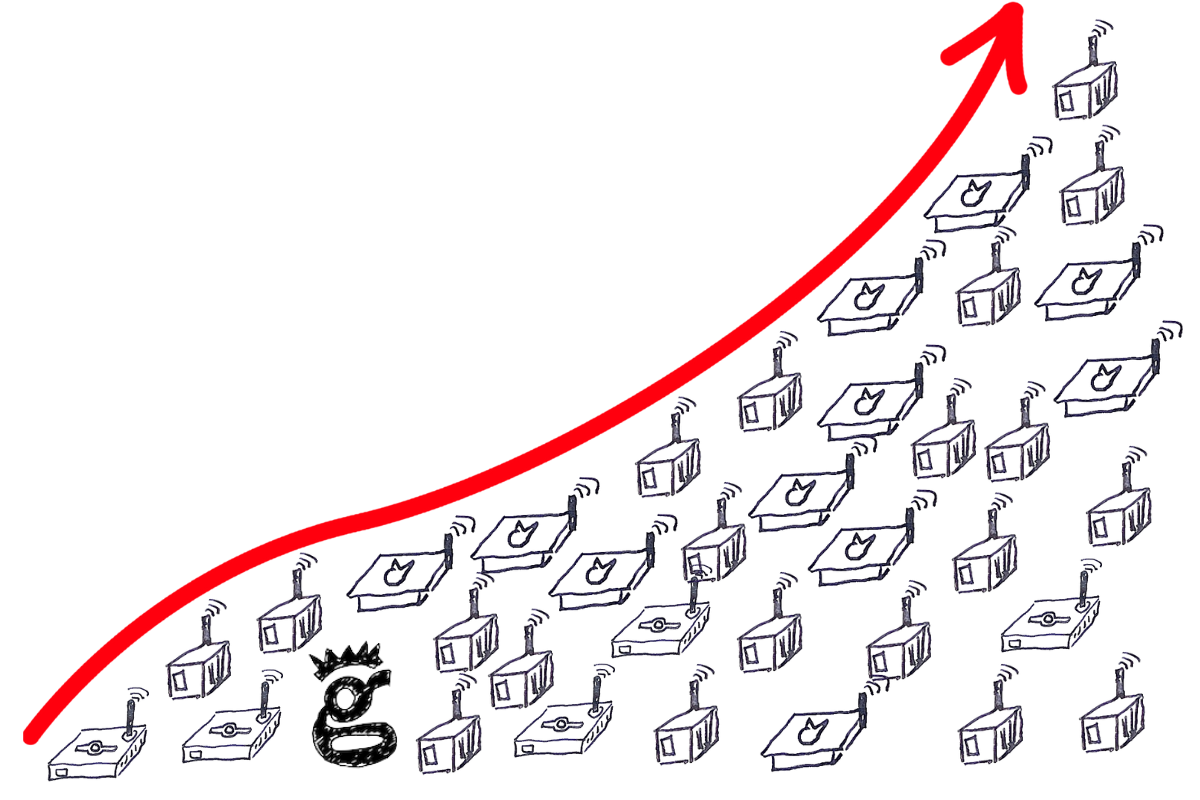
Helium has been an incredibly exciting ride so far, but as far as the general public goes, has one main stumbling point: It's not yet being used.

While that may seem like a giant problem, there are two critical (and often un-noticed) aspects: Remember, the network is still brand new. While it neatly solved the "chicken and egg" problem when it comes to how to deploy gateways when no one is using gateways yet, we're left now with a (golden) egg: A giant, unused network.

This giant unused network has two main problems, both of which are what the Silicon Valley folks call "high quality" problems.

First, it grew so fast it outpaced the ability of the market to produce hardware to be used on it. In fact, it grew so fast that it outpaced the market's ability to keep up with supplying the hardware to build it, never mind the sensors to use on it. This caused the main consternation, unfairly attributed to Helium Inc, of not being able to place an order for a miner. Helium built the first 5,000 miners. The other 895,000 or so were produced by third party manufacturers that had to go through a vetting process and immediately have the order ship.

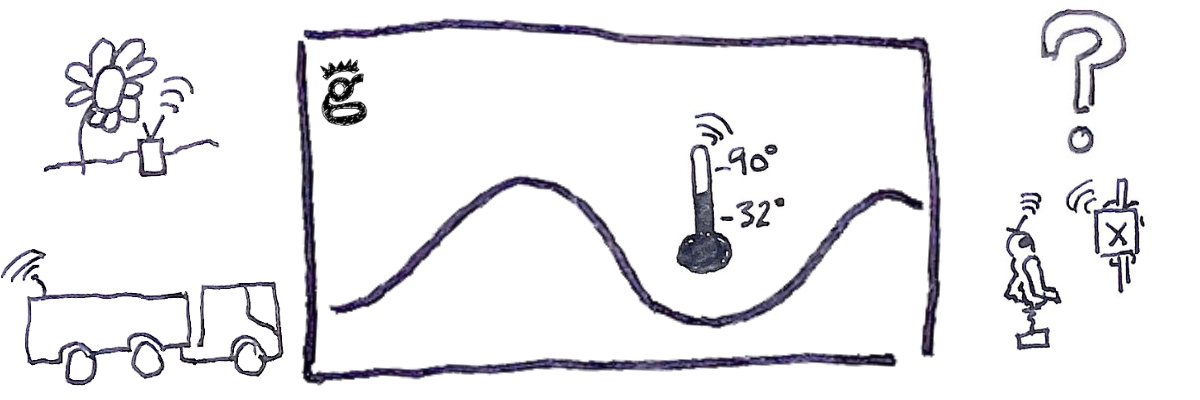
The sensors that will produce the most network data have not been built yet. This applies both to current available sensor ideas like vehicle trackers and soil data trackers as well as future solutions that only make sense when you have a widespread, cheap to use LoRa network. One example of a Not-Yet-Here sensor is a LoRa-enabled device permanently fastened to a catalytic converter. The technology exists to do this, but no one has built that business yet. Will you be the one to do it?

As Jameson Buffmire, VP of Decentralized Wireless over at CalChip Connect, has said:

"The enemy of innovation is not competition, it's inertia"

-Jameson Buffmire, VP Decentralized Wireless at CalChip Connect

The problem is not that there's a ton of competition, it's that this isn't the way we've done things before. Integrating LoRa, satellite, cell, and the rest of the protocols isn't brand new, but it ain't, by a long shot, commonplace.

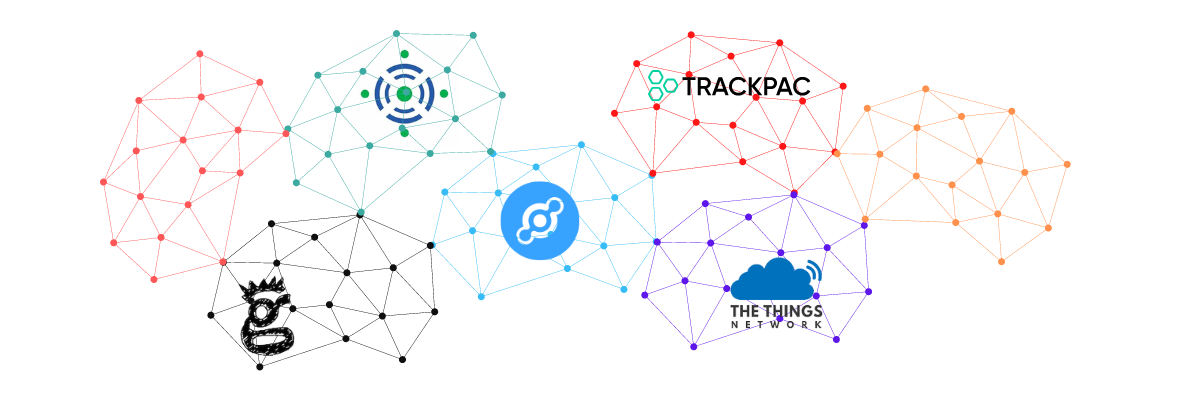
This brings us to the second problem that comes from having a giant network no one is using -- without usage you don't have a real world stress-test, and without a stress test you don't know if you can rely on it. Clever operators like Paul over on at disk91 are mitigating this risk by building networks that CAN roam onto Helium but also have other networks roaming built in as a redundancy.

This is probably the way we'll see Helium usage grow. For a long time, usage will slowly accrete as more and more fleets start to roam onto it. Unlike the bubbly early days, this gives the network time to work out bugs without catastrophic failure and build a reputation for reliability and ease of use. In the long term it'll probably become the de facto worldwide LoRaWAN it set out to be, and few people will remember this initial build out turbulence.

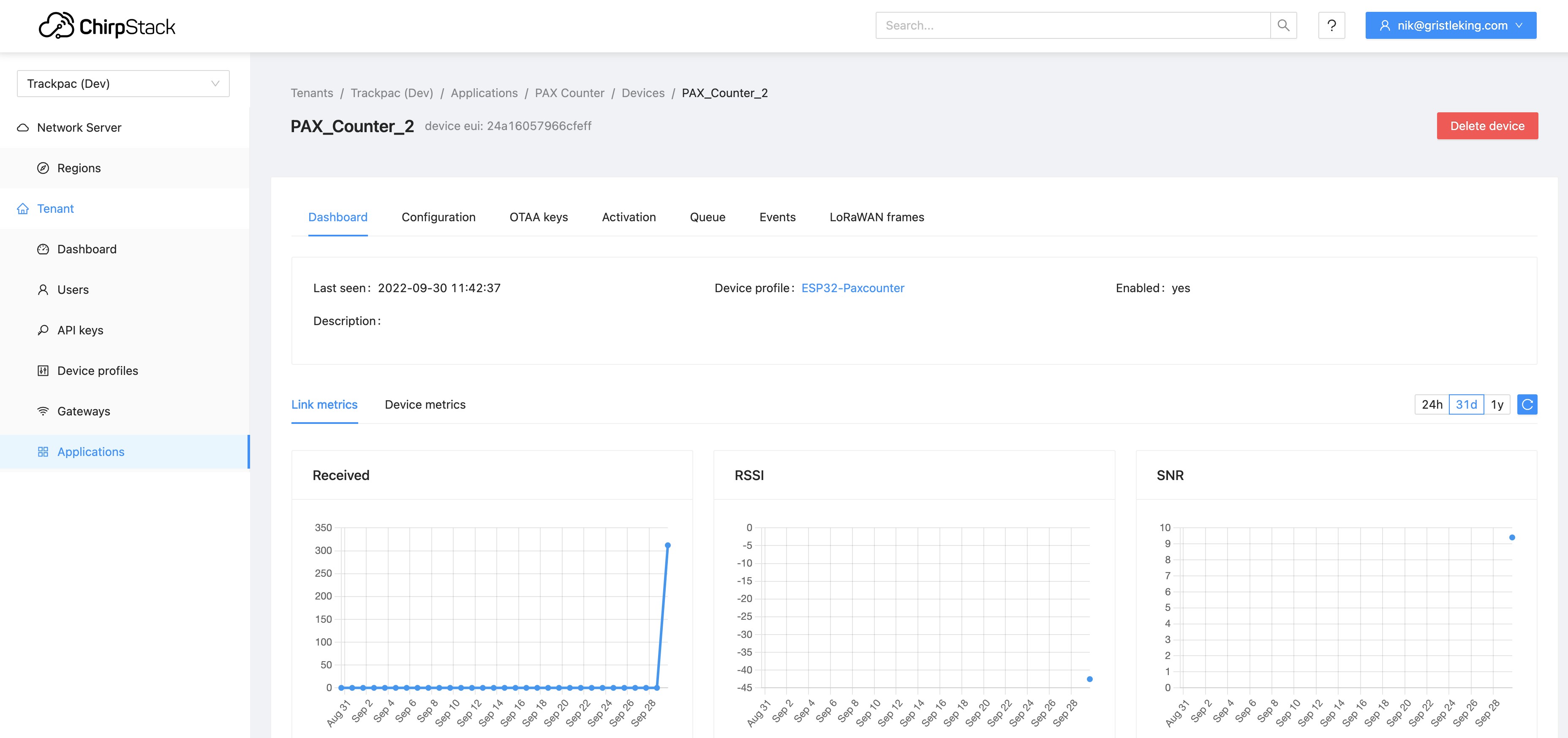
Remember, what it looks like right now is NOT what it'll look like in a year. Here's an example of today (September 30th, 2022) on a Chirpstack server run by Trackpac.

Now we circle back to where we started, with Rob Putt's idea: If you want to be a successful player in the long term world of IoT, now is the time to be relentless and build. Whether you figure out how to use Chirpstack, develop a new sensor, build the ability for others to use and re-sell network services, or just pay attention to the massive innovation going on in the wider space, this is an inflection point for those willing to do the work.

Very few are paying attention, the field is wide open. The limits are your imagination - it doesn't get any better.

"Go for build."

The Explosion of Blockchain + Meatspace

· 4 min read
Nik
Site Owner

At the recent TIPIN Summit put on by Lattice Capital, it became apparent that blockchain + meatspace projects are about to hit the mainstream of the cryptogalaxy.

With panels featuring everyone from Helium, the largest and most successful player in the space, to Anode Labs announcing the launch of the React Network (tokenizing Virtual Power Plants), the atmosphere in the room was electric; we witnessed the birth of a new paradigm.

As a start, here are seven "blockchain + meatspace" projects (aka TIPIN, or Token Incentivized Physical Infrastructure Networks). All of these work in the same general way: You install local infrastructure in the form of an antenna or device, then make the utility of that device available as part of a node in a larger network. In return for the usefulness you provide, whether it's radio coverage, power management, or a data stream, you're rewarded with token.

Helium - Decentralized wireless (DeWi), has deployed a worldwide LoRa network and a national, though yet sparse, CBRS network and has announced a partnership with telco giant T-Mobile.

Pollen - Decentralized wireless, focusing on becoming a cryptocarrier and MVNO (Mobile Virtual Network Operator) like Helium.

DIMO - Small device you put in your car that collects vehicle data and allows you to use it or sell it for tokens.

Hexagon Wireless, Mycelium, Hepta Networks - All aggregators of DeWi aiming to capitalize on having the hardware in hand and placing it in high quality locations (rooftops, telecom towers, etc)

Anode Labs / React Network - Aggregating electrical power demand and supply and paying the user back with tokens in exchange for local controls. They coordinate the energy created by solar panels, the energy stored in batteries, and the energy used (or not used) on site, like HVAC, refrigeration, or vehicle charging.

GEODnet - A project allowing you to add a "reference station" to your property in the form of a satellite antenna that improves local (20 mile radius) GPS accuracy to sub-centimeter.

WeatherXM - Weather station installed at your location that gives you hyper local weather predictions and contributes to meso and macro area weather forecasting accuracy.

There are dozens of other projects, from Foam to MapMetrics to Hivemapper to Birdbot. I keep an updated list for the Gristle Crüe on our private channel in the Gristle King Discord. If you'd like to stay abreast of the latest developments (and get briefs on these projects directly from the founders), consider joining the Crüe.

The rise of these blockchain + meatspace projects as ways for a group of strangers to cooperate and be rewarded with tokens that are tradable on the open market is exciting, but there's another aspect driving the adoption that has potential to be a society-changer: The growth of brand new businesses.

According to Harley Finkelstein, President of Shopify, we saw two very exciting things happen in 2021: First, the number of new businesses started in the US hit over 5 million that year, more than twice the previous 15 year average and the highest since 2004.

Second, Google searches for "how to start a business" outpaced searches for "how to get a job" for the first time ever. Harley's conversation with Patrick O'Shaughnessy is excellent, for now let's take as a given that we're entering (yet another) new paradigm of people taking more ownership over their income stream & agency through starting a business.

When you combine the rise of both blockchain + meatspace projects AND the rise of new businesses starting, you start to see the immense wave of innovation and change that is just now beginning to hit the shores of humanity.

Whether you're a farmer in Uganda who wants to jump straight into using IoT to improve production and manage your land far better than the First World has managed theirs, or you're building an opportunity for people to reap the benefits of the hundreds of data streams all of us are throwing off every day, the next half-decade will see an acceleration and explosion of new growth and individual agency when it comes to the powers we have unearthed at the intersection of blockchain + meatspace projects.

THIS is an extraordinarily exciting time to be alive. If ever there was a time to quit your day job and dive headfirst into a new world, the window for success in that endeavor will probably remain open for the next 12 to 18 months.

Rock 'n roll!

Helium HIP 70 Explained In Pictures

· 3 min read
Nik
Site Owner

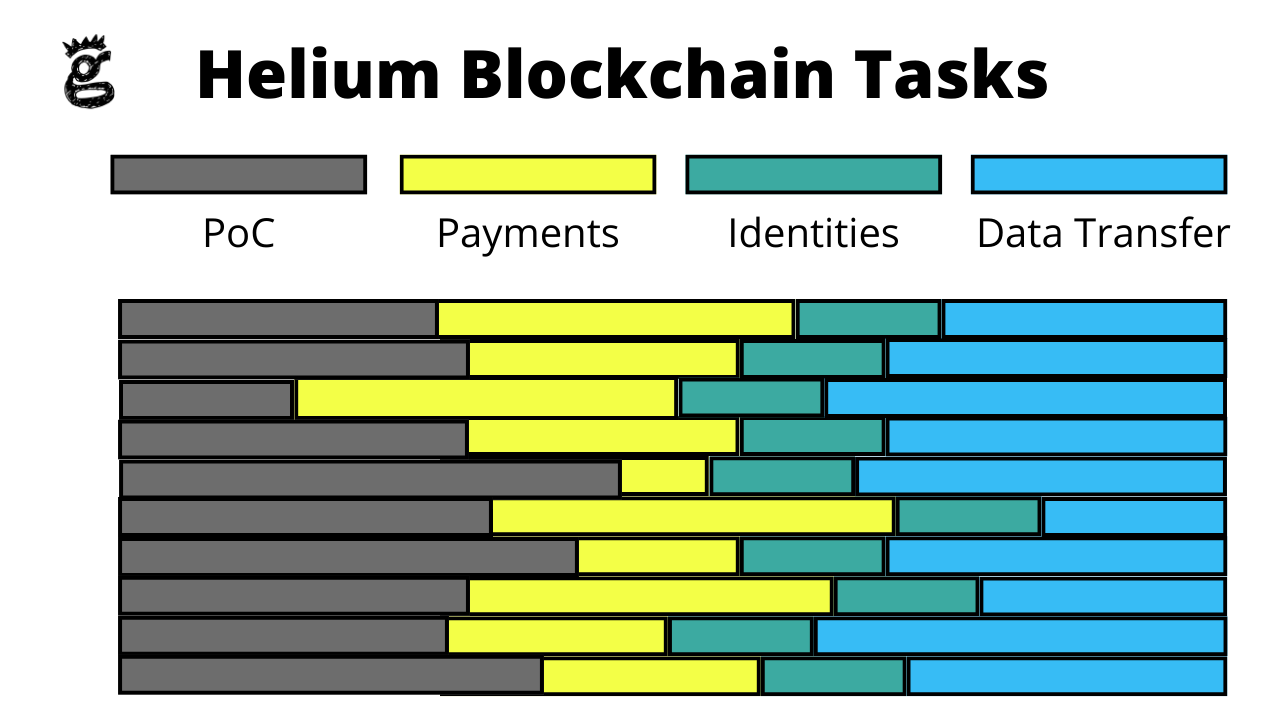
HIP 70 is simple. We (the Helium Community) are moving from doing everything ourselves to farming out a few things to experts. Here's what it looks like.

Let's start with the current system. Every action on one blockchain that tries to do everything and is getting bogged down:

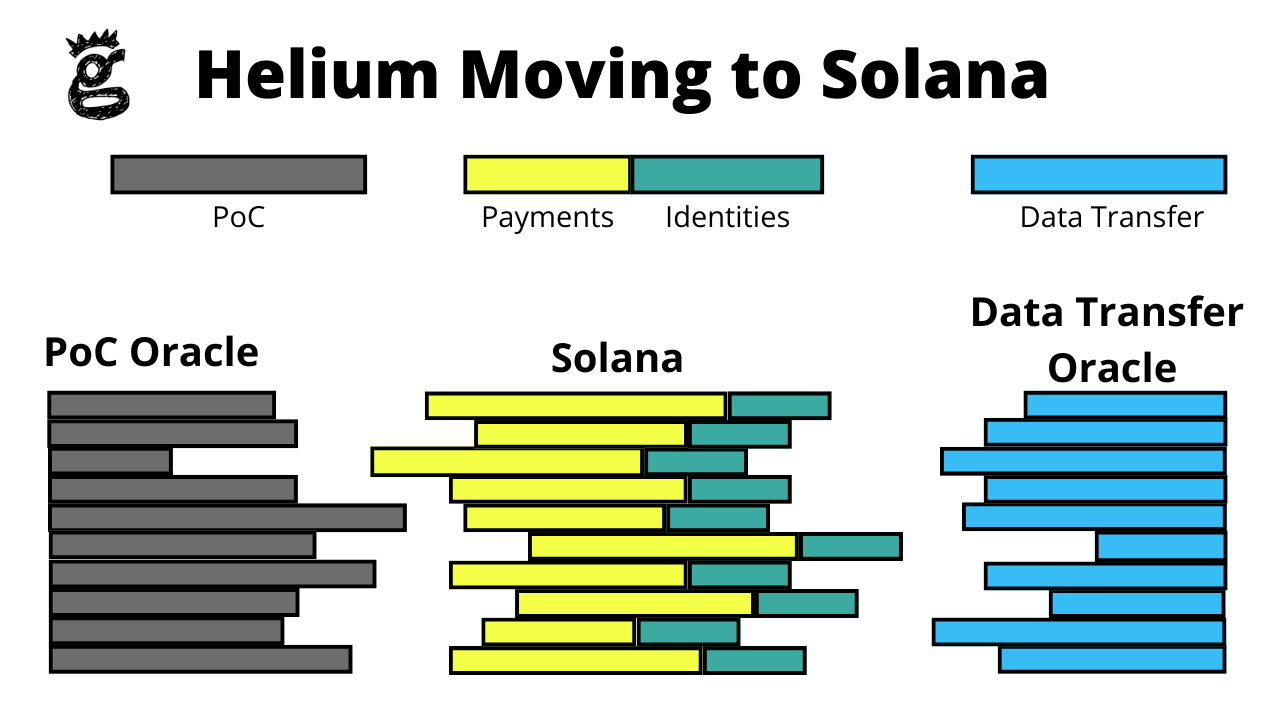
Yes, I know Validators aren't in that graphic. We'll get to 'em in a sec. Let's do part 1 of the move, which is splitting off the two most important things that don't need to be on a a blockchain: Proof of Coverage (PoC) and Data Transfer. Keep in mind that Data Transfer is literally the reason the network exists; it bloody well should have its own giant home.

The two actual most important functions of the network, PoC (Proof of Coverage) and Data Transfer (the reason the network exists) will move to Oracles (a fancy word for a giant computer that can do all the calculations required quickly without having to do anything else, then report the results to the blockchain. Which will be Solana.)

That split looks like this:

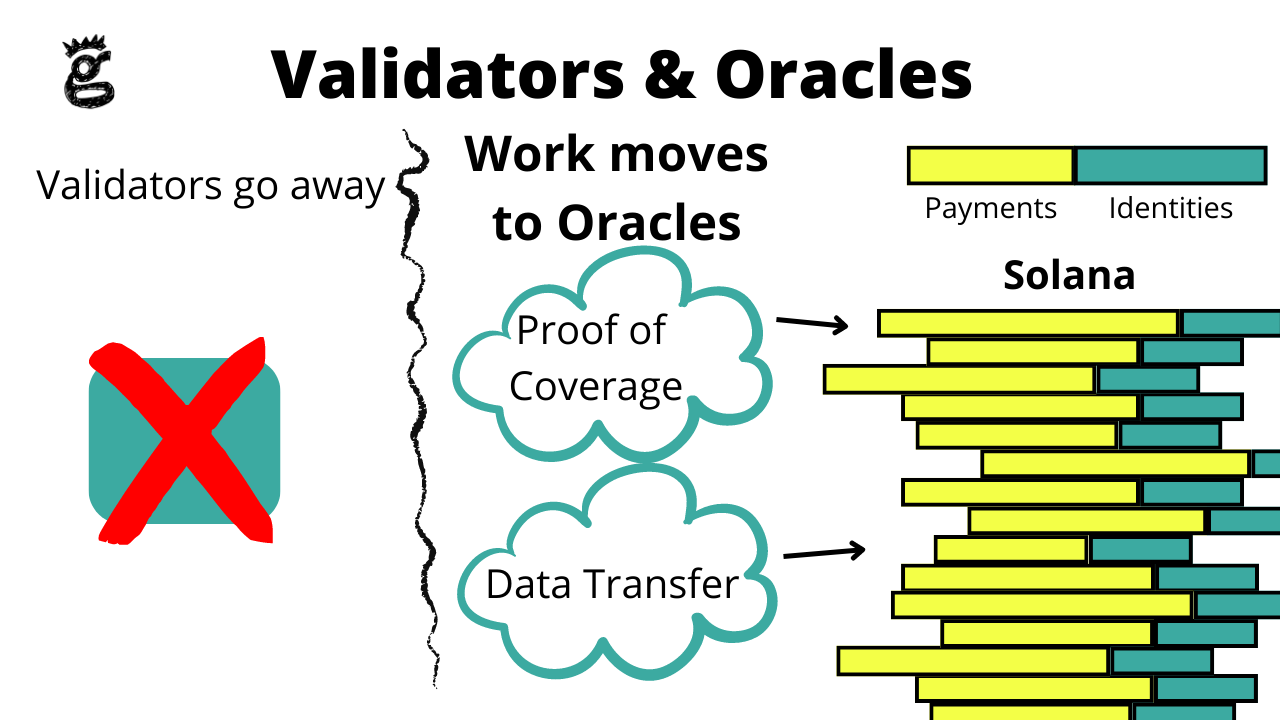
Ok, now what about Validators? They're gone, no longer needed. With the Oracles doing the work of PoC and Data Transfer and the blockchain recording it, what needs to be validated?

Helium runs on Solana, and in the long run, you (the Hotspot owner) get the benefit of having a few different entities who are expert in their fields working for you.

Now, just because we can get through it in 3 graphics doesn't mean it's an easy task. It'll be a hellaciously complicated and difficult thing requiring extraordinary expertise and hard work. My prediction is that we'll see it complete in March of 2023. I'll leave that here.

In the meantime, you the Hotspot owner don't really have to do anything special if you don't want to. You're always welcome to contribute and build. You can certainly learn to use Chirpstack right now if you've got extra time, or figure out how to run an Oracle, or dream up cool uses of smart contracts now that they'll be available on Solana.

Or you can go to the beach. Whatever you do, in less than a year we're very likely to have a much better system, a few powerful new partners, and something the world has never seen before - a fully operational Network genesis machine.

Rock 'n roll!

Archived Comments

Bronson - 9/21/2022

Can you write something on what happens to HNT as a coin and its relationship to Solana (SOL) as a coin? Do we need to convert to SOL? Will both still be available etc....? How does coin management change?


Nik - 9/21/2022

HNT will still exist, just as a token on the Solana chain. For the average user, there'll be no change other than that things will move a lot faster (assertions, transfers, etc.) Helium Wallet app will be generally the same.


An Off Grid Water Monitoring System

· 15 min read
Nik
Site Owner

I got into Helium to deploy and use a LoRa Wide Area Network (you can read about that here). Along with everyone else, I then got caught up in the wild gold rush of '20-'21, deploying hotspots and earning HNT, helping clients do the same, and occasionally just looking around and wondering at the madness of it all. While that was fun, and an incredibly profitable excuse to get out into some of my favorite parts of the backcountry in San Diego, that run is over and I can finally return to the reason I found and started with this project: Sensors.

As the VCs like to say, I have a thesis. My thesis is that widespread IoT deployment will create a new source of wealth from the streams of physical data these devices generate. This seems obvious: If you know more about the world than someone else (the fancy term is "information asymmetry") you can trade your information for a market price.

Now, this idea isn't new. Having information asymmetry is how businesses like Google and Facebook succeed, how governments fight and win wars, and how generally anyone succeeds. When you know more, you can do more.

What is different here is that a new fundamental structure for collecting that information has been built, is open to anyone, and is cheap to use. With almost a million Hotspots providing a gateway onto the Helium Network (as of late Aug 2022), there is no shortage of entry points to get information from where it is collected into your hands.

The hurdle at this point is two-fold. First, you've got to use your creative mind to develop an idea for the profitable use of the information collected by sensors. The information isn't out there yet, just the framework for collecting it.

Second, you've got to have the technical ability to deploy those sensors, gather their data, and turn it into something useful. I've written about a very basic project before (how to get a sensor on the network), which is a great start. However...

The Network is in the process of changing from that method to one that is more traditional. Now, the guts of that are pretty technically complex but the upshot is not: With the move away from Helium Console and onto Chirpstack (or any LNS, which stands for LoRaWAN Network Server), it'll be easier and more reliable to use the Helium Network.

Still, it ain't iPhone simple yet, and I've found the best way to understand how it works is to use it for a specific purpose.

In my case, I was given the purpose by the usual purpose-giver in my life, my wife.


"Get up", the DM read. "Don't ask questions, don't bargain, drive up there right now and buy it. It's a steal at this price."

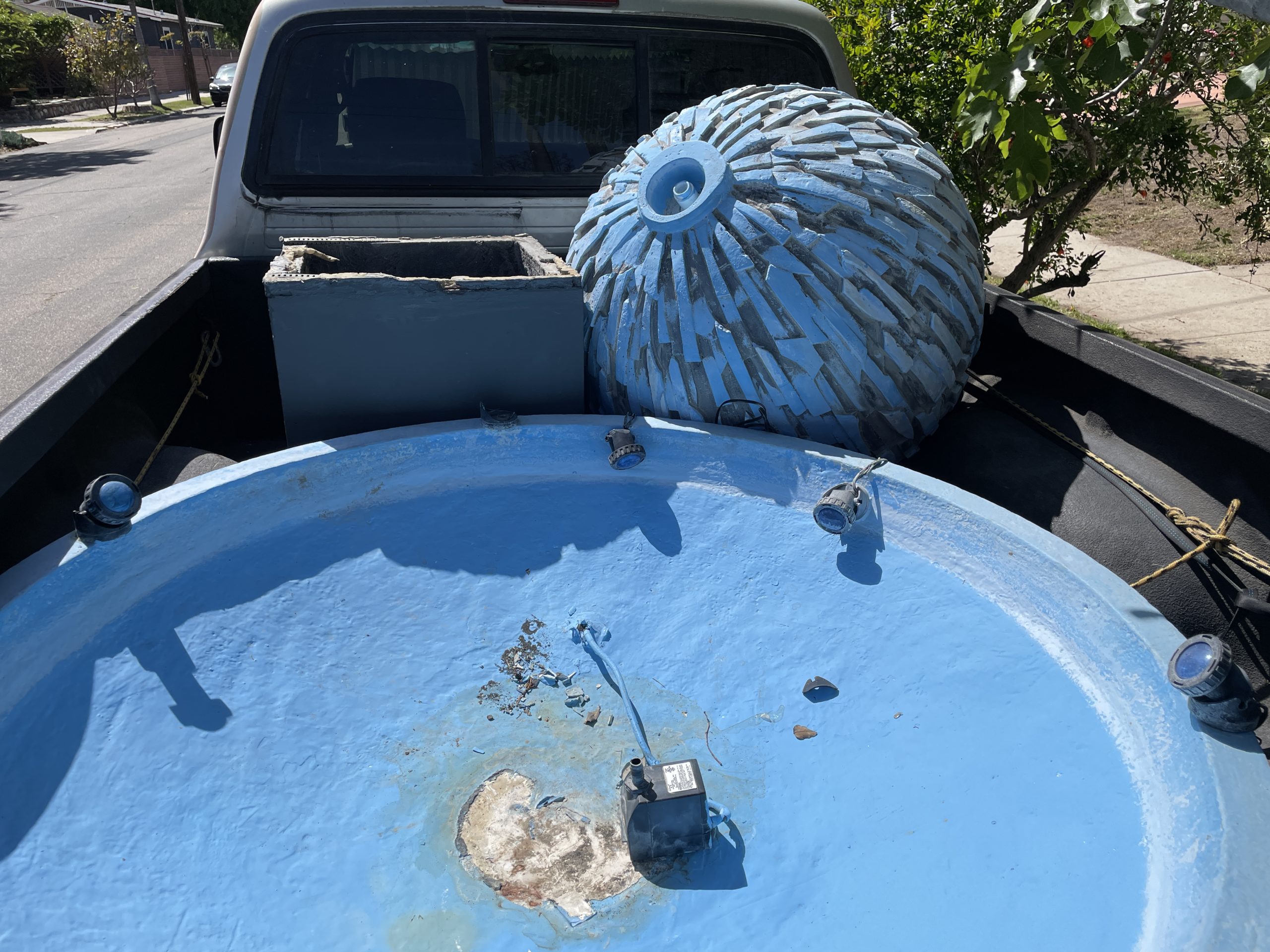
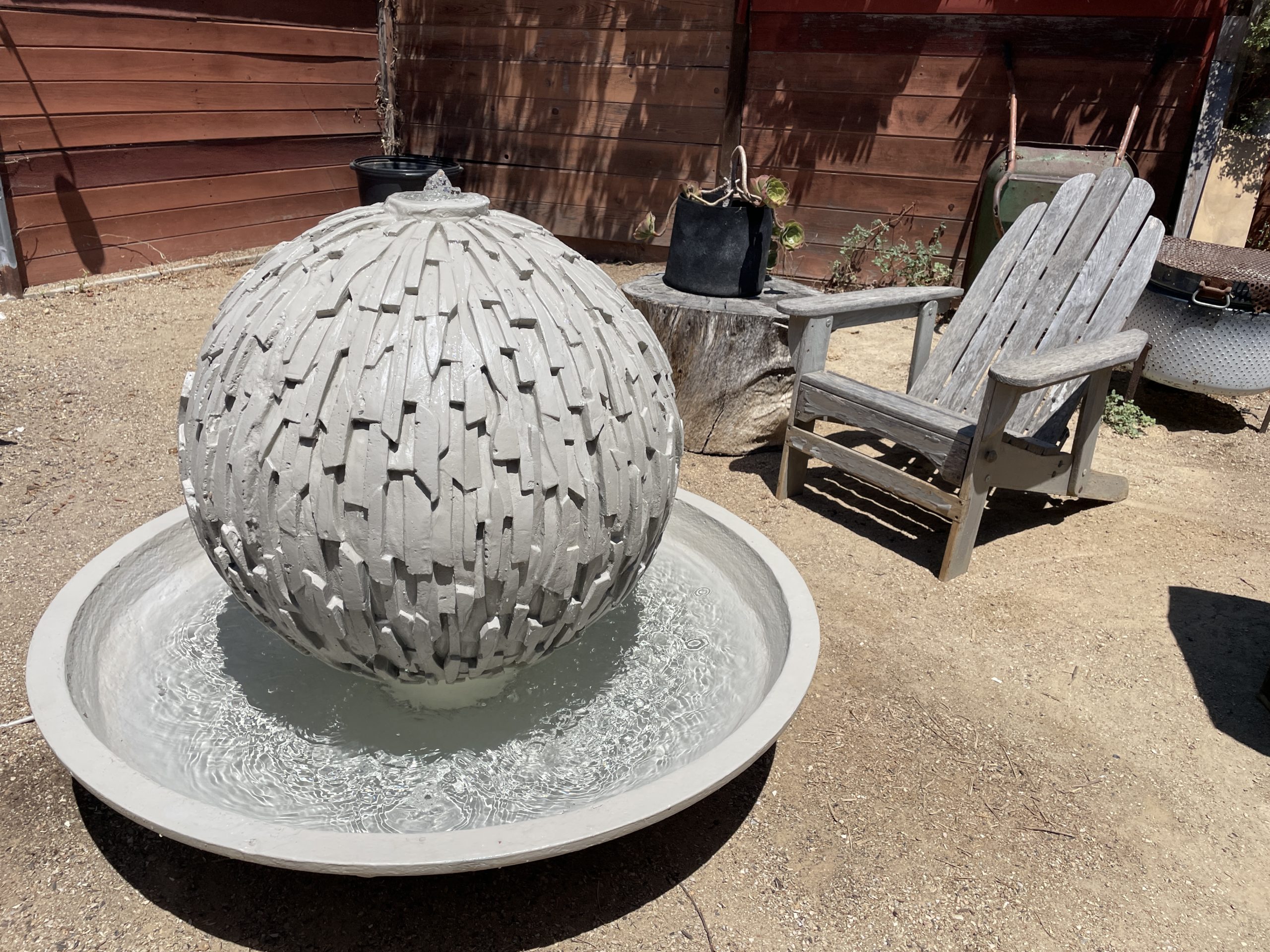
One of Lee's Instagram buddies was blasting her on a Friday morning about a fountain on Craigslist. Now, this wasn't just any old fountain. This was a giant jagged concrete ball and cup, an odd design that was unusual, but not flat-out weird. It's the kind of thing you might see in front of a small town bank that supported the arts. Technically the style is called "Brutalist".

The fountain was up in Los Angeles, about a 2 hour drive north from our place in San Diego. So, about 2 hours and 10 minutes after we got the DM, we were pulling into the driveway of a gated community where the fountain was.

I can't say the fountain was a horror show, but it sure didn't look like the brochure. Faded blue paint, fountain lights only half attached, a few cut wires, and the "industrial water pump" in the ad was just a $20 special off Amazon that, well, wasn't that special. Still, I've always liked a good project, and this had "project" written all over it. We loaded it into my truck and drove back home.

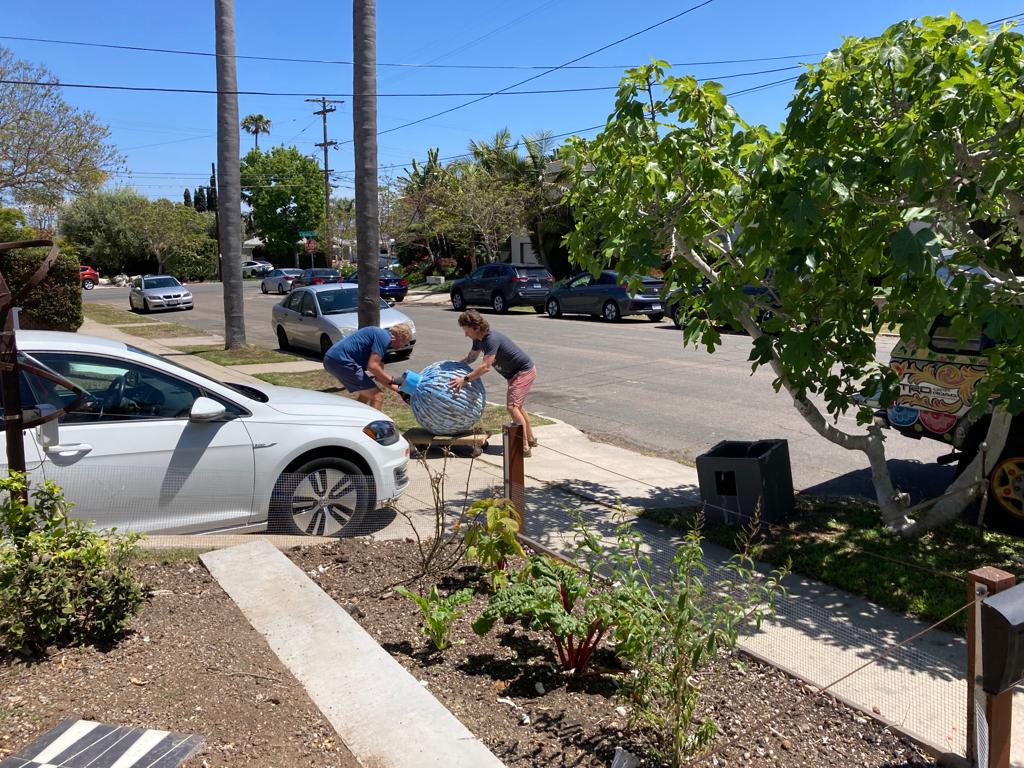
Of course, neither the ball nor the fountain are light or easy to move (they're concrete, though at least the ball is hollow), so I enlisted the help of my neighbor Pete, and we got everything moved into the backyard using his little roller cart.

I spent the next month or so grinding off the paint with a wire wheel in 15 minute efforts slipped in between consulting, writing, State of the Network shows, and the rest of the GK life.

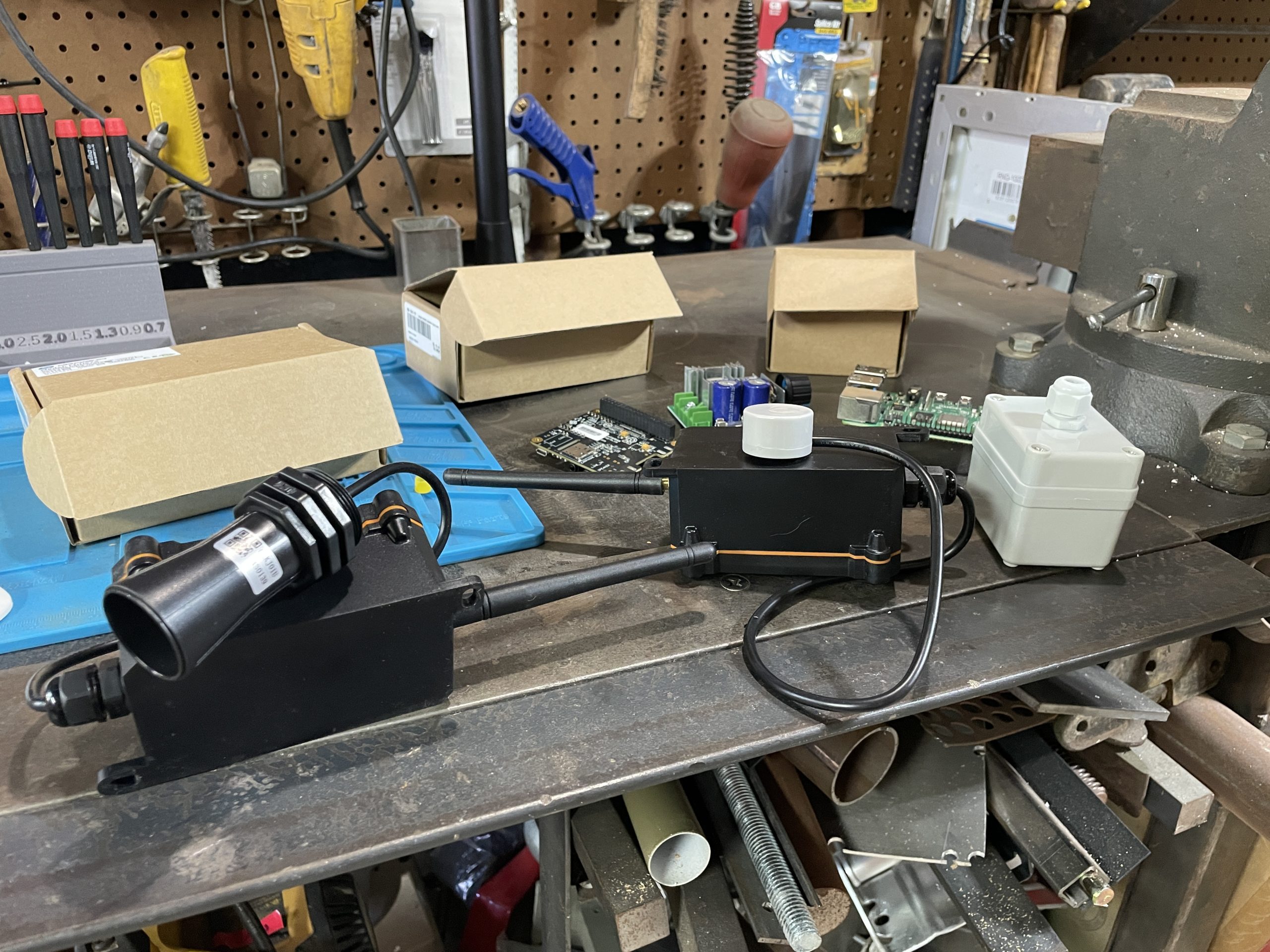
With help from Seeed, I put together a bevy of sensors to use in what I began calling "The Fountain Project." There's a Liquid Level Sensor, an Industrial EC and EDS Sensor, a SenseCAP LoRaWAN Data Logger, a Soil Moisture, Temperature, and Humidity Sensor, plus a Dragino LT-2222-L, the LDDS 20 Liquid Level Sensor (back up and cross check), a Water Flow Meter Sensor, and for the hell of it, a Dissolved Oxygen Sensor.

You see, I've seen a ton of different requests come through for various water data-collection projects in Helium. Flash floods warning systems, monitoring water levels in stock tanks, tracking water quality in ponds, etc. I thought it'd be pretty cool to take what was a small refurbishing project in my backyard and turn it into a giant super-fun example of a data collection machine.

I figured we'd track everything we could think of to track, from water temp to turbidity, acidity to depth, flow to TDS (total dissolved solids). As it turns out with water, there's a lot to keep track of!

I reached out to local double-E (that's Electrical Engineer) Dirk Beer at DB Tech to help design and build the system. I met Dirk through Helium, and saw right away that his knowledge and expertise would be critical on a project of this complexity if I wanted to finish it in any kind of reasonable time frame. Dirk is an Applied Cognitive Scientist, which basically means he figures out how to make sure you can use complicated technology.

This definitely seems like that. After all, we're combining a bunch of sensors that aren't yet user-friendly, sending that data through a growing network that is making a major shift in how the data is processed, and then displaying it in a variety of ways on technology that requires a fair amount of education to set up.

So that's the baseline; we get and display the data. Pretty cool, but that ain't the full value-add. I'm super curious about how we combine all the data we're receiving to understand new aspects of water monitoring, as well as taking our "private" data stream and referencing it against publicly available data streams like weather, air quality, or even water quality.

This intersection of public and private data streams hold promise as a rich vein of information to mine, with lots of potential asymmetry options bubbling up.

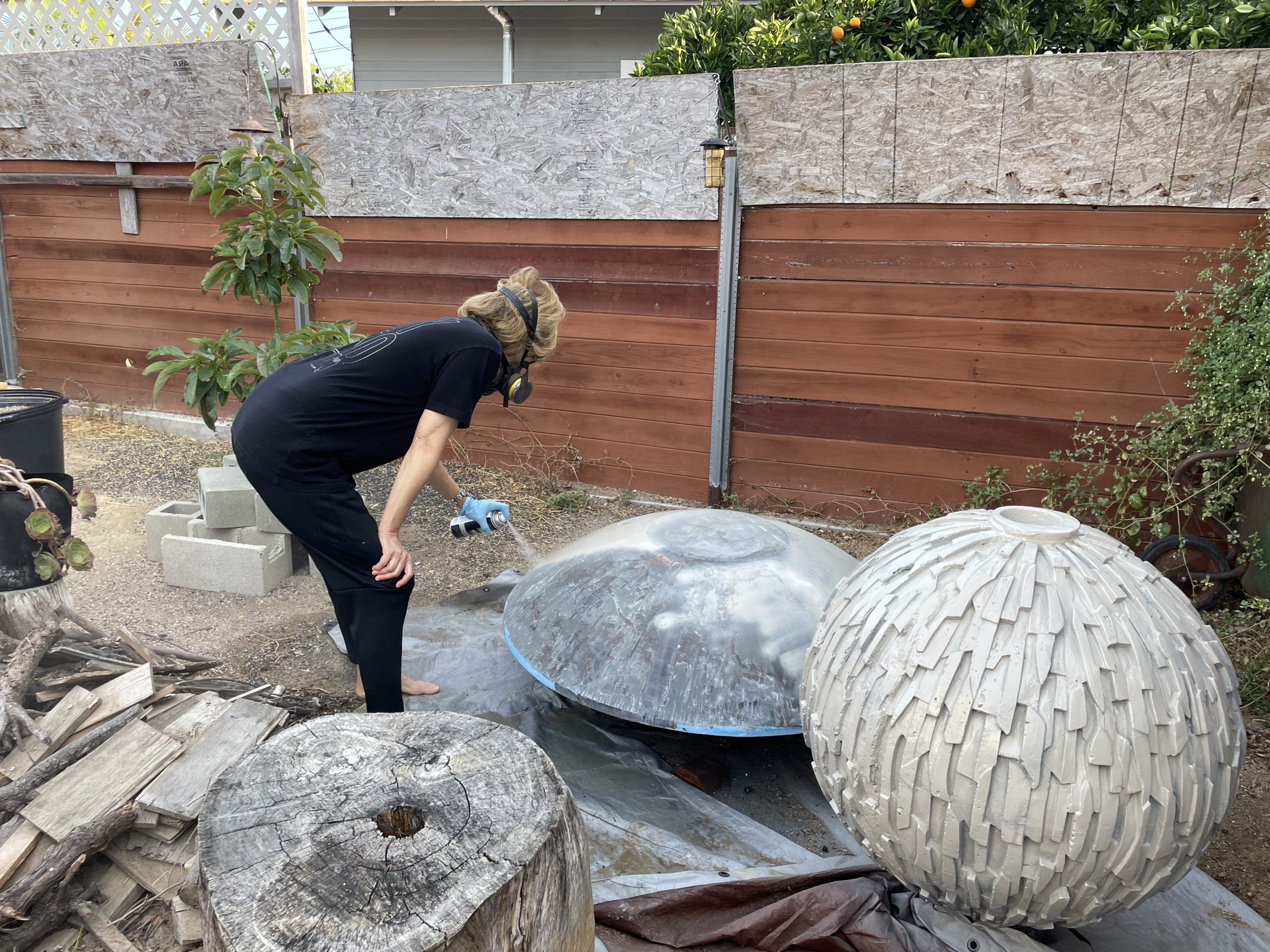
With all that in my dreams and the future, I still had work to do. So I asked my wife Lee to help. :)

I finished up with grinding and painting the fountain, (Lee helped with the painting) replaced the pump, and got it working.

For a while, it was beautiful.

Then, another wrinkle popped up: Algae.

https://vimeo.com/745540237

Yep, with plenty of sun, constant water, and lots of little crevices, it turns out the fountain is an algae growing machine. This brings up an obvious point: You can track all the data you want, but if the medium you're tracking in gets overwhelmed, well, you're just tracking muddy waters.

That means I had to build a filter system in order to keep the water clean enough to monitor, and really to have something to monitor in the first place. Now, this may seem weird, but I discovered a personal obsession, almost a fetish, with designing a water filtering system. There's so much to do, and know, and it's easy (and fun) to go overboard. I mean, physical filtering is one thing, but why stop at screens and sand when there's UV light, ozone bubbling, and protein skimmers?

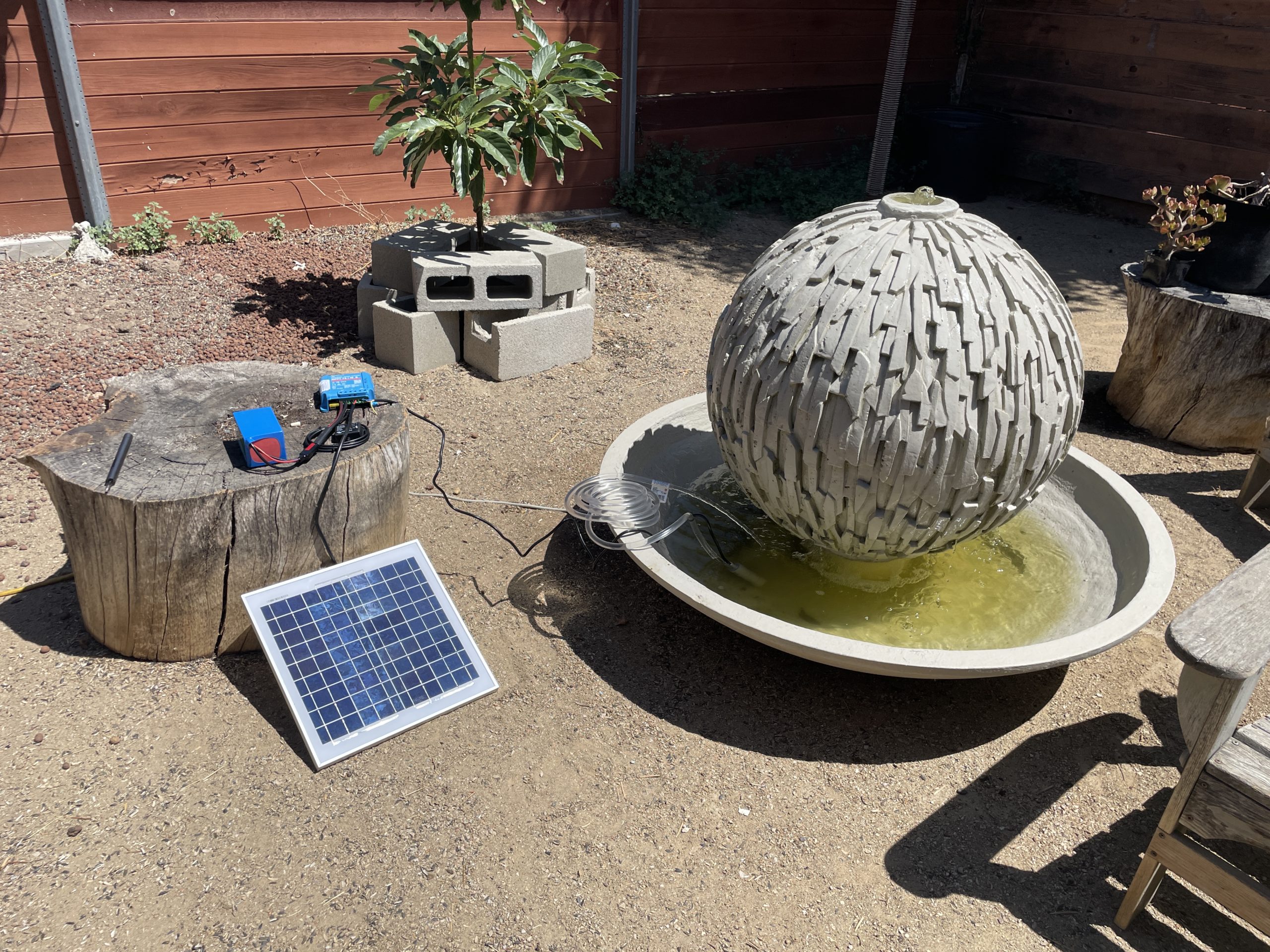
I started off by dipping my toe in with a small $12 pump on Amazon and building my own DIY PVC filter, then sending the water out through a small (I thought it'd be a lot smaller) UV sterilization device. The pump was 12 VDC, which means I could use some of the off-grid components I'd bought for Helium the year before to run it. I pulled out a 100 watt solar panel and the 50 Ah battery along with a Victron charge controller, hooked it all up, and ran it for a day or so.

The good news was that the solar panel was generating enough energy. The bad news was it was only 78% of rated power. The ugly news was that I'd probably need more of everything to do the job I wanted to do.

It was a janky set up, I know. Still, I knew it wasn't my final, it was my first, and I'd learn a bunch. I did.

First, even in a small water volume like mine (less than 15 gallons), with the amount of sun the fountain gets and our balmy outdoor temps, the pump wasn't circulating enough water through the filter & treatment system to keep the water clean. It was mostly clear, but with a greenish hue. Not acceptable for Lee, plus the tiny pump had a loud whine running at high rpms.

Now, before you tell me to just add bleach every few days to kill the algae, I've got to tell ya: Bleach won't fly with Lee. End of story. I know, I know. Bleach kills everything and will save me 40 hours and probably a thousand or so dollars. See the above re. Lee.

The second problem is that there isn't enough water movement. Sure, the pump was moving water through the filter, and the filter was working, but the problem was that it wasn't all the water in the tank, just some of it. In order to clean all the water you have to treat all the water. In order to treat all the water you have to move all the water past the pump, and an intake diameter smaller than my favorite pen just can't create enough suction to generate tank-wide water movement.

Now, I'm sure eventually some aquarium expert will come here and shake her head at my ignorance in hoping my initial plan would work, but hell, for a first attempt it wasn't bad.

For my second run, I decided I'd go more towards the overboard side, with a much larger pump housed in an external structure, ozone treatment on top of the UV light, multiple physical filters, and including water movement throughout the fountain in the design. If I can swing it, I'll add in a protein skimmer. I mean, at this point, why not?

I also wanted to move all the machinery out of the fountain. The whole point of the thing is to add a little serenity into the backyard, and tubes and pumps and filters all jumbled together next to it don't really add to the vibe we're going for. Plus, I needed a roof big enough for the solar panels that'll provide the power for all this. Moving water ain't energy-cheap.

Since I was going whole-hog, I figured I'd add in a reservoir to the pumphouse where all the water treatment happens, pulling in untreated water from the fountain and returning clean water.

For all that to work, I'm planning on taking the fountain apart, drying it all out, drill a few new holes in the concrete bowl for drainage and return (you know I love drill concrete, right?), re-paint a color that makes algae less obvious, and build a stand to let gravity do at least some of the work for me. Oh, and build a little home for my mega pump & filter contraption.

So, that's where we are now, at the end of Stage 2. Stage 1 was the purchase, prep, and initial setup. Stage 2 was adding in a separate pump and filter. Stage 3 will be building out a more robust filter and water movement system, and Stage 4 will be adding in sensors to the network in order to monitor whether or not the system is working, and when it isn't, what exactly is going wrong.

If you'd like to follow along with this and keep up with all the sensor decisions and learnings, the best way to get the most information is to join the Gristle Crüe. The Crüe is a paid membership for folks serious about learning together. Think of it as a Mastermind for Blockchain & Meatspace projects, with Helium front and center. We meet once a week on Zoom for presentations by experts or discussion amongst ourselves (including in October our first Hotseat session!) and have our own private Discord to problem solve quickly with fellow experts. If you want to maximize the whole blockchain & meatspace opportunity, join the Crüe.

If you think I'm batshit crazy OR you're a water treatment guru and can see clear flaws in my thinking, drop your comments below, and thanks in advance!

What Is The State Of Play In The World of DeWi?

· 20 min read
Nik
Site Owner

Helium is the project that started it all, but the DeWi space is rapidly growing. With that growth come questions, mysteries, and opportunities. New players, both known and unknown, are entering the mix. As the idea of 5G starts to really get legs, one question you should constantly be asking yourself is, "What is the state of the space?" I'm glad you asked...

https://youtu.be/HxJdrAxdNxM

The thing we call "Helium" is now at least 3 separate entities (Nova Labs, the Helium Foundation, and it could be argued, the greater community of Hotspot owners). Helium may eventually stand to mean the entire decentralized wireless space; it certainly created it. For now, let's start with a useful beginning point, which is somewhere in 2020, when the first Helium Hotspots were being sold.

Helium started by playing in an uncontested space: Building a global LoRa network. Until Helium came along, most of us neither knew about nor cared about LoRa. I mean, I did, but only as far as it was useful to me in my paragliding endeavors. That's how I found Helium, but that's another story.

Helium, using a token as an incentive, deployed a global network of 800k+ LoRa gateways in about 2 years. They did that on the cost of the salaries for a few dozen people plus the first whack of cash to do a production run of what would ultimately be less than 1% of the Hotspots/nodes/gateways on the Network. No one else had done anything close to that before, no matter how much cash they had.

Helium started with LoRa because it was uncontested. The Helium team knew they would eventually get to a point where they entered contested space, whether that was 5G, WiFi, or all data flow on the planet. Before they showed up for the big game, they wanted at least a scrimmage under their belt. LoRa was that scrimmage.

That test game taught them a lot. They were far more successful than they'd hoped to be. Now, success isn't always rainbows and HNT, and part of the rapid and unmitigated success played out in an angry crowd of customers who didn't understand what they were getting into, or how it worked, or what to expect. Overwhelming growth also highlighted faults in the engineering and governance plans they had.

Of course, faults were expected. Every good engineer knows that you don't get it right on your first try, and when your first try blooms into a global network you're going to have global problems to go along with it. Helium is stacked with excellent engineers, so while the individual issues may have been surprises, everyone on the Helium team expected significant turbulence along the way, and they got it.

Now, most of us didn't think about all that. We weren't asking, "What can we learn from building out an esoteric global network in an uncontested space?"

The vast majority of people deploying hotspots were doing so because, as Steve on the DeWiGo blog has said, "People just want crypto." I get it. I'm one of those people, just like you. Still, as the dust settles and thousands of people are realizing they aren't going to be earning that much crypto, you've got to wonder:

What did we just build? What lessons can we learn? What lessons did the venture capitalists learn? The big telecoms? How does this direct our next actions?

When you think about in terms of lessons learned, it helps re-frame the questions that you ask about the next project. If I've learned anything in a few dozen spins around the sun, it's that the questions you ask determine the outcome you get.

Let's start with a few lessons learned. Keep in mind that some of these lessons may not seem important to you. They may seem to only apply to venture capitalists or big companies. You may want to skip them. Don't. If you're going to invest your blood and treasure in a project and you want returns on that, you had better be able to see the thing from every perspective possible, large and small.

Let's begin with a lesson for people thinking about building the next big decentralized network. These are the engineers, the investors, the students, the dreamers who saw what Helium did and thought, "I can do better."

First and obviously, building a decentralized network decentralizes what are called "CapEx" for "CApital EXpenditures". A normal person would call that cash. It also means you can keep OpEx, or OPerational EXpenditures low, because all you have to do is maintain a network someone else built. You might think of OpEx as "payroll" and "tech support".

Translation: It's relatively cheap to build and maintain a giant global decentralized network.

Implication: Expect many more decentralized blockchain + meatspace competitors to spring up. That's not just in wireless. Helium led the way to show how successful these projects can be, but that ain't where it stops. Need an example outside of DeWi? What does a decentralized Glucose Monitoring Network look like, where you get paid in GLUC tokens to contribute your blood sugar data stream through a device you buy and maintain?

Second, any time easy cash comes up for grabs, then graft, grifts, and general cons will immediately embed. Not dedicating resources to combat that from the beginning can create significant customer dissatisfaction. Dissatisfaction equals friction, and friction in business kills profits.

Third, anonymity sounds really cool, but when you're trying to stamp out the graft (read "gaming" "cheating" "stealing" etc) mentioned above, it's pretty hard when you don't know who to step on. Just having the ability to make players anonymous doesn't mean it should be used willy nilly.

Fourth, with all of those above things being true, structuring the incentives of any of these blockchain + meatspace projects (NOT just DeWi projects) is critical to long term success.

I'll tell ya this: If I were building a blockchain + meatspace project, employee #2 would be the most competent economist I could find at any price.

Perhaps the dismal science isn't quite so bad after all?

Fifth, a network that is global can exist and still be more or less unused. Solely building actual utility on that network may create enormous wealth. Examples of companies building on the giant currently unused network we all created include Trackpac and Uplink Engine.

Sixth, transparent and effective governance is critical to efficient growth and community management. Relying on a decentralized group to make good decisions together is neither efficient nor likely to come up with the best outcome. As Kenneth Stanley has explored, group decisions end up being things that are the least bad for everybody, not necessarily the best thing for the group as a whole.

Seventh, an education plan that details to the community what to expect, what is changing and why, and how they should prepare for future growth can remove significant amounts of friction. A community living in ignorance because information is not easy to find is ripe for being led astray by the biggest voice, whether that voice is informed or not. Education is essential.

If you are reading this thinking that your team needs help with an education plan, please reach out. I built the largest blog on the net for Helium that helps explain to thousands of people what was (and is) happening with the project. I would be happy to apply the lessons learned here to other projects.

With all that learned from the "LoRa scrimmage", let's take a look at the next network Helium announced, "Helium 5G" on April 27th, 2021.

Helium launched it first, but Helium 5G has not been the wild success LoRa was. Why? Let me be clear here: It's NOT because the Helium team is stupid, or ignorant, or unable to learn lessons from the past. Many of the lessons from LoRa were so cleanly applied to the 5G rollout that you didn't notice some of the friction was gone. Still, 5G is a different animal entirely and (I suspect) the announcement was rushed. Let's start with the differences between LoRa and 5G.

First, LoRa was basically uncontested. In 2019 you could've announced an intent to stamp out the existence of LoRa as pestilential spectrum or to make it an interplanetary protocol; nobody cared.

Second, the reason LoRa was uncontested was that very few people knew how to use it, let alone use it in everyday life. It's still complex, and the likelihood that the average global citizen will use it in 2022 hovers only slightly above absolute zero. Hell, less than 1% of the world's largest LoRaWAN network even votes on how to use it, and the number of citizen technologists who will today improve their life through some LoRa stat can be measured with the number of fingers on a carpenter.

Now, that's not an indication of value, but of current use. The "battle" for LoRa wasn't a battle; Helium just came in and scooped a delicacy off the platter that no one knew existed. That is unlikely to happen again, and if you were there to watch it, you were reminded of the great hockey player Wayne Gretzky's quote, "I don't skate to where the puck is, I skate to where the puck will be." Helium was there, but the puck has moved again.

Third, because large LoRa networks didn't exist, no one knew the value of large LoRa networks. Now, let me be super clear here: Helium obviously knew the value; that's why they targeted it. Some senior level execs at various companies around the world also knew and know the value, though my feeling is they couldn't believe that a global network could be (and has been) built out so quickly and cheaply.

Suffice to say, a global LoRa network is HUGELY valuable. If you believe that, and I do, I'd advise (as your personal investment advisor on the internet) that you hold onto both your Hotspots and your HNT.

With all that in mind, pretty clearly the LoRa rollout is the opposite of "Helium 5G", aka data on cell phones. How?

  1. Everybody knows what cell data is. It is not an unknown
  2. There are large, established, and very dangerous competitors in the water. Hi Charlie Ergen!
  3. Everybody already uses cell data. 7.1 billion phone users in the world is close enough to everyone.
  4. The part we're using, CBRS, is a small slice and we have the lowest priority.

So, why would a company that came off a giant successful launch of an unknown product in an unknown space to an unknown market enter a new space that was crowded, dangerous, and well known, at a bottom tier and almost completely unprepared to deliver? I mean, ask yourself that!

To be clear, I don't know why. It still seems silly to me to launch so early, and I cannot make sense of it. I do have a few guesses:

First is probably useful hubris. We need bold, daring visionaries to architect a new future. If you've ever met Amir Haleem, you know he is exactly that. If people like him don't imagine a world for the rest of us to grow into, well, we don't have much hope. We do, and it's a result of useful hubris. I support that.

Before I get to the second reason, let me state for the record: The Helium/Nova team (and probably Pollen, for that matter) represent some of the smartest and most technologically capable humans in existence. I would not discount their decisions. In general with Helium, I've always assumed that everyone knows more than me and is smarter than me. I believe that to be true in this case.

Second, Helium HAD to announce 5G. They had to claim it. They didn't know how far along either a telco or their next competitor was. Those entities could've announced on April 28th, 2021 or...later, which is what Pollen did 10 months later, in February of 2022. Giant telcos still (as of July 2022) aren't tipping their hand.

So now we've got the (miniature) elephant in the room, which is PollenMobile. The question everyone's tiptoeing around is,

Is PollenMobile a competitor to Helium?

You are goddamn right they are! HOWEVER...

Both Pollen and Helium have to survive long enough to be able to emerge on the other side of the telco battles. Remember, they're not entering an uncontested space that nobody cares about. They're entering one of the most competitive markets in the world, with giant dangerous players walking around who are exceptionally well funded, well organized, and stand to lose mountains if they don't play this right.

My take on the Helium vs Pollen debate is to support both, to roll out both, and to help both of them get big enough to build us a better world.

That's what we're betting on. When you build with Helium, Pollen, or whatever the next project is, you're betting that a decentralized world, with all the mess and mistakes of a newborn human endeavor, will be better than a centralized one.

We are betting that a bright and shining thread in human history, one of spreading power throughout a community and applying rewards where they're earned, will actually win out the battle. It may not. That thread is covered in grease and gore, the blackened fat and blood of a thousand fiery battles between the well-governed and the ill-used. The burnt out tattered ends of that thread mark the tread of history, though the shining remains yet. Where we end up in the future will be determined in part by where we place our bets today.

That's why I'm betting on both. Deploying both.  Learning from both, working with both, and more.  They only GET to be competitors if they survive to adult-hood. They're not even pre-teens yet; let's get 'em to maturity before they go into mortal combat with each other.

For the record, I'm pro-Helium & pro-Pollen.

"But, but, but, I thought we were going to talk about the state of the space, what about that?"

We are, but I had to set the stage first, dawg.

Now that we've got an idea of the larger currents swirling around, the lessons learned, and what's at stake, you can start to make better decisions about what you're going to invest your money in, and how, and where.

What will be the next steps in this space? What do you want to support and build? How will you, as an individual, or company, or investor, place your bets? Will you support a decentralized world?

Let me point you in a direction. It's not the only one you should explore, it just gives you an idea of how to think about the state of play here.

Let's start with a defined question: Will Helium go after WiFi, or VPN (Virtual Private Networks) or CDN (Content Delivery Networks)?

Run through the same 4 questions for each one:

  1. Does it already exist?
  2. Is it being used at any kind of scale?
  3. Is someone currently paying for it?
  4. What has to be true in order for a decentralized version of this to exist?

The first three are easy answers. Answering the last one is what will deliver value to Nova Labs, and the Helium Foundation, and PollenMobile and a host of other organizations entering this radical, vulnerable, and potentially world changing decentralized blockchain + meatspace arena. Perhaps YOU have an answer to that question that no one has thought of, and you hold the key to a better world for all of us. If you do, I sure hope you step forward and put your shoulder to the wheel of progress, helping us all build this better world together. If I can help you, let me know.

Figuring it all out is what makes this exciting, I'm stoked you're along for the ride!


Waitwaitwait...what're we up against, Nik?

I mean, are we REALLY up against giant dangerous players in a well developed space? Is there any hope at all? (Yes, that's why this is so exciting!)

Interesting facts

Hexagon Wireless raised $2 million to buy hardware for Decentralized Wireless projects. They're buying and deploying a ton of Pollen hardware.

Helium raised $364 million across 7 rounds of funding since 2013. Currently valued at a billion-ish, with the largest LoRaWAN network in the world and rapidly growing a small cell (what they call 5G) presence across the US.

Those seem like big numbers, right? Wrong.

Back in 2020, the FCC sold CBRS Priority Access Licenses (a priority level ABOVE ours) in Auction 105 for a total of $4,543,232,339 in net bids.

What are Priority Access Licenses? We'll take a very quick detour here to talk about the electromagnetic spectrum, from long wave to millimeter wave. In the US, the government sells access to portions of the spectrum to different players. It's why when I turned to FM station 107.3 in Boston as I kid I rocked out to WAAF, but now another company has bought the rights to frequency and broadcasts...something that ain't rock 'n roll. They've paid to broadcast on that band within a certain power range, and no one else is allowed to.

A Priority Access License means that a company pays for priority over the next level down to broadcast. It means that if I'm broadcasting with my Helium small cell on, say, 3.56 GHz and the company who owns the local PAL wants to use 3.56 GHz, I get booted off.

Confusingly in our band (CBRS, 3.55-3.7 GHz), a Priority Access License still doesn't give you the top priority; that's reserved for the US government.

Even as a second tier user, those licenses are valuable. Companies paid $4.5 billion (with a B) for a tiny slice of spectrum that the US government STILL has priority access over. We're at the bottom of that priority list. As the use of that spectrum fills up, you should expect that your DeWi network will negotiate with owners of the PALs to allow us to broadcast under their license. Yes, we'll slice out some profit for them in order to do that. That's just business.
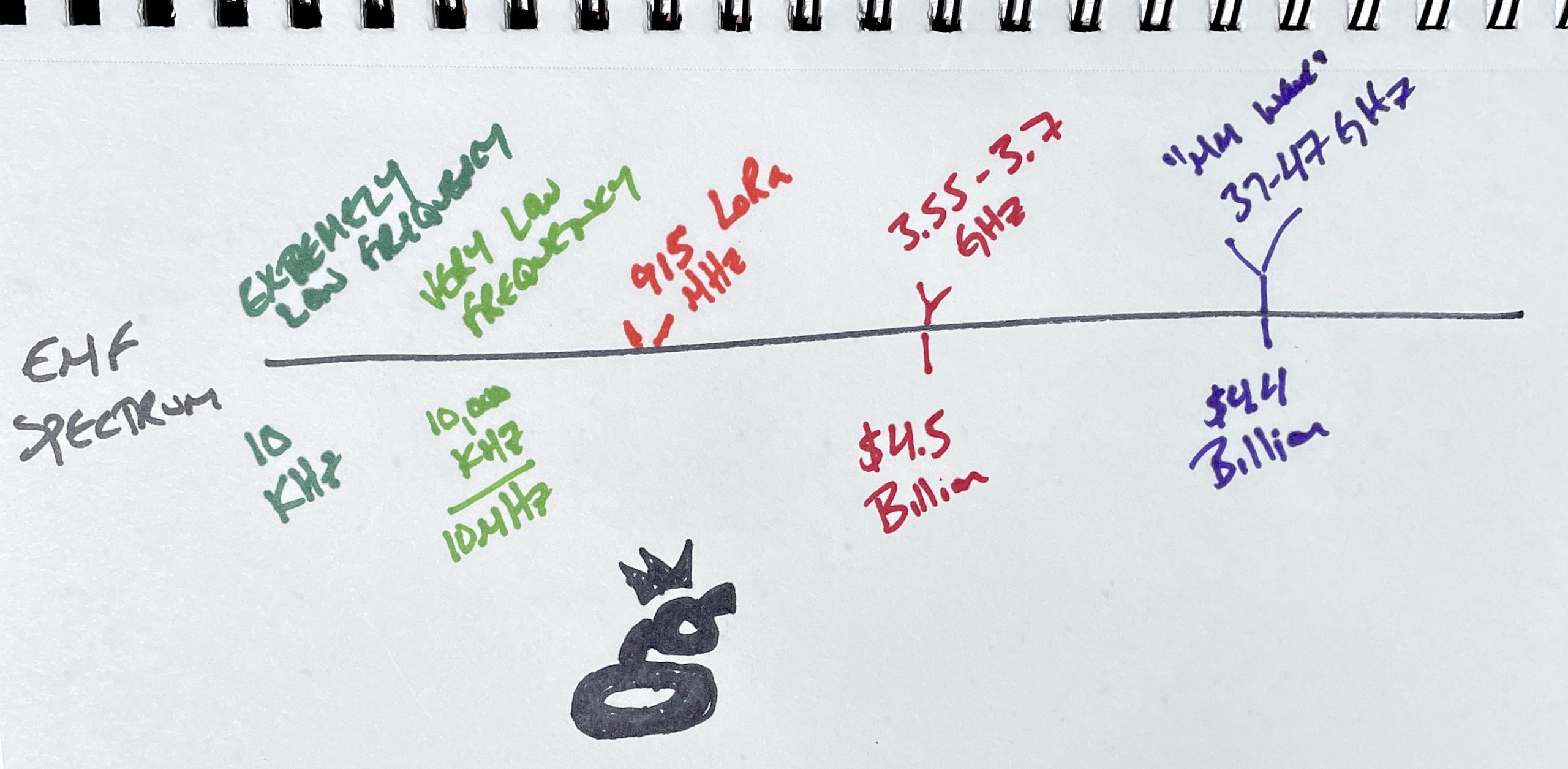
$4 billion is not all the telcos have spent, not by a long shot. That was for just 150 MHz of spectrum, from 3.55 to 3.7 GHz. The same players have, well, you can read the FCC's auction summary here. You can look for Auction 105, which I've referenced above, or Auction 107 for the 3.7 GHz band (from 3.7-3.98 GHz), where they've spent over $80 billion (again, with a B) on spectrum. Suffice to say, we ain't talking chicken feed. In fact, the US Government Accounting Office reports that $258 billion has been spent on auctioning off spectrum. Helium's billion dollar evaluation doesn't look so impressive now, except...

The good news is that, having spent so much on buying the rights, the telcos may not have enough cash left to roll out the hardware.

That's where you (and decentralized networks) come in. You buy the hardware and provide the coverage, get paid for the data your unit(s) process in cryptocurrency, and the telcos will manage the billing in fiat to the end customer. If this plays out the way these decentralized networks are aiming for, everybody wins. That's what's so cool about this.

  • End customers should get cheaper rates because telcos are paying less.
  • You get paid in crypto to deploy coverage.
  • The telcos buy crypto to pay for data usage, then bill their customers in fiat.

Those are the stated goals for Helium, being what's called a "neutral host". For Pollen, they want to be their own network, like AT&T or DISH or Verizon. Neither is definitively right or wrong. It's exciting for us to watch because we're seeing two (and hopefully more) competitors using the same technology applied in different ways for slightly different goals. It won't be an easy road to the top, and there's no guarantee that any bet you place will be a winner.

For those of you who lived and came of age in the 80s, recall the immortal line from AC/DC,

"It's a long way to the top if you want to rock 'n roll."

I don't know about you or when you were born, but I'm guessing if you've gotten this far, you're a lot like me. And me? I was born to rock.


Nik Hawks is available for hire if you'd like help with your blockchain + meatspace project. Whether you're an investor considering a new project and want to de-risk it by adding experience, or you're on the team and trying to work out how to align the incentives for your space and keep the community educated, Nik will help you evaluate and design outcomes that increase the value of the project. Reach out here.

Archived Comments

Karl Weaver - 1/18/2023

Why does Pollen Mobile charge US$250 to scan an eSIM to access Pollen Mobile's Network, that is US$20 per month for a year of coverage upfront but I pay that monthly for a iPAD data only plan with a traditional MNO for a data-only plan, and can also obtain global WWAN coverage. Pollen Mobile's real value is using CBRS 3.5Ghz data network in a DeFi network for remote last mile or dead zone coverage for many smaller communities. Do you think this upfront price is justified, it's basically a year-long prepaid plan for Pollen Mobile but where is the coverage map? Dish network? Is this the real reason Apple iphone 14 is eSIM-Only so that Apple users can freely access private LTE networks without having to deal with traditional MNOs and competition?


Nik - 1/18/2023

Hi Karl, they charge that because it earns PCN.


Unlock Helium 5G: My Rooftop Installation

· 4 min read
Nik
Site Owner

How hard is it to deploy a Helium 5G miner? There are at least three aspects to this: Physical, Legal, and Risk/Reward. Let's start with the easiest one, which is the physical installation.

As it turns out, a Helium 5G miner is not that different than a LoRa miner to physically install. Just like a LoRa miner, it needs to be connected to power and the internet. In most miners, this can be accomplished via a PoE (Power Over Ethernet) set up, though the power requirements are typically more, in the 20-30 watt range (vs 5 watts for a LoRa miner.)

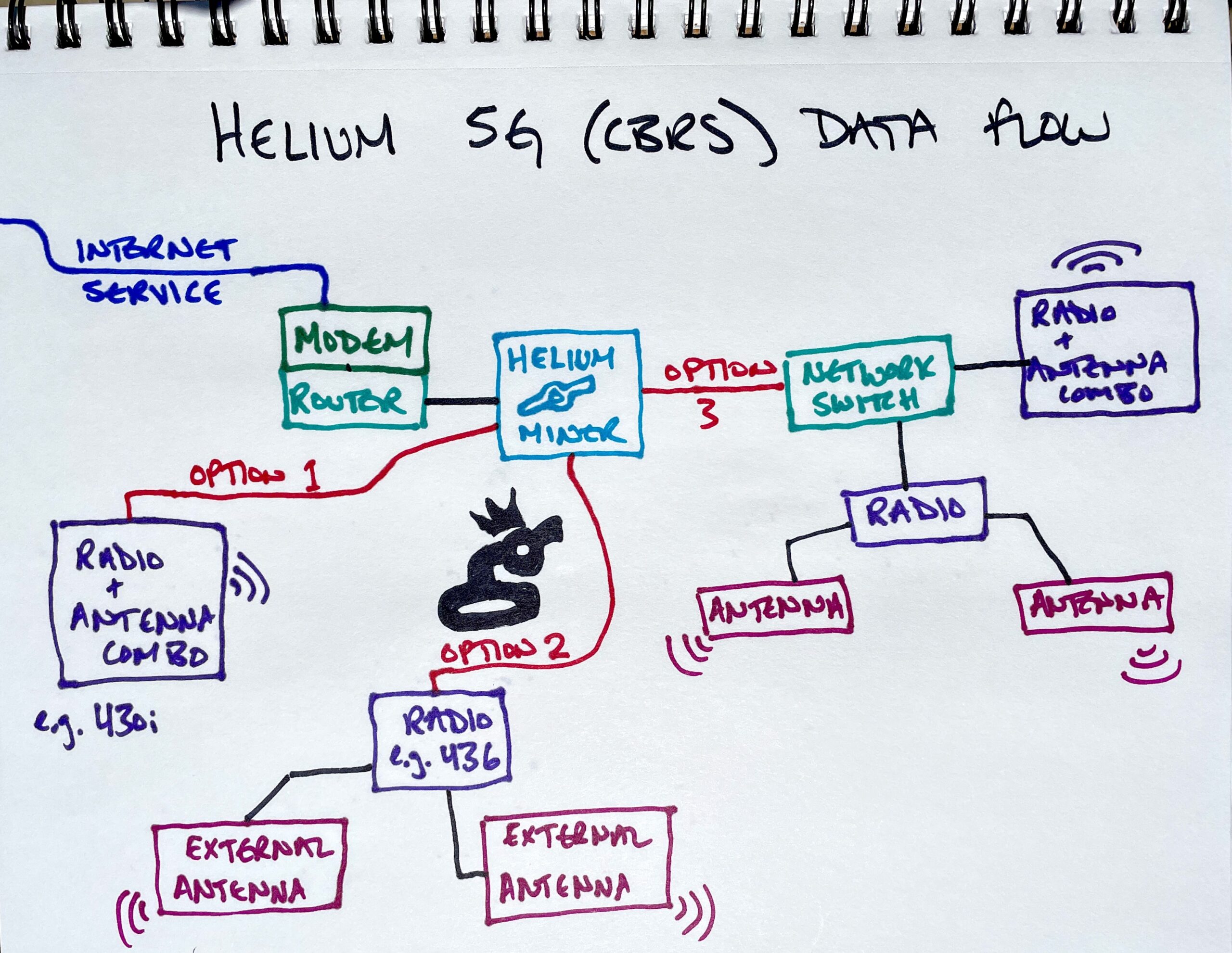
The general signal flow looks like this: Internet service-->Modem-->Router-->Miner-->Radios (can be more than one)-->(sometimes) multiple antennas. You can keep it simple with a radio/antenna combo, or you can get complex with multiple radios and multiple antennas. If you want someone to install yours for you, HeliumDeploy has a "find installers" page here. If you think you can do it yourself (I think you can!), keep reading.

Here's a video of a very basic setup, like Option 1, above.

https://youtu.be/8Um8Lln5YK4

Next, you've got to find a location. That's the hardest part. The three vital aspects of a successful Helium 5G install are:

  • High footfall
  • Poor current coverage
  • High dwell time.

Listing 'em is easy. Finding a place where all three intersect can be really tough.

Now, when we finally get 5G Mappers (a top secret project currently under construction) we'll have a much better idea of where coverage already exists, but until then, you've got 2 choices. First, you can use an Android app like Cell Network Info on most Android phones; a Galaxy S10 is an excellent choice. If you don't/won't use an Android, you can (like I do) just wing it. If you're seeing a lot of people standing around on their phones and it appears they don't have great coverage, you might have a good spot.

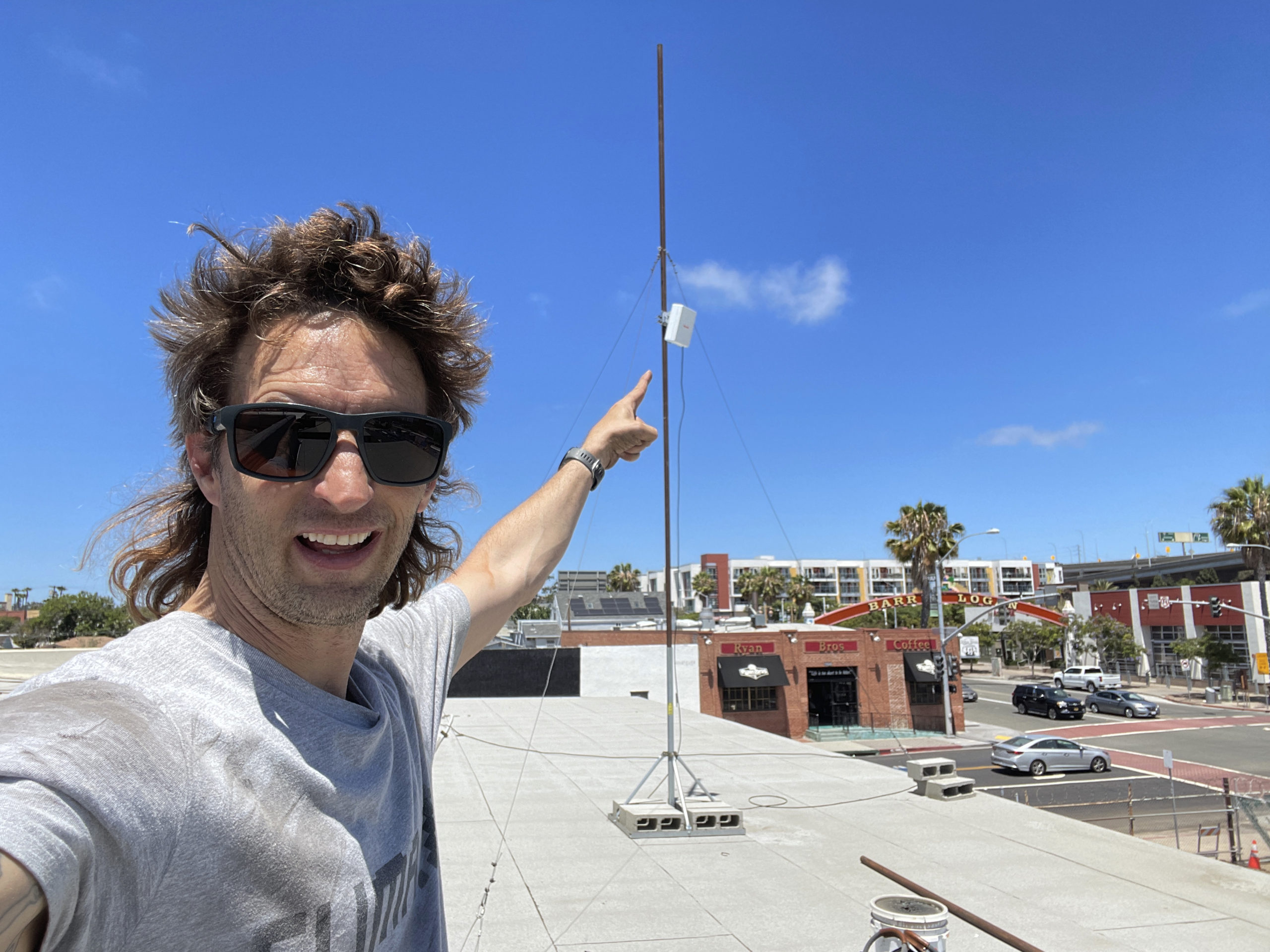
That's what a local trolley stop looked like to me, so I took down a "LoRa-only" miner I had up and replace it with a Helium 5G set up.

Your second option for checking out coverage is to use existing cell network maps, like CellMapper. When you use that, you want to go through the carriers and choose "band 48 - CBRS" to check coverage in your area. Those maps are NOT always accurate, but they're a good start. I've found that if you choose the "5G Network" it often won't let you choose band 48, so try the 4G-LTE as well.

Once you've got your location and it looks good, get that install up and running. As I write this in mid-July 2022, the rewards a Helium 5G miner will earn are still unclear. At the end of the day, what will really make a difference is when people start actually USING the network, so until Helium announces a deal with any of the majors (Verizon, T-Mobile, AT&T, Sprint) we're all just putting these up with NO guarantee of anything other than providing coverage for the Helium network.

I know there's still a ton of uncertainty around 5G, so in early July I asked the Gristle Crüe what questions they had (the Gristle Crüe is my private membership option) and then posed them to an expert (Dennis aka Elmo aka The Professional). I thought the interview was useful enough to release to the general public, here it is! If you want to join the Gristle Crüe and have a chance to get your questions answered, check us out here!

https://youtu.be/8OMbS-S2A\_w

Still have questions about a Helium 5G deployment? Did I get something wrong? Leave a comment and we'll make this a better resource for everybody!

Is Helium 5G Safe To Deploy?

· 9 min read
Nik
Site Owner

As we all begin the next mad rush to deploy Helium 5G miners, one of the questions I hear asked is, "Is 5G safe?"

Let's start with defining what 5G means; it's NOT 5 gigahertz. In this case, 5G refers to the Fifth Generation of mobile networks. 5G is a set of rules determining who can transmit how much on what frequency. We (including me) commonly use it rather loosely, saying "I'm going to deploy a Helium 5G miner".

What that actually means is that we're going to deploy a Helium miner that will transmit and receive on a specific frequency band within the 5G set of rules. That band is from 3.55 gigahertz to 3.7 gigahertz, shortened to 3.55 GHz - 3.7 GHz. As I've discussed in other articles, that band is the CBRS, or Citizens Broadband Radio Service.

Now that we've set the stage, let's move on to potential health issues of Helium 5G radio frequency radiation, or RFR.

I'll give you the non-scientific version first: The parts of the 5G band we're using for Helium combined with the power output we're limited to probably aren't a big deal as long as you're NOT standing with your head next to the radio. Pretty straightforward. Why do I think this?

Look, you probably already have WiFi in your house. Your WiFi router pushes out about the same amount of power that your CBRS radio will, and at frequencies that are slightly lower (2.4 GHz) and slightly higher (5 GHz). If you're OK with WiFi, you should be OK with CBRS. That's the common sense reasoning, but let's get deeper.

We'll start with a study done on zebrafish in 2020. Zebrafish are a fantastic option for these kinds of studies because they reflect the intelligence level of the person who screams "5G WILL FRY YOUR BRAIN!" without doing any research beyond a few sensational YouTube videos. Nothing against YouTube, it's part of my core educational strategy, but it's definitely not a gold standard for scientific inquiry.

On a more serious note, this study on the Impacts of high does 3.5 GHz cellphone radio frequency on zebrafish embryonic development found:

"Our results revealed no significant impacts on mortality, morphology or photomotor response and a modest inhibition of startle response suggesting some levels of sensorimotor disruptions."

Now, that study was conducted on zebra fish. Zebra fish are not humans. They share about 75% of their DNA with us. In the scientific community, they are an accepted norm to use when assessing environmental impacts on biology.

My takeaway after reading the study and talking to Dr. Dasgupta, one of the authors of that study is this: With high dose exposure during your developmental years, you may lose some of your reflex speed. That is a layman's takeaway. By the way, we invited Dr. Dasgupta to speak to the Gristle Crüe recently and he came on and gave us a presentation on that specific study. Want to dive deep? Join the Gristle Crüe and hang on!

Next, let's take a look at a study done on "mobile phone base stations during temporary events". What's that cover? Let's say you go to a state fair, or a concert in the desert. In order to provide coverage, certain operators (including those of us deploying Helium 5G units) will install temporary radios to handle all the extra cell phone traffic.

These temporary installations (loosely) double the amount of RFR you get, from 391 µW/m2 at normal levels up to 792 µW/m2 during the fair. BOTH of those values are under legal (European) limits.

A µW/m2 is "one millionth of a watt per square meter". The µ means "micro".

The legal limit in the US for frequencies between 2 and 5 GHz is 10 million µW/m2 for up to 30 minutes.

In this study, measurements were taken throughout an apartment complex that had a "mobile base station" on its roof. A Mobile Base Station is what a normal person might call a "cell tower" if it's free standing or "cell cluster" on a roof; those are the big honkin' radios the telcos use. Those are generally NOT safe to be near, and the mean measurement (remember, "mean" is the average) reflects that. Throughout the building, the mean radiation level was 3,811 µW/m2. I'd consider that (as a layman) generally not cool to be around.

However, that's a commercial mobile base station, and not what most of us in Helium will be deploying. Now, we're going to head off into "maybe-land" here, and things are uncertain. While there's a brisk trade being conducted in protecting you from EMF radiation, there isn't a ton of hard data on the effects of RF radiation on humans from cell towers in the ranges that we're deploying. That doesn't mean it's bad or not bad; it just means we don't know.

Let's start with what we DO know. If you're in an area with reliable cell service, you're probably surrounded by mobile base stations blasting out RFR at around 5-10 watts, although they're probably not that close to you. This varies, but is a good place to start. According to the FCC:

In the case of cellular and PCS cell site transmitters, the FCC's RF exposure guidelines recommend a maximum permissible exposure level to the general public of approximately 580 microwatts per square centimeter. This limit is many times greater than RF levels typically found near the base of cellular or PCS cell site towers or in the vicinity of other, lower-powered cell site transmitters. Calculations corresponding to a "worst-case" situation (all transmitters operating simultaneously and continuously at the maximum licensed power) show that, in order to be exposed to RF levels near the FCC's guidelines, an individual would essentially have to remain in the main transmitting beam and within a few feet of the antenna for several minutes or longer. Thus, the possibility that a member of the general public could be exposed to RF levels in excess of the FCC guidelines is extremely remote.

FCC Website, Human Exposure to RF Fields: Guidelines for Cell Sites

How does 580 µW/cm² compare to our outdoor fair study above, where the average exposure was 792 µW/m²? Pay attention, because one of those uses centimeters as the area value, and one uses meters. Big difference. 1 µW/cm² is equal to 10,000 µW/m², so 580 µW/cm² = 5.8 million µW/m². Moral of the story? Far better to go to a Spanish festival than to stand in front of a US cell tower.

Still, that doesn't leave us with an answer to our question: Are Helium 5G units safe?

The straight answer is that nobody knows for sure. I've seen links to studies claiming that EMF will cross the blood brain barrier and interfere with calcium levels, but that ignores the fact that those frequencies have to get inside you first, and most high frequency doesn't go more than skin deep; they doesn't have the penetrating power. That's not to say those studies are quackery, but it's also unlikely we're facing an existential threat from EMF.

Let's talk about another aspect of RF: Ionizing and non-ionizing radiation. Ionizing radiation is the dangerous stuff; X-rays, gamma rays, the kind of full power radiation you need to put a lead apron on to be around. Ionizing radiation will go right through you and disrupt the atoms in your molecules (that's the "ionization" part), leaving a trail of destruction in its wake. CBRS is NOT ionizing.

Non-ionizing radiation is the stuff that doesn't do that kind of damage. Sure, it can shake your molecules around a bit, but it doesn't have the power to knock an electron off an atom. Non-ionizing goes into the "questionable" bucket of unhealthy radiation.

Is it good for you? Probably not. Is it bad for you? No serious studies proving that it is categorically bad have been done. The closest thing is the zebrafish study above, and while it shows that direct radiation on an embryonic zebrafish has negative effects on their startle response, it's not like you're going to be bathing in 3.55 GHz for hours every day.

Now, before you go all screamer on me, I know that some people are more sensitive to EMF than others. If that's you, I have a hard time believing you're considering putting up a CBRS radio, but just in case...don't do it!

If you're a part of the non-EMF-sensitive part of the population like most of us, and you wade through the radio frequency cocktail of current modern living (WiFi, cell signals, AM/FM radio, TV, and the rest of it), you're probably not going to notice or be effected by the RF pushed out by CBRS.

Now, to be clear, that is NOT MEDICAL ADVICE! For me, I think of my general "EMF hygiene" guidelines being appropriate:

  • Don't sleep in front of a CBRS radio.
  • Don't spend significant amounts of time close to the focused area of emitted RF (look at the radiation pattern supplied with your antenna).
  • Spend time outdoors in the sunlight exercising, eat healthy foods, get plenty of sleep, laugh with your friends, and keep overall stress low.

That's it. That's pretty much all I can reasonably do. At the end of the day you are already in an RF soup of convenience; it's why your cell phone works pretty much everywhere, why you can still hear WAAF anywhere in the greater Boston area, and why you can track a paraglider throughout Southern California. You're already in the mix, my friend.

Hey, if you want to stay in the know and go deeper into these topics, and you'd like to be part of a group helping each other learn and succeed in the whole blockchain + meatspace arena that Helium started, I'd love to have you join the Gristle Crüe. As I finish writing this, I'm reflecting on the conversation the Gristle had today with Dr. Dasgupta and how useful it is to be learning from world class experts in the company of folks just like you. If that sounds exciting, well, join the Gristle Crüe!

Rock on!

Weather XM - An Easy Way to Stack Your Pole

· 4 min read
Nik
Site Owner

With the rise of Helium, many of us were introduced to the new concept of combining a blockchain application with actual physical real world usage and tokenizing the incentives. I call that combo blockchain + meatspace, and Helium is just the beginning.

As most of us who got serious about Helium quickly realized, the name of the game is getting an antenna outside and up high. As it turns out, those skills and that location are useful for more than just deploying Helium Hotspots.

One project where you can add a device to the same pole (or roof) you've already secured is WeatherXM. It's a small weather station that reads wind speed, direction, air temp, humidity, light, a rain gauge, and pressure. The outdoor station communicates over LoRa to a base station in your house that connects to your WiFi.

WeatherXM has just announced (29June2022) a waiting list for Helium compatible stations, so the requirement for a WiFi base station/miner may soon be gone. They've also recently (30June 2022) announced a $5 million seed round of funding led by Placeholder VC. That's promising, though not particularly strong evidence that they'll eventually crush. I mean, I hope they will because I love weather stations. ;)

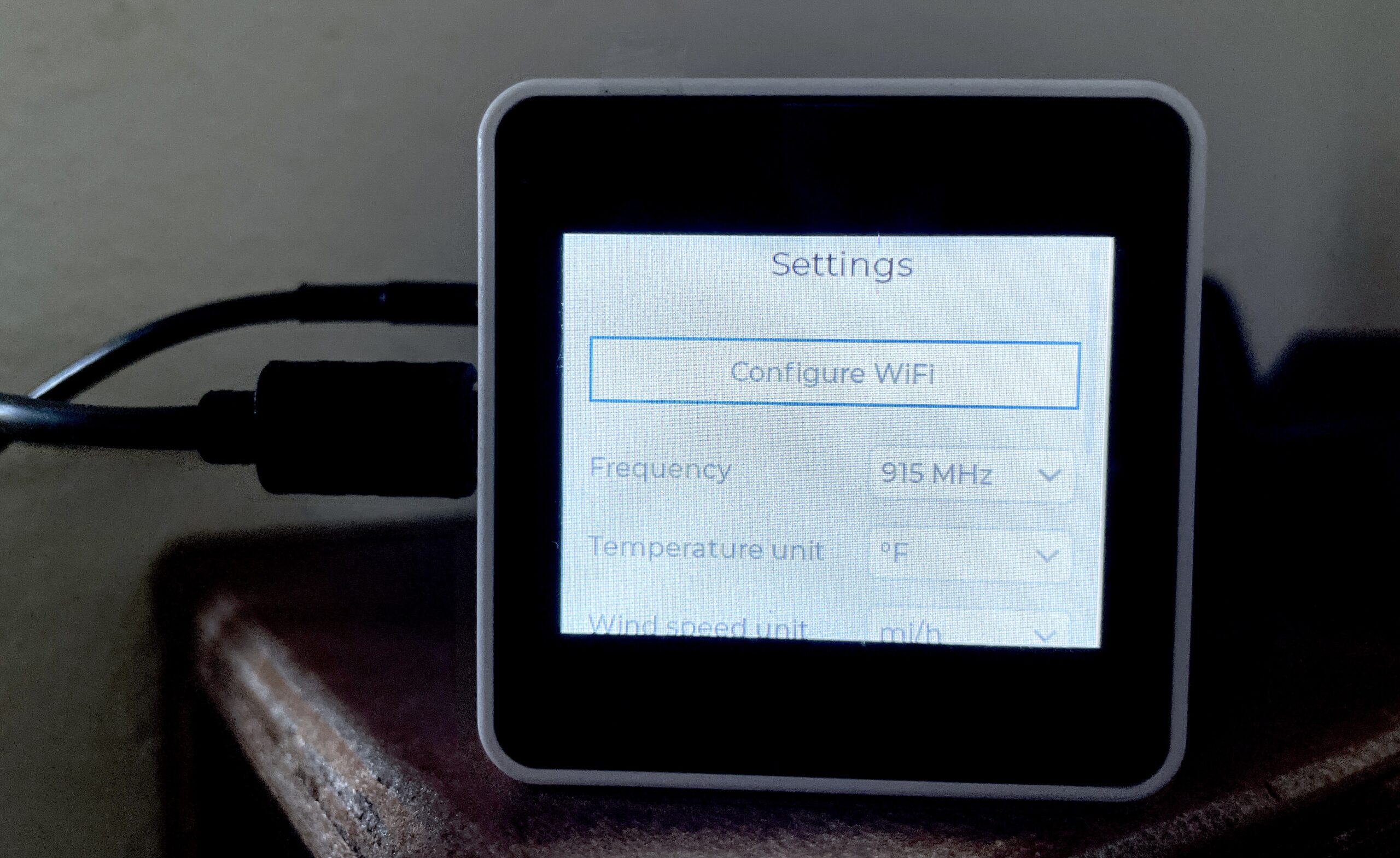
Set up is straightforward with the WiFi connection version, which is what I bought (the Helium compatible one wasn't available at the time.) It goes in two steps. First, connect the miner to power, then to your Wifi. This part happens indoors, and the only slightly janky thing is that the miner has a GPS antenna which has to be near a window.

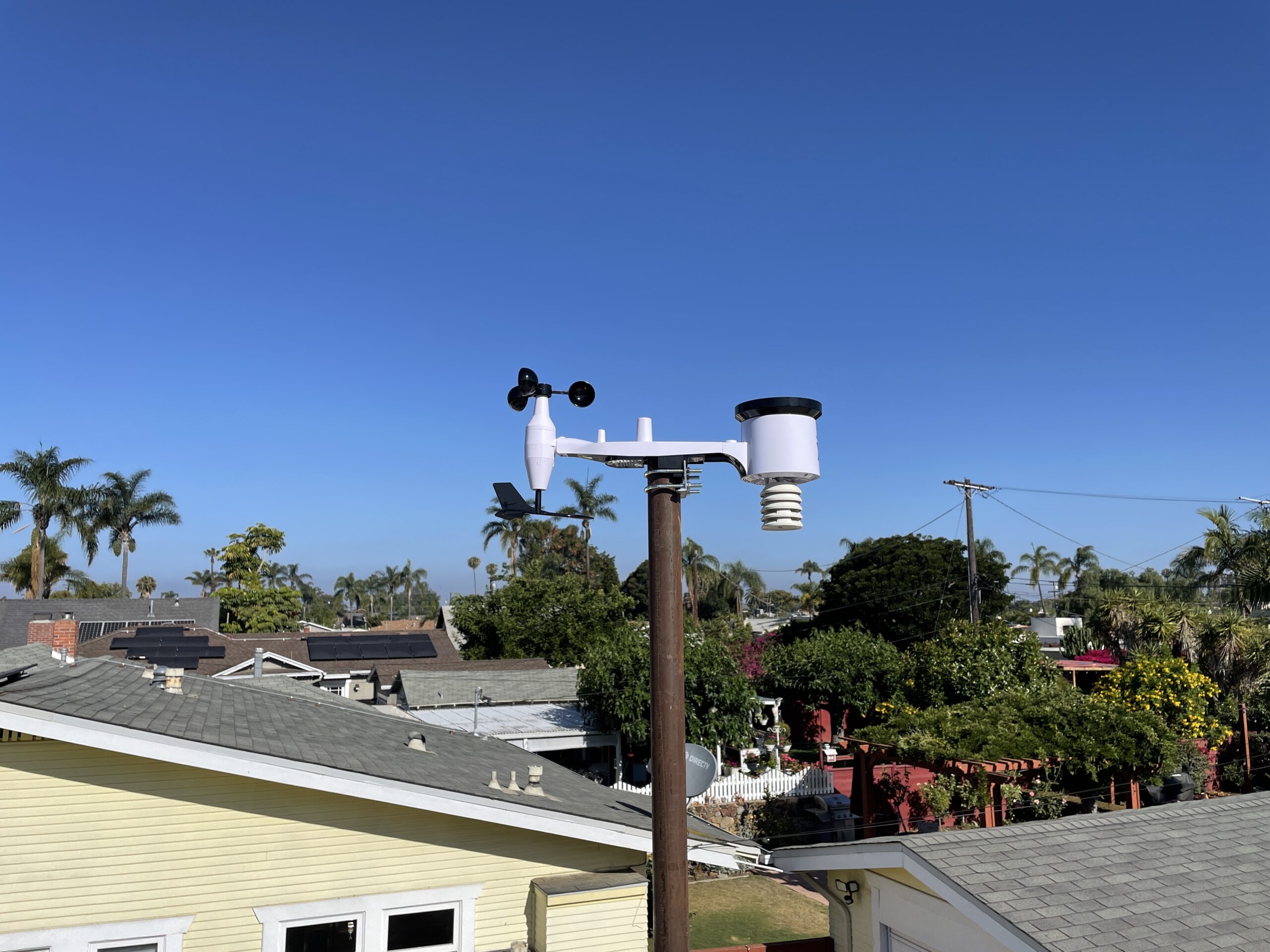
Second, put the parts together for the weather station using the included tools, mount it on top of a pole, and you're all set. I used an extra tripod and a short length of pole I had laying around. I've seen them mounted to the same pole a Helium miner is on using a standoff arm; that seems totally fine to me.

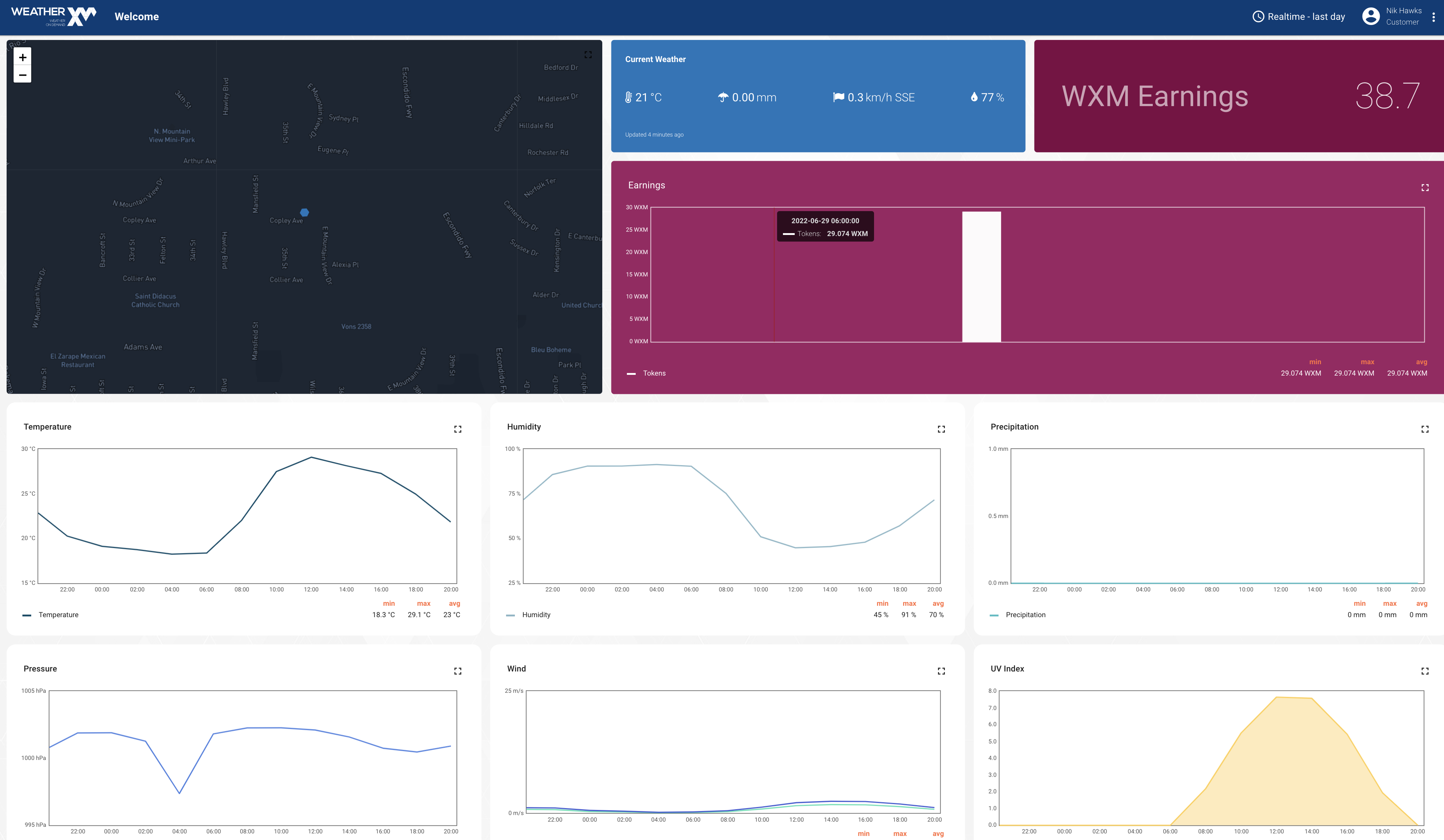
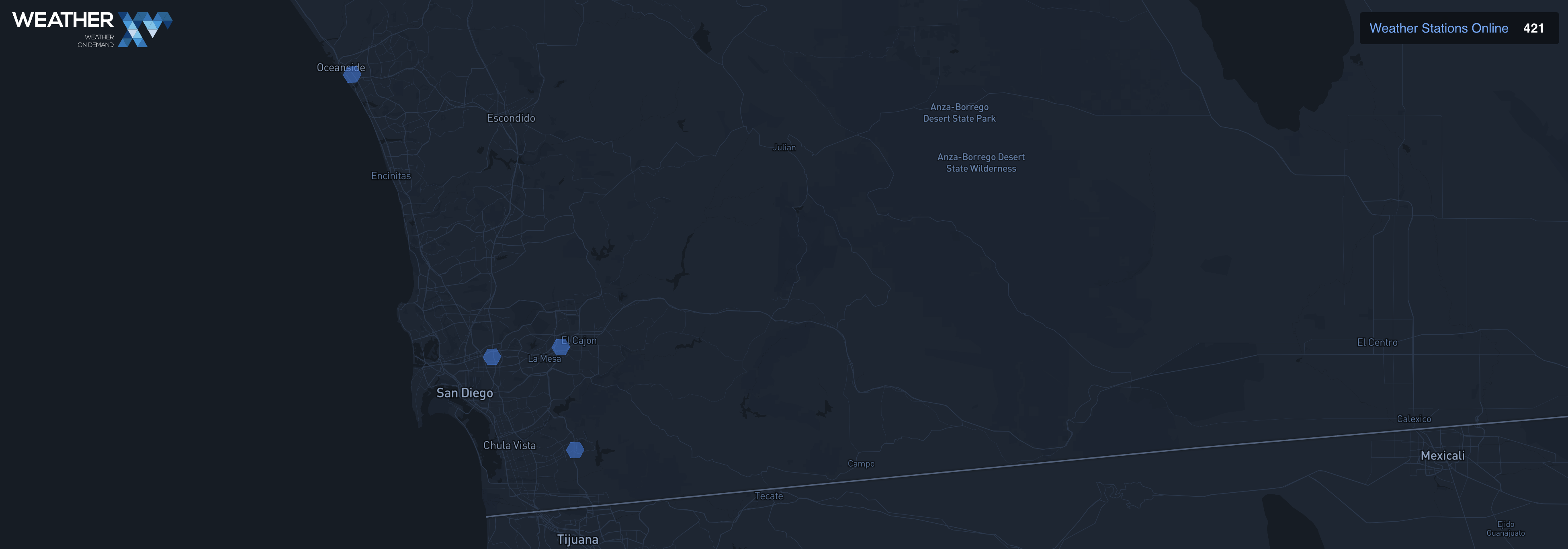
As of today, June 29th 2022, there are 421 stations worldwide on the network, and in the first 24 or so hours my station earned 29.074 WXM.

It reminds me a bit of the early days of Helium; not many spots on the map!

The main idea behind most of these blockchain + meatspace projects is that you deploy some kind of device that provides a data flow. The company, in this case WeatherXM, will resell that data flow and pay you for it in tokens. How much those tokens are worth, where you can redeem them, and if the network will ever actually be used are still up in the air.

For now I'm just using it to compare indoor and outdoor temps here in San Diego to decide when it's time for A/C and when I can use our whole house fan to cool the place down.

Right now there isn't much more info out there; while there's a token there doesn't seem to be a ton of interest on the WeatherXM to dive deep into crypto; they just want to incentive deployment through tokens. Cool with me, I love weather stations!

Rock on!

How Do You Assess A Blockchain + Meatspace Project?

· 11 min read
Nik
Site Owner

How do you know if a new blockchain + meatspace (B+M) project (like Helium, or GEODNet, or Planetwatch) is likely to succeed? What are the key indicators of success or failure?

Since joining the Helium Network when the Hotspot count was around 7k, I've gotten to see what it's like to be part of a wildly successful project as it grew to more than 800k Hotspots. I jumped into Planetwatch in October of 2021 and have seen what it's like to be part of a stumbling project, and having recently received GEODNet and WeatherXM devices that I'd ordered months before, I think those projects will be somewhere in between, though more likely than not to succeed.

There are a long list of these projects, from DIMO to MapMetrics to Birdbot to RevoFi. Some are still building, some are stumbling, some may be scams. It's a new and exciting space, with all the usual opportunities and pitfalls of any frontier. Investment companies are beginning to come up with their own terms for blockchain + meatspace that are more institutionally appealing, like Lattice Networks' TIPIN (Token Incentivized Physical Infrastructure Networks).

This should be a tip off that the big money is starting to pay attention to these projects, and that the core idea of incentivizing growth with tokens is too good to ignore. It's such a strong thing that we'll see a lot of poorly thought out projects just tacking on tokens to drive interest and sales; that's a recipe for crash and burn.

So, what makes for a successful project? Perhaps before we go there it's important to talk about a significant difference between these B+M projects and "normal" businesses. B+M projects are one that combine blockchain technology with the "real" world. Whether it's radio waves, weather data, or satellite accuracy, all B+M projects have a direct connection between a blockchain and a non-digital asset.

B+M projects are different. The "non-digital" aspect is what keeps 'em semi-normal. Radio is radio, and follows the laws of physics. It's the other aspect, the blockchain one, that makes them different.

Being on a blockchain allows a B+M project to use tokens to incentivize adoption. Earning tokens drives incredibly powerful incentives that can (and often do) make these businesses and projects grow far faster than they're ready to, or than normal people are used to. That exceptionally rapid rise in value can drive poor decisions in the popular market.

The reason that earning tokens is so powerful is the same reason a free market with corporations supported by stock holders is so powerful; investors get exposure to significant upside for minimal effort. Critically, when it comes to B+M projects, there is almost no friction to invest; you buy a device, it earns tokens, you're an investor. It's that easy.

Of course, with ease in exposure to upside comes danger and risk from downside. That downside is most obvious with projects that rug you (a now-common term used liberally to apply to any hint of a scam, but actually meaning that the project owners "pull the rug out from under you" and abscond with your invested money.)

The downside is far less obvious when it comes to making sure that an investor knows what they're getting into. Investing money is easy to do poorly and very difficult to do well. In the world of professional investing there is the concept of an "Accredited Investor", basically referring to someone wealthy enough and savvy enough to make reasonable investment decisions and able to handle losses on bad investments.

As we've seen in every blockchain + meatspace project so far, from Helium to RevoFi to WeatherXM to GEODNet, the average purchaser of the device is neither an expert investor nor an expert in that specific technology. Many early adopters are, like me, "citizen technologists". We enjoy technology and learning about it. Typically we take the time to read the white paper and most of the documentation, and develop a strong grasp of the project, where it's going, and what it can do. These kinds of projects allow us to combine a love of learning new things with the potential to profit from that learning.

However, the vast majority of the next wave of adoption, the fat hump of the distribution curve when it comes to deployments, is motivated primarily by earning "free money" and almost nothing else. With almost zero barriers to entry, this creates unnecessary pitfalls for a huge number of people. The danger in these B+M projects is tempering raw greed with any kind of required education, waivers, or disclosures.

Now, in the beginning (way back in 2018, when Helium wrote the white paper that underlies their current project), no one knew or expected what would happen. Through exceptional effort, an incredible skill base, and serendipitous market timing, Helium exploded in popularity. It also eventually became awash with Hotspot owners who had no idea of what to expect when it came to earnings. That ignorance has created a huge amount of ill-will in the Helium community, and that negative sentiment has detracted from the value of the project.

As investors in the casual sense (and in the professional sense), it is intuitively obvious that ill-will is not good for a project. Ill-will represents a form of inefficiency, friction, or drag, and limiting the potential for it to develop should be a part of any B+M project from the beginning.

This is why it's so important to create an education plan early in the process of a B+M project. More on education plans at the end.

For now, know that tokenized projects are a different beast entirely than a standard investment. The incentives are so great and the barriers to entry are so low that both scams and ill-formed projects abound. In the future, we can expect governments to step in and begin regulating tokenized projects. In the meantime it is on you, as either a casual investor (i.e. token holder) or a venture firm, to do reasonable research on a project.

What should you look for?

Here is what I look for in a blockchain + meatspace project:

Start with the numbers. They're the LEAST useful but usually easiest to find. You've got to start somewhere, I'd consider this the bottom.

  • How many tokens will be produced?
  • On what schedule will they be produced?
  • What segment of tokens goes to fiat investors?
  • What segment of tokens goes to project investors?
  • What segment will go to device owners?

What (if any) are growth predictions, and ideally, what are growth predictions and that temper the massive attraction of tokenization? As an example in Helium, if the people who bought Hotspots when there were only 300k on the Network had known that with 800k Hotspots on the Network their earnings would be halved, would they have bought so many?

How are the tokens earned?

Is it passive, where you just plug 'n play then go to sleep? Is it active? Are there areas for optimization? Are there obvious gaming/spoofing/grift opportunities? This is vitally important to understand, and some of the following questions will dive much deeper into it. Know for that that both a shallow and a deep understanding of the "how" is critical to make a risk-correct assessment more likely.

What are the plans for the future?

What are project owner's assessments for the project over the next 6 months, 1 year, 5 years, and 20 years? If they don't have clear a clear idea of where they're going (being wrong is fine), I'm much less confident in the long term success of the project. Fairly obviously, those plans should make sense. As an example, Helium's plan to move into 5G sounds good at first, but it's built on pretty shaky foundations. A very small slice of radio spectrum that has been paid for by other giant players where Helium participants have the bottom priority is not something I'd plan a giant roll out on. They have, and while they have yet to be wrong once I understood what they're doing, I don't fully understand this move yet. More on that over on my recent article, State of the Space.

What does the thing do?
In plain English (or the language of your choice), what problem will the network solve?

Is this being done already, and at what cost?

If the cost difference between what this network will do and the current solution is more than 2x, that is a good sign but not a sure thing.

What is the estimated delivery time for devices?

This is a key aspect to be conservative on, for two reasons. First, global supply shortages ensure that most units that have connection to blockchain technology will not ship within an Amazon time window. Second, there is already enough hype in the B+M space. An overabundance of hype will whiplash into toxicity if not met.

Whether the project produces the device (like WeatherXM, or it's one third party (like GEODNet) or multiple third parties (like Helium), the project structure should include incentivization for manufacturers to publicly and accurately predict this. As an example in Helium, manufacturers who deliver 2 weeks or more outside of their predicted delivery estimate would have higher onboarding costs for Hotspots.

Is there a clear way to beneficially optimize operations of the device?

Can you put the thing higher, or give it a better antenna, or somehow gain a competitive advantage through your own additional investment or efforts? This aligns incentives for excellence, which is a healthy goal for any project. Do not confuse this with a clear way to optimize WITHOUT network benefit. If that exists, it's a giant red warning light!

What are the incentives for all parties?

  • Project Team (core devs, etc)
  • Device owners
  • Fiat investors
  • Network users

The incentives for a project are what drive it's growth. Properly aligned, they act as the right amount of fuel for the fire. Improperly aligned they encourage gaming, stealing, poor behavior, and ultimately, a failed project. The incentive structure is one of the most exciting aspects of any blockchain + meatspace project, and also one of the least understood. Despite hundreds of years of economic study, we humans still don't seem to have a grasp on how to clearly build a well formed incentive structure. They are tricky, require expert and innovative thinking, and will probably require long term maintenance.

If the incentives aren't clear to you, do NOT, I say again, do NOT invest.

If you can answer all of those questions clearly in your own mind, you'll have a very good idea of what you're getting into and the likelihood of success for this project.

What is their marketing/community/education plan (if they have one)?

I'm biased, but one of the very best indicators for me of the long term success of a project is the core team making an earnest effort to educate potential investors before they put their money into it. Most don't. This seems to come from these projects being formed mostly by very smart engineers who don't have the time or skill set to educate the community on their efforts. They're too busy working and getting things done. That's fine, but ignorance breeds fear, and fear is fertile ground for business friction. Friction dramatically increases risk.

A blockchain + meatspace project without an education plan and a dedicated position for "market facing education" is one that carries an order of magnitude higher risk than one without.

An education plan address the questions above in all of the three major formats (writing, listening, watching video) and exposure to it should be a mandatory first step in the purchase process for any project device. As an example in Helium, every manufacturer selling a Hotspot should attach a copy of the Helium education plan (which does not yet exist) with every purchase having links to all three formats.

If you'd like help building an education plan for your project, or if you know of a project that is in sore need of an education plan, please let me know, I'd love to help you level up your project's likelihood of success.

Rock on!

The Transition to Light Hotspots - What Happened?

· 6 min read
Nik
Site Owner

TL;DR Despite a massive change to the Network, at a macro level we're more or less where we were (up 3%) with the number of Hotspots getting rewarded for beaconing, and down 4% for number of Hotspots getting rewarded for witnessing. The rewards themselves are lower, but that's always the long term trend of any crypto mining network.

Now, I know some of you will howl about this and talk about flatlines and earning tanking, but remember, we're not looking at YOUR Hotspot, we're looking at the Network. I had some Hotspots go down. Some stayed up. The key thing to do in the month of May was something other than worry over your Hotspot. Very few people did that. While you were worrying, here's what actually happened.

Dave Akers over at HeliumAnaltyics.io has written an in depth report about the statistics behind the transition, which I have shamelessly borrowed graphs and numbers from for this article. Yes, he approved my borrowance.

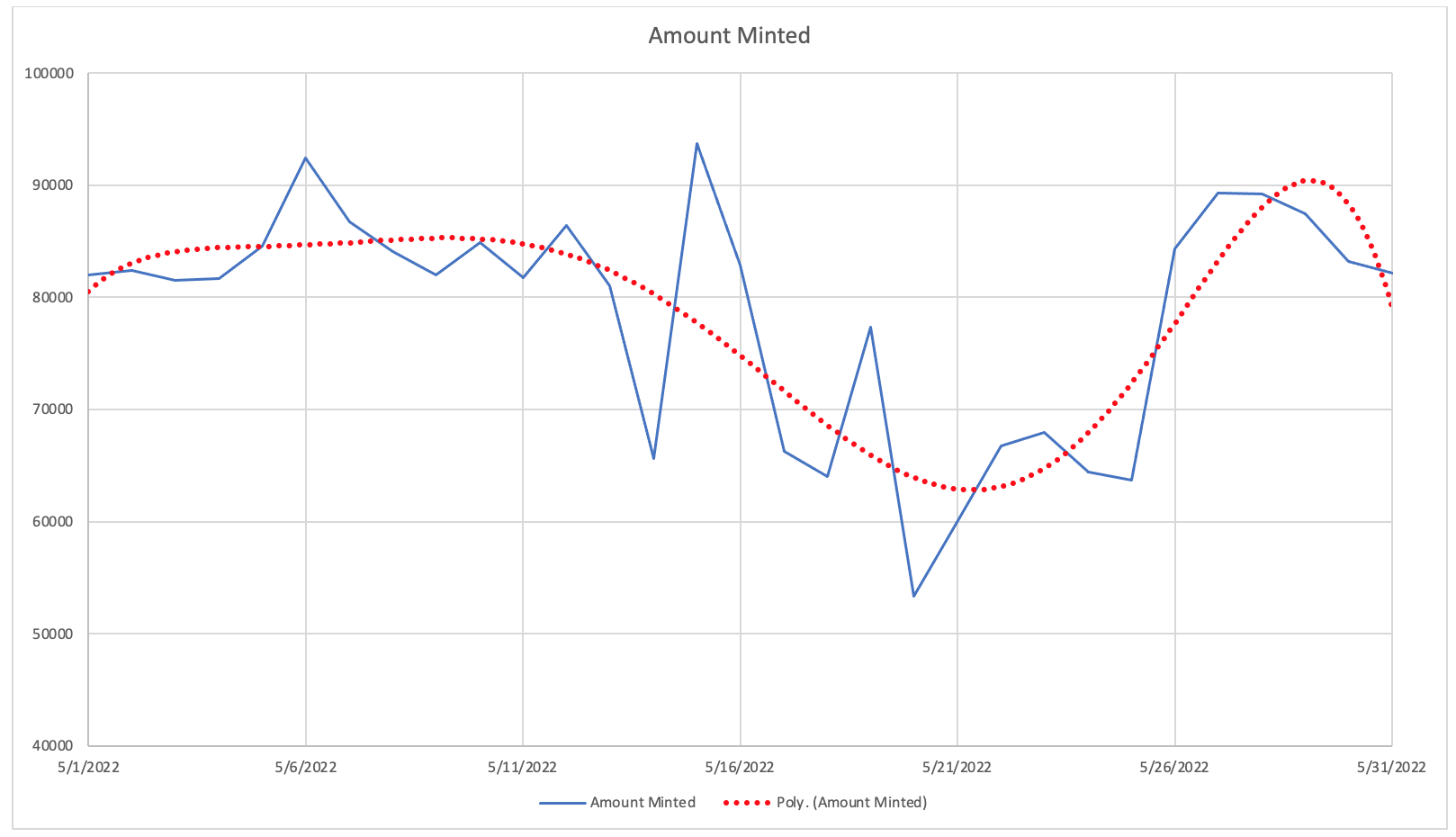
The amount of HNT minted dropped temporarily and was spiky enough to freak out thousands of Hotspots owners. The trend line (red dots) is better to watch than day-to-day (blue line), but most people gnaw their knuckles whilst staring at the blue. In any event, it is now approaching normal.

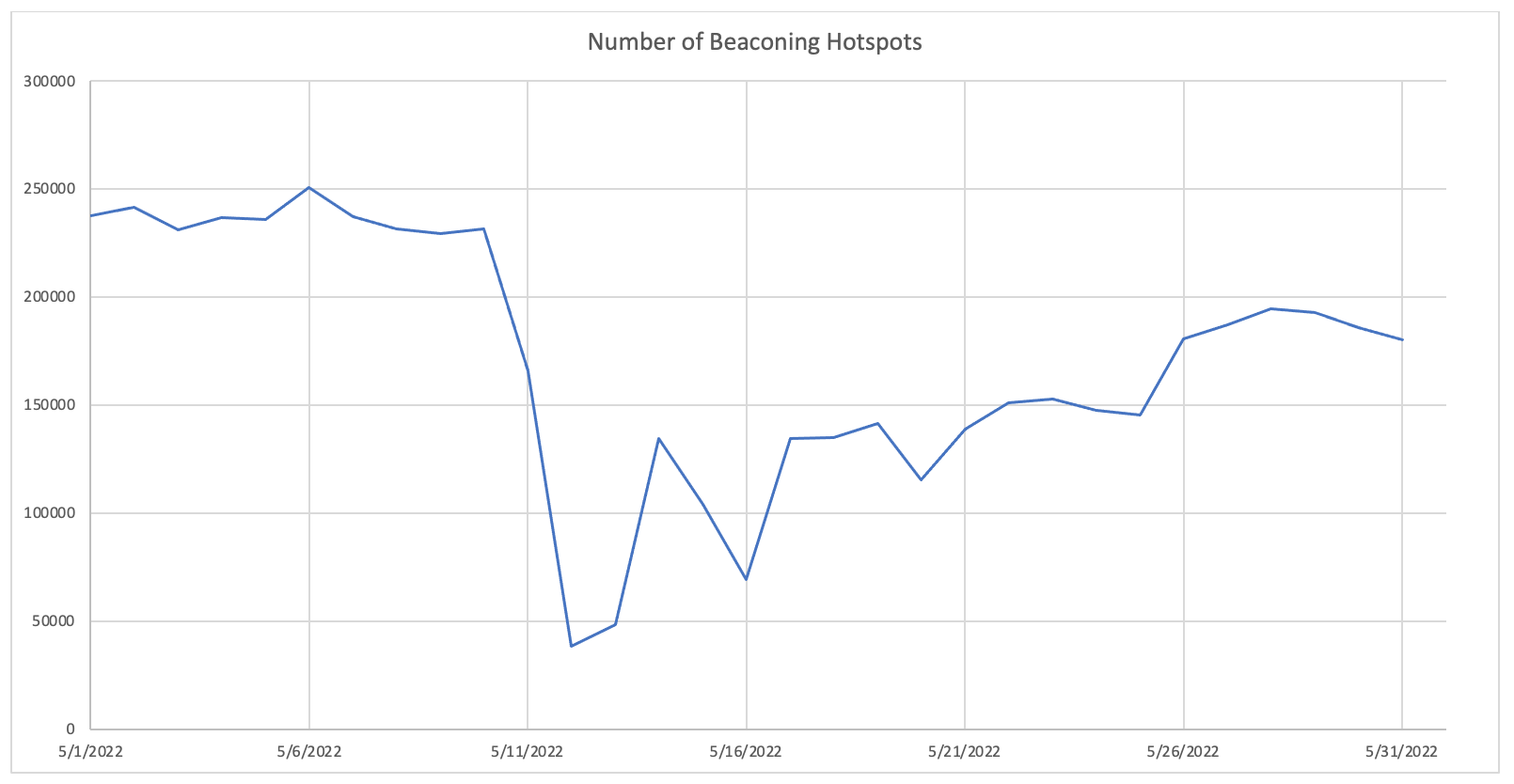
The number of Hotspots beaconing dropped sharply on May 11th and hasn't recovered fully yet.

The devs (that's the cool way of saying "Developers", we used to call them "Programmers" but apparently that is well out of vogue) tried to ramp up the PoC rate early on, but that didn't work. What it DID do was uncover some old bugs that had been undiscovered and were causing Hotspots in rural areas to earn less.

When the number of beacons dropped, it appeared to many owners that their Hotspots were dead. No beacons means no witnesses, so if no one in your area beaconed, there was...nothing to do. This nothingness triggered the Great Freak Out, and for a good 10+ days almost no one was happy. I was, but Mom says I'm special.

Ok, so what actually happened? We (and by we I mean the Nova & Helium Foundation team, I personally did nothing, see above) changed a Network from relying on 800k+ relatively weak (computer-weak) nodes to test each other ("construct Challenges") and shifted that burden over to 3k+ much stronger computers (the Validators).

In doing so, we lost about 5% of our earnings. You may see the 0.9% figure bandied about, and that is also correct in terms of the overall Network, but in terms of the portion that we Hotspot owners get (the PoC, or Proof of Coverage earnings), we lost 5%.

How much HNT is 5%? About 800 a day. So, instead of that 800 HNT being split between 800k+ Hotspots, it now gets split between 3k+ Validators.

What did we get in exchange for giving up 5%? Well, we don't quite have it yet, but we're going to get a much more stable Network.

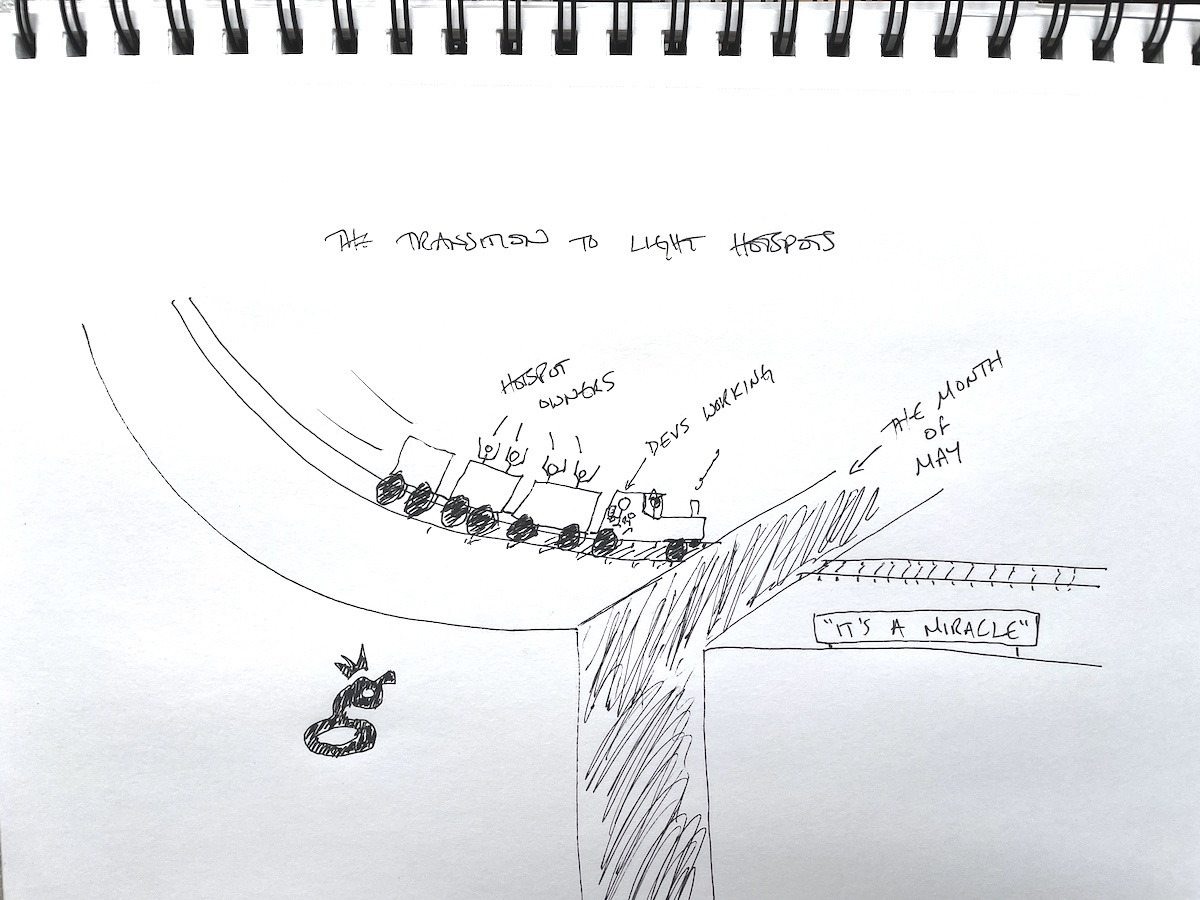
Think of it this way: Helium relying on all the Hotspots to construct Challenges was kind of like a train hurtling toward a cliff where the tracks ended. Sure, it was working, but we were about to go off said cliff.

Switching the responsibility to construct Challenges was like having that train fly off one side of the cliff, go totally off the rails and be uncomfortably airborne, then land perfectly on the other side, where the rails continue into Validator-land. It was never going to happen smoothly, but we're still on the rails and the wobbling will soon subside.

One truly amazing thing is that during the whole transition time, the Network has almost continuously kept up with passing the data from sensors on to integrations. That is analogous to the waiters on the train in the image above constantly pouring tea into cups and not spilling a drop.

That is a major win, though for most of you with more Hotspots than sensors you probably (to be completely honest) don't give a rat's ass about sensors.

You want your HNT. I get it. Let me give you the hard truth about HNT: The "good old days" of 1 or 10 or 100 HNT a day per miner are gone. They will never come back. Those aren't my rules, those are solely a function of more and more miners splitting the same size pie.

If you want to know what to expect, I would *predict* (NOT FINANCIAL ADVICE!) that an average Hotspot will earn 1 or less HNT/month.

So, where does that leave you? Ya got three options, it's up to you to decide:

  1. You can unplug. That is the "cut off your nose to spite your face" option. Maybe you can "sew your nose back on" by selling the miner?
  2. You can keep mining and hope I'm wrong and that your earnings will go back up. I think that's stupid, but I've been wrong before.
  3. You can learn to use the Network we've built. This is the path I'm taking.

I can't help you with options 1 or 2. I can definitely help you with option 3. It's the most difficult and potentially most profitable path for the long term.

For those of you willing to take that path, you can follow along for free on this blog and my Discord server or YouTube channel, or you can sign up for the Gristle Crüe and for $49/month join a group of enthusiastic and competent people who are willing to work and learn and help each other take advantage of all the opportunities and options coming down the pipe.

Whatever you do, I hope it works out well for ya. I'll be here kicking ass and taking names, learning and sharing in the pursuit of excellence.

The transitions to Light Hotspots isn't complete, and I wouldn't be caught dead saying "It's in the can" (sorry Joey, couldn't resist), but we're close, and much of the worst is behind us. Onward!

Rock 'n roll.