Building An Atmospheric Test Lab
The third time I heard about pico balloons I was fascinated with them. It was Dr. Matthew Patrick who hooked me, describing a world filled with science and nerds and launching things into the upper reaches of the atmosphere.
I began to insert myself into the system, reading the many posts about how various pico-balloonists were experimenting with payloads, balloons, gas volumes, pressure readings, and more.
I joined the Pico Balloon Group and began reading about how this activity was being conducted. One thing that stood out was that A) pico balloons are mostly a ham radio pursuit, B) ham radio operators are VERY technical, and C) no one was going out to the edge of batshit crazy when it came to testing what worked.
Each balloonist had their own way of doing things, whether it was sealing up the neck of the balloon, the pressure at which they pre-stretched, how they arranged the solar panels on their payload, whether or not they were using WSPR or APRS or something else to transmit; it was a long list.
I had (and still have) a bunch of questions, so I thought I could contribute to the space by developing a lab to test what works and what doesn't up in the 35,000 to 60,0000' altitude range.
My hypothesis is that while equipment has changed and improved quite a bit over the last 20 years, physics hasn't. 50 Torr (a unit of vacuum pressure) in 1998 is no different than 50 Torr today. With that in mind, I set out to build a lab that would have been cutting edge in the early 2000s and would also be cheap enough for a wildly ambitious dude to push out a little corner of science in his garage.
I ordered a thermal vacuum chamber custom built for IBM's ARC (Almaden Research Center), an Edwards RV3 dual vane rotary vacuum pump, a Cryofab nitrogen dewar to I can get temps down in the -70F range, a larger clear vacuum chamber for non-cold-temp work down to 1 Torr, and a variety of gauges, controllers, and data readers to suppor this atmospheric science quest.
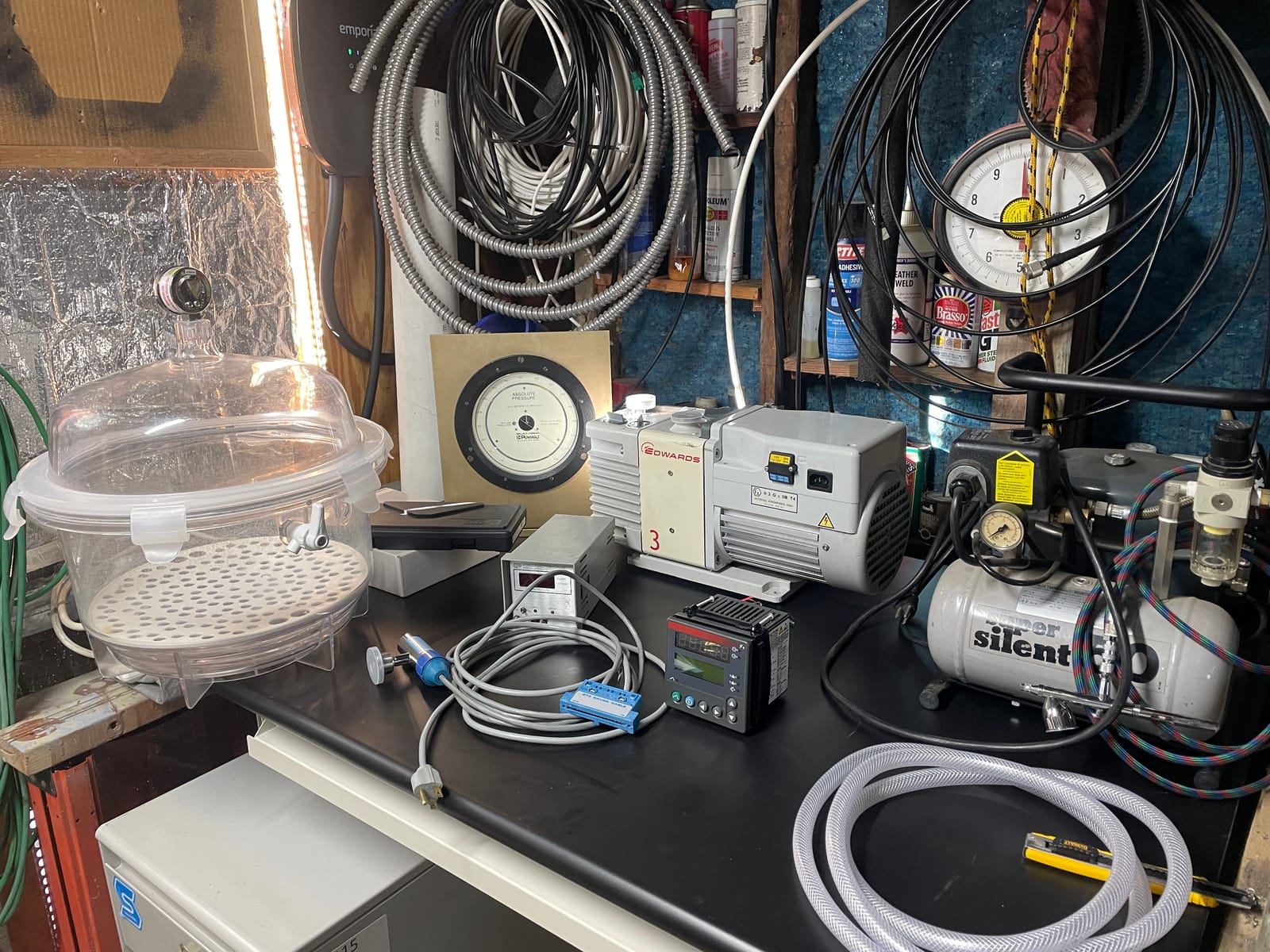
None of them are cutting edge as of 2026, but all of them should be far more than adequate for the work I plan on doing.
My first experiments will be with sealing methods; what works, what doesn't, what matters, and how can a seal that will reliably hold up to 50,000' or so be repeatedly achieved.
In support of that, I've bought a couple of sealers to complement what I already had around the house, which was a cheap FS-100, and will be testing each of them. My working hypothesis is that an excellent seal can be achieved with equipment costing less than $75 delivered as long as a specific method is followed. Still, that's only a hypothesis, and there's only one way to find out!
I've got a bunch of other ideas and experiments, from a custom LoRa board to testing different materials to making custom balloons. If you'd like to suggest any ideas or experiments, feel free to reach out via the Contact page.